5+ The graph below gives information about the percentage of the population in four Asian countries living in cities
The graph below gives information about the percentage of the population in four Asian countries living in cities from 1970 to 2020, with predictions for 2030 and 2040. Summarize the information by selecting and reporting the main features and making comparisons where relevant hay nhất giúp bạn có thêm tài liệu tham khảo để viết bài luận bằng Tiếng Anh hay hơn.
5+ The graph below gives information about the percentage of the population in four Asian countries living in cities
Đề bài: The graph below gives information about the percentage of the population in four Asian countries living in cities from 1970 to 2020, with predictions for 2030 and 2040. Summarize the information by selecting and reporting the main features and making comparisons where relevant
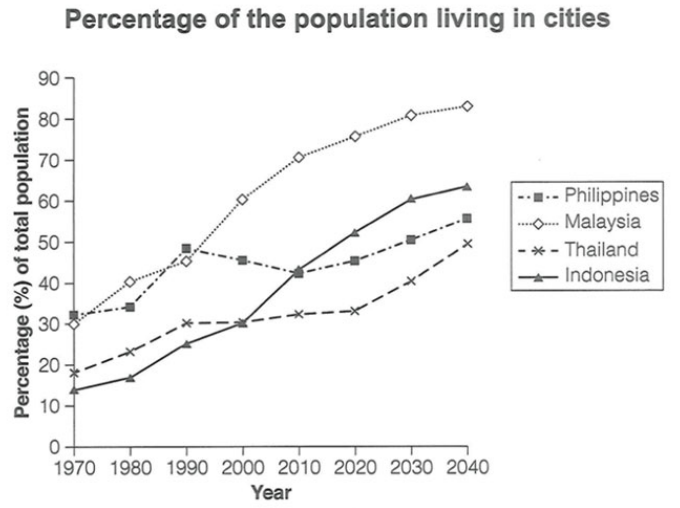
The graph below gives information about the percentage of the population in four Asian countries living in cities - mẫu 1
The line graph illustrates the proportion of people living in urban areas in four Asian countries—Philippines, Malaysia, Thailand, and Indonesia—from 1970 to 2020, with projections up to 2040. Overall, the percentage of urban populations increased in all countries, and this upward trend is expected to continue in the future.
In 1970, Malaysia had the highest urban population at around 35%, while Indonesia had the lowest at about 10%. Over the following decades, Malaysia experienced a steady rise, reaching roughly 70% in 2020 and is predicted to exceed 80% by 2040. The Philippines also saw growth, rising from 30% in 1970 to around 50% in 1990, followed by slight fluctuations before reaching nearly 60% in 2040.
Thailand and Indonesia started with much lower figures but showed consistent increases. Thailand’s urban population grew from 15% in 1970 to about 40% in 2020 and is forecast to reach 50% by 2040. Indonesia’s growth was more dramatic, climbing from 10% to 60% over the same period and projected to reach 65% by 2040.
In summary, urbanization has accelerated across all four countries, with Malaysia remaining the most urbanized and Indonesia showing the fastest growth.
Hướng dẫn dịch:
Biểu đồ đường minh họa tỷ lệ dân số sống ở khu vực thành thị tại bốn quốc gia châu Á — Philippines, Malaysia, Thái Lan và Indonesia — từ năm 1970 đến năm 2020, cùng dự đoán đến năm 2040. Nhìn chung, tỷ lệ dân số thành thị tăng ở tất cả các quốc gia và xu hướng này dự kiến sẽ tiếp tục trong tương lai.
Năm 1970, Malaysia có tỷ lệ dân số thành thị cao nhất, khoảng 35%, trong khi Indonesia thấp nhất, chỉ khoảng 10%. Trong những thập kỷ tiếp theo, Malaysia tăng đều, đạt khoảng 70% vào năm 2020 và dự kiến vượt 80% vào năm 2040. Philippines cũng tăng từ 30% năm 1970 lên khoảng 50% năm 1990, sau đó dao động nhẹ trước khi đạt gần 60% vào năm 2040.
Thái Lan và Indonesia bắt đầu với tỷ lệ thấp hơn nhưng đều tăng ổn định. Dân số thành thị của Thái Lan tăng từ 15% năm 1970 lên khoảng 40% năm 2020 và dự đoán đạt 50% vào năm 2040. Indonesia tăng mạnh hơn, từ 10% lên 60% trong cùng giai đoạn và dự kiến đạt 65% vào năm 2040.
Tóm lại, quá trình đô thị hóa diễn ra mạnh mẽ ở cả bốn quốc gia, trong đó Malaysia vẫn là nước đô thị hóa cao nhất, còn Indonesia có tốc độ tăng nhanh nhất.
The graph below gives information about the percentage of the population in four Asian countries living in cities - mẫu 2
The graph compares the percentage of people living in cities in four Asian countries—Malaysia, the Philippines, Thailand, and Indonesia—between 1970 and 2020, with estimates for 2030 and 2040. It is clear that urbanization has increased significantly in all countries and is expected to continue rising.
Malaysia consistently had the highest proportion of city dwellers, starting at around 35% in 1970 and climbing steadily to over 70% by 2020. This figure is projected to reach about 80% by 2040. The Philippines followed a similar upward trend, though at a slower pace, rising from 30% to around 50% in 2020 and expected to reach 60% by 2040.
Thailand and Indonesia began with smaller urban populations but experienced strong growth. Thailand’s figure rose from 15% in 1970 to 40% in 2020, while Indonesia’s increased sharply from 10% to 60% during the same period. By 2040, both are predicted to reach around 50% and 65% respectively.
Overall, all four countries have become more urbanized over time, with Malaysia leading throughout and Indonesia showing the most rapid expansion.
Hướng dẫn dịch:
Biểu đồ so sánh tỷ lệ dân số sống ở thành phố tại bốn quốc gia châu Á — Malaysia, Philippines, Thái Lan và Indonesia — trong giai đoạn từ 1970 đến 2020, cùng dự đoán cho năm 2030 và 2040. Rõ ràng rằng quá trình đô thị hóa đã tăng mạnh ở tất cả các quốc gia và sẽ tiếp tục trong tương lai.
Malaysia luôn có tỷ lệ dân số thành thị cao nhất, bắt đầu khoảng 35% năm 1970 và tăng đều lên hơn 70% vào năm 2020. Con số này dự kiến đạt khoảng 80% vào năm 2040. Philippines cũng có xu hướng tăng tương tự nhưng chậm hơn, từ 30% lên khoảng 50% năm 2020 và dự đoán đạt 60% vào năm 2040.
Thái Lan và Indonesia bắt đầu với tỷ lệ thấp hơn nhưng tăng mạnh. Tỷ lệ của Thái Lan tăng từ 15% năm 1970 lên 40% năm 2020, trong khi Indonesia tăng nhanh từ 10% lên 60% trong cùng giai đoạn. Đến năm 2040, cả hai dự kiến đạt lần lượt khoảng 50% và 65%.
Nhìn chung, cả bốn quốc gia đều ngày càng đô thị hóa, với Malaysia dẫn đầu và Indonesia có tốc độ phát triển nhanh nhất.
Xem thêm các bài luận Tiếng Anh hay khác:

TÀI LIỆU CLC DÀNH CHO GIÁO VIÊN VÀ PHỤ HUYNH LỚP 9
Bộ giáo án, bài giảng powerpoint, đề thi file word có đáp án 2026 tại https://tailieugiaovien.com.vn/
Hỗ trợ zalo: VietJack Official
Tổng đài hỗ trợ đăng ký: 084 283 45 85
 Đề thi vào 10 các sở Hà Nội, Tp. Hồ Chí Minh...
41 tài liệu
Đề thi vào 10 các sở Hà Nội, Tp. Hồ Chí Minh...
41 tài liệu
 Giáo án Word 9
95 tài liệu
Giáo án Word 9
95 tài liệu
 Đề thi giữa kì, cuối kì 9
254 tài liệu
Đề thi giữa kì, cuối kì 9
254 tài liệu
 Chuyên đề dạy thêm Toán, Lí, Hóa... 9
71 tài liệu
Chuyên đề dạy thêm Toán, Lí, Hóa... 9
71 tài liệu
 Đề thi HSG 9
8 tài liệu
Đề thi HSG 9
8 tài liệu
 Bài giảng Powerpoint 9
42 tài liệu
Bài giảng Powerpoint 9
42 tài liệu
Công cụ giáo viên (2048.VN)
Tạo- trộn đề thi miễn phí từ file PDF, Word, Giao bài nhanh chóng, Hoàn toàn Free
- Đề thi lớp 1 (các môn học)
- Đề thi lớp 2 (các môn học)
- Đề thi lớp 3 (các môn học)
- Đề thi lớp 4 (các môn học)
- Đề thi lớp 5 (các môn học)
- Đề thi lớp 6 (các môn học)
- Đề thi lớp 7 (các môn học)
- Đề thi lớp 8 (các môn học)
- Đề thi lớp 9 (các môn học)
- Đề thi lớp 10 (các môn học)
- Đề thi lớp 11 (các môn học)
- Đề thi lớp 12 (các môn học)
- Giáo án lớp 1 (các môn học)
- Giáo án lớp 2 (các môn học)
- Giáo án lớp 3 (các môn học)
- Giáo án lớp 4 (các môn học)
- Giáo án lớp 5 (các môn học)
- Giáo án lớp 6 (các môn học)
- Giáo án lớp 7 (các môn học)
- Giáo án lớp 8 (các môn học)
- Giáo án lớp 9 (các môn học)
- Giáo án lớp 10 (các môn học)
- Giáo án lớp 11 (các môn học)
- Giáo án lớp 12 (các môn học)