Với 60 câu hỏi trắc nghiệm Tiếng Anh 9 Unit 6: The self sách Friends plus 9 gồm đầy đủ các kĩ năng:
Phonetics, Vocabulary and Grammar, Reading and Writing có đáp án và giải thích chi tiết giúp học sinh ôn luyện trắc nghiệm Tiếng Anh 9 Unit 6.
Mark: She is a _______ who always follows the school rules.
A. realist
B. conformist
C. optimist
D. extrovert
Đáp án đúng: B
A. realist (n): người sống thực tế
B. conformist (n): người luôn tuân theo quy tắc
C. optimist (n): người lạc quan
D. extrovert (n): người hướng ngoại
Dựa vào “always follows the school rules”
→ Chọn B. conformist: người luôn tuân theo quy tắc
Dịch nghĩa:
Linda: Susan đúng là một học sinh giỏi.
Mark: Cô ấy là người luôn tuân theo các quy tắc của trường.
Question 2. Choose the correct answer.
Jenny: Why are your brother and you always arguing?
Tom: We are _______. Our personalities are very different from each other.
A. fish and chips
B. peas and beans
C. chalk and cheese
D. bacon and butter
Đáp án đúng: C
A. fish and chips: cá và khoai tây chiên (món ăn)
B. peas and beans: đậu Hà Lan và đậu
C. chalk and cheese (idiom): khác nhau hoàn toàn
D. bacon and butter: thịt xông khói và bơ
Dựa vào “Our personalities are very different from each other” → chọn C.
Dịch nghĩa:
Jenny: Sao em trai và cậu lúc nào cũng cãi nhau thế?
Tom: Chúng tôi khác nhau hoàn toàn. Tính cách hai đứa rất khác nhau.
Question 3. Choose the correct answer.
Hoa: Hours after Japan’s surrender in World War II, Vietnam declared _______ from France.
Nam: Millions of people had sacrificed themselves for these historic moments.
A. dependent
B. dependence
C. independent
D. independence
Đáp án đúng: D
A. dependent (adj): phụ thuộc
B. dependence (n): sự phụ thuộc
C. independent (adj): độc lập
D. independence (n): sự độc lập
declare independence from…: tuyên bố độc lập khỏi…
Dịch nghĩa:
Hoa: Vài giờ sau khi Nhật đầu hàng trong Thế chiến II, Việt Nam tuyên bố độc lập khỏi Pháp.
Nam: Hàng triệu người đã hi sinh cho khoảnh khắc lịch sử này.
Question 4. Choose the correct answer.
Alice: What is the difference between this course and the previous course?
David: On this course there is an emphasis on _______ experience and practical work.
A. hands-on
B. hands-off
C. hands-up
D. hands-down
Đáp án đúng: A
A. hands-on (adj): thực hành, thực tế
B. hands-off (adj): không dính líu
C. hands-up (n): giơ tay
D. hands-down (adv): chắc chắn, dễ dàng
Ta cần tính từ bổ nghĩa cho danh từ “experience”
Ta có: hands-on experience: kinh nghiệm thực tế
Dịch nghĩa:
Alice: Khóa học này khác khóa trước thế nào?
David: Khóa này chú trọng vào kinh nghiệm thực hành và công việc thực tế.
Question 5. Choose the correct answer.
Sam: Why did you change your mind to choose that restaurant?
Olivia: At first, we did not want to go into the restaurant as it looked small, but the food was delicious. We then realized that we can’t _______.
A. judge a book by its cover
B. sleep like a baby
C. sing a different tune
D. see eye to eye
Đáp án đúng: A
A. judge a book by its cover: đánh giá qua vẻ ngoài
B. sleep like a baby: ngủ say
C. sing a different tune: thay đổi thái độ
D. see eye to eye: đồng quan điểm
Nhà hàng nhìn nhỏ nhưng đồ ăn ngon → không nên đánh giá qua vẻ ngoài. Chọn A.
Dịch nghĩa:
Sam: Sao bạn đổi ý chọn nhà hàng đó vậy?
Olivia: Lúc đầu không muốn vào vì nó trông nhỏ, nhưng đồ ăn rất ngon. Lúc đó chúng tôi nhận ra rằng không thể đánh giá qua bề ngoài.
Question 6. Choose the correct answer.
Hannah: A lot of kids today are overweight _______ potatoes.
Leo: We need to encourage their parents to change their habits and lifestyles.
A. stool
B. couch
C. desk
D. lamp
Đáp án đúng: B
A. stool (n): ghế đẩu
B. couch (n): ghế dài/ghế sô pha
C. desk (n): bàn học, bàn làm việc
D. lamp (n): đèn
Ta có thành ngữ: couch potato: người lười vận động, chỉ ngồi xem TV
Dịch nghĩa:
Hannah: Nhiều trẻ em ngày nay bị thừa cân vì chỉ ngồi ì một chỗ xem TV.
Leo: Chúng ta cần khuyến khích bố mẹ các em thay đổi thói quen sống.
Question 7. Choose the correct answer.
Mia: What is the benefit of the new program?
Lucas: The program enables students to _______ some experiences of the world of work.
A. make
B. gain
C. express
D. take
Đáp án đúng: B
A. make (v): làm, tạo ra
B. gain (v): thu được, đạt được
C. express (v): bày tỏ, thể hiện
D. take (v): lấy, mang
Ta có: gain experience: có được kinh nghiệm.
Dịch nghĩa:
Mia: Lợi ích của chương trình mới là gì?
Lucas: Chương trình giúp học sinh có được một số kinh nghiệm về môi trường làm việc.
Question 8. Choose the correct answer.
Emma: How do employees behave in a professional environment?
Jack: Most employees try to ________ to company policies to maintain a good reputation.
A. reward
B. rebel
C. assist
D. conform
Đáp án đúng: D
A. reward (v): thưởng
B. rebel (v): nổi loạn, chống đối
C. assist (v): hỗ trợ
D. conform (v): tuân thủ, tuân theo
Ta có: conform to/with something: tuân thủ cái gì đó
Dịch nghĩa:
Emma: Nhân viên cư xử thế nào trong môi trường chuyên nghiệp?
Jack: Hầu hết cố gắng tuân theo chính sách công ty để giữ uy tín tốt.
Question 9. Choose the correct answer.
Mrs. Lee: Mr. Chan is away, so who will conduct today’s meeting?
Mr. Brown: On behalf of the CEO, Andrew and _______ will conduct today’s meeting.
A. I
B. me
C. myself
D. by myself
Đáp án đúng: A
A. I (chủ ngữ)
B. me (tân ngữ)
C. myself (đại từ phản thân/nhấn mạnh)
D. by myself (một mình)
Cần một đại từ nhân xưng đóng vai trò là chủ ngữ trong câu
→ Andrew and I (chủ ngữ).
Dịch nghĩa:
Bà Lee: Ông Chan đi vắng, vậy ai sẽ chủ trì cuộc họp?
Ông Brown: Thay mặt CEO, Andrew và tôi sẽ chủ trì cuộc họp hôm nay.
Question 10. Choose the correct answer.
Kate: Peter is working hard on the driving test.
Daniel: He wants to pass his driving test so that he can drive _______ to work.
A. his own
B. him
C. himself
D. by himself
Đáp án đúng: C
A. his own: của riêng anh ấy, thường phải đi với một danh từ phía sau
B. him (tân ngữ): anh ấy
C. himself (đại từ phản thân): tự mình / chính mình
D. by himself: một mình, tự làm mà không cần giúp đỡ
- drive himself to work: tự lái xe đưa chính mình đi làm, đúng ý khi anh ấy thi bằng lái để tự chủ.
- drive by himself to work: lái xe một mình đến chỗ làm (nhấn mạnh không có ai đi cùng).
Trong câu này, cụm từ “drive himself” (tự lái xe/lái xe cho chính mình) là cách diễn đạt tự nhiên và chính xác hơn về mặt ngữ pháp để chỉ hành động tự điều khiển phương tiện.
Dịch nghĩa:
Kate: Peter đang ôn thi lái xe rất chăm.
Daniel: Cậu ấy muốn đậu để có thể tự lái xe đi làm.
Question 11. Choose the correct answer.
Sarah: Where is Kendal?
Chris: Kendal _______ is quite a small town in England.
A. it
B. itself
C. by itself
D. its
Đáp án đúng: B
A. it (đại từ nhân xưng)
B. itself (đại từ phản thân/nhấn mạnh của it)
C. by itself: một mình, tự làm/tự vận hành
D. its (tính từ sở hữu)
Cần một đại từ phản thân được đặt ngay sau danh từ để nhấn mạnh chính danh từ đó.
Chọn B. itself
Dịch nghĩa:
Sarah: Kendal ở đâu vậy?
Chris: Bản thân Kendal là một thị trấn nhỏ ở Anh.
Question 12. Choose the correct answer.
Lily: What do your close friend and you occasionally do at weekends?
Ben: We occasionally meet up to chill _______ and watch a movie at weekends.
A. up
B. off
C. out
D. down
Đáp án đúng: C
Ta có: chill out: thư giãn.
Dịch nghĩa:
Lily: Cuối tuần bạn và bạn thân thường làm gì?
Ben: Chúng tôi thỉnh thoảng gặp nhau để thư giãn và xem phim.
Question 13. Choose the correct answer.
Ava: What is the theory about?
Ethan: The theory of universal grammar believes that we’re all born _______ an innate understanding of the way language works.
A. with
B. for
C. to
D. from
Đáp án đúng: A
be born with something: sinh ra đã có.
Dịch nghĩa:
Ava: Học thuyết nói về điều gì?
Ethan: Học thuyết ngữ pháp phổ quát cho rằng chúng ta sinh ra đã có sự hiểu biết sẵn có về cách ngôn ngữ hoạt động.
Question 14. Choose the correct answer.
Daisy: What does David do for a living?
Paul: _______ his earnings as a football coach, he also owns and runs a chain of sports shops.
A. Instead of
B. Prior to
C. In that
D. Apart from
Đáp án đúng: D
A. Instead of: thay vì
B. Prior to: trước khi
C. In that: bởi vì
D. Apart from: ngoài... ra
Ta cần một cụm từ nối để thêm thông tin về công việc, chỉ ra rằng David làm cả hai việc.
Chọn D. Apart from
Dịch nghĩa:
Daisy: David làm nghề gì?
Paul: Ngoài thu nhập từ việc làm huấn luyện viên bóng đá, anh ấy còn sở hữu và điều hành một chuỗi cửa hàng thể thao.
Question 15. Choose the correct answer.
Professor Lee: This is the new research proposal.
Dr. Harris: Yes, it outlines several solutions, some of _______ require further approval from the ethics committee.
A. where
B. which
C. whom
D. that
Đáp án đúng: B
Cấu trúc: [cụm từ định lượng] + of + which (áp dụng cho vật).
→ some of which
Dịch nghĩa:
Giáo sư Lee: Đây là bản đề xuất nghiên cứu mới.
Tiến sĩ Harris: Vâng, nó trình bày vài giải pháp, một số trong đó cần được ủy ban đạo đức phê duyệt thêm.
Question 16. Choose the correct answer.
Olga: Can you describe the university you went to?
Jacob: The university _______ I studied for four years is known for its excellent engineering programs.
A. where
B. which
C. whom
D. when
Đáp án đúng: A
A. where (thay thế cho nơi chốn, đóng vai trò trạng ngữ).
B. which (thay thế cho vật, đóng vai trò chủ ngữ/tân ngữ).
C. whom (thay thế cho người, đóng vai trò tân ngữ).
D. when (thay thế cho thời gian).
Ta cần một đại từ quan hệ thay thế cho danh từ chỉ địa điểm (university) và đóng vai trò là trạng ngữ chỉ nơi chốn trong mệnh đề quan hệ.
Dịch nghĩa:
Olga: Bạn có thể mô tả trường đại học bạn học không?
Jacob: Trường đại học nơi tôi học 4 năm nổi tiếng với các chương trình kỹ thuật xuất sắc.
Question 17. Choose the correct answer.
Alex: Why don’t you come over to play a new video game with me?
Brian: _______
A. Great. I’d love to.
B. I’m afraid so.
C. You’re welcome.
D. I didn’t know that.
Đáp án đúng: A
Alex: Why don’t you come over to play a new video game with me?
(Sao bạn không qua đây chơi game mới với mình?)
A. Great. I’d love to. (Tuyệt vời. Mình rất thích.)
B. I’m afraid so. (Mình e là vậy)
C. You’re welcome. (Không có gì/Chào đón bạn)
D. I didn’t know that. (Mình không biết điều đó)
Dịch nghĩa:
Alex: Sao bạn không qua đây chơi game mới với mình?
Brian: Tuyệt! Mình thích chứ.
Question 18. Choose the correct answer.
Tina: What type of person are you?
George: _______
A. Tell me about yourself.
B. That would be great.
C. It all sounds positive.
D. I suppose I’m an optimist.
Đáp án đúng: D
What type of person are you? (Bạn là kiểu người như thế nào?)
A. Tell me about yourself. (Hãy kể cho tôi nghe về bạn)
B. That would be great. (Điều đó sẽ tuyệt vời)
C. It all sounds positive. (Nghe có vẻ tích cực)
D. I suppose I’m an optimist. (Tôi nghĩ tôi là một người lạc quan.)
Dịch nghĩa:
Tina: Bạn là kiểu người như thế nào?
George: Tôi nghĩ tôi là người lạc quan.
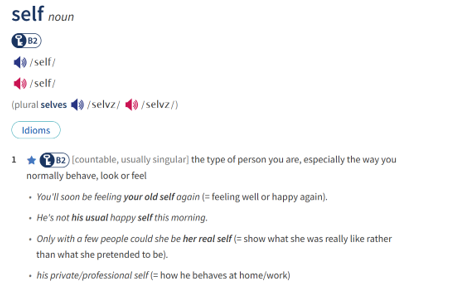
Questions 19-20. Look at the entry of the word “self” in a dictionary. Use what you can get from the entry to complete the sentences with TWO or THREE words.
Question 19. After spending a week in the hospital, you will feel like ________ again.
A. your old self
B. your usual self
C. real self
D. private self
Đáp án đúng: A
A. your old self: Bản thân cũ của bạn (ám chỉ trạng thái khỏe mạnh, quen thuộc trước đó).
B. usual self: Bản thân thường ngày
C. real self: Bản thân thật sự (ám chỉ tính cách chân thật, đối lập với vẻ ngoài/vai trò xã hội).
D. private self: Bản thân riêng tư (ám chỉ khía cạnh cá nhân, không công khai).
Trong ngữ cảnh sau khi nằm viện, ý nghĩa là “bạn sẽ cảm thấy tốt như trước đây”.
→ Chọn A. your old self.
→ After spending a week in the hospital, you will feel like your old self again.
Dịch nghĩa: Sau khi ở bệnh viện một tuần, bạn sẽ cảm thấy như chính bạn trước đây.
Question 20. Unlike his ________, he was a bit moody this morning.
A. old self
B. usual self
C. real self
D. professional self
Đáp án đúng: B
A. old self: Bản thân cũ (thường dùng để so sánh với trạng thái hiện tại đã thay đổi hẳn).
B. usual self: Bản thân thường ngày (chỉ trạng thái, tính cách điển hình, quen thuộc).
C. real self: Bản thân thật sự (không phù hợp để đối lập với một trạng thái cảm xúc nhất thời).
D. professional self: Bản thân chuyên nghiệp (chỉ vai trò công việc).
→ Unlike his usual self, he was a bit moody this morning.
Dịch nghĩa: Không giống như con người thường ngày của mình, sáng nay anh ấy hơi cáu kỉnh.
Questions 1-6. Choose the word (A, B, C or D) that best fits each space in the following passage.
Character building (1) _______ to the process of developing and strengthening personal qualities that are valued and contribute to a person’s (2) _______ of identity and purpose.
These qualities may include honesty, integrity, responsibility, empathy, kindness, respect, self-control, resilience, and perseverance among (3) _______. Character building can take place through a variety of experiences and activities, including education, personal relationships, and participation in community service or other volunteer work. It may involve (4) _______ and working towards personal goals, reflecting on one’s values and beliefs, and making choices that align (5) _______ those values.
Building (6) _______ character can be an ongoing process throughout a person’s life and can help them become a better person and make positive contributions to their community and the world.
Question 1. Character building (1) _______ to the process of developing and strengthening personal qualities...
A. links
B. hopes
C. manages
D. refers
Đáp án đúng: D
A. links (v): liên kết
B. hopes (v): hy vọng
C. manages (v): quản lý
D. refers (v): ám chỉ, đề cập đến
Cụm từ cố định: refer to: ám chỉ/đề cập đến/là
→ Character building refers to the process of developing and strengthening personal qualities...
Dịch nghĩa: Xây dựng nhân cách được hiểu là quá trình phát triển và củng cố các phẩm chất cá nhân...
Question 2. ... that are valued and contribute to a person’s (2) _______ of identity and purpose.
A. scene
B. scent
C. sense
D. scenario
Đáp án đúng: C
A. scene (n): cảnh, khung cảnh
B. scent (n): mùi hương
C. sense (n): cảm giác, ý thức
D. scenario (n): kịch bản, viễn cảnh
Cụm từ cố định: a sense of identity and purpose: cảm giác/ý thức về bản sắc và mục đích (sống).
→ ... contribute to a person’s sense of identity and purpose.
Dịch nghĩa: ... được trân trọng và góp phần vào ý thức/bản ngã và mục đích sống của một người.
Question 3. These qualities may include honesty, integrity, responsibility, empathy, kindness, respect, self-control, resilience, and perseverance among (3) _______.
A. others
B. another
C. the other
D. the another
Đáp án đúng: A
A. others (pron): những người/những cái khác
B. another (pron): một người/cái khác (số ít)
C. the other (pron): người/cái còn lại (trong hai)
D. the another: sai cấu trúc
Cụm từ cố định: among others: trong số những cái/những người khác nữa.
→ These qualities may include honesty, integrity, responsibility, empathy, kindness, respect, self-control, resilience, and perseverance among others.
Dịch nghĩa: Những phẩm chất này có thể bao gồm sự trung thực, chính trực, trách nhiệm, đồng cảm, tốt bụng, tôn trọng, tự chủ, kiên cường và kiên trì cùng với nhiều phẩm chất khác nữa.
Question 4. It may involve (4) _______ and working towards personal goals, reflecting on one’s values and beliefs, ...
A. setting
B. to set
C. to setting
D. set
Đáp án đúng: A
Cấu trúc: involve + V-ing: bao gồm việc làm gì.
Ngoài ra ta cũng thấy “working” sau “and” nên cần V-ing để cấu trúc song song.
→ It may involve setting and working towards personal goals...
Dịch nghĩa: Nó có thể bao gồm việc đặt ra và phấn đấu hướng tới các mục tiêu cá nhân, suy ngẫm về các giá trị và niềm tin của bản thân...
Question 5. ... and making choices that align (5) _______ those values.
A. for
B. in
C. with
D. at
Đáp án đúng: C
Cụm từ cố định: align with something: phù hợp với, hòa hợp với cái gì.
→ ... making choices that align with those values.
Dịch nghĩa: ... và đưa ra những lựa chọn phù hợp với các giá trị đó.
Question 6. Building (6) _______ character can be an ongoing process throughout a person’s life and can help them become a better person and make positive contributions to their community and the world.
A. huge
B. strong
C. heavy
D. sharp
Đáp án đúng: B
A. huge (adj): to lớn, khổng lồ
B. strong (adj): mạnh mẽ, vững chắc
C. heavy (adj): nặng nề
D. sharp (adj): sắc bén
Cụm từ cố định: strong character: nhân cách mạnh mẽ, vững vàng.
→ Building strong character can be an ongoing process throughout a person’s life and can help them become a better person and make positive contributions to their community and the world.
Dịch nghĩa: Xây dựng tính cách mạnh mẽ có thể là một quá trình liên tục trong suốt cuộc đời của một người và có thể giúp họ trở thành người tốt hơn và đóng góp tích cực cho cộng đồng và thế giới.
Dịch bài đọc:
Xây dựng nhân cách được hiểu là quá trình phát triển và củng cố những phẩm chất cá nhân được trân trọng và góp phần vào ý thức về bản sắc và mục đích sống của một người.
Những phẩm chất này có thể bao gồm: sự trung thực, chính trực, tinh thần trách nhiệm, lòng đồng cảm, lòng tốt, sự tôn trọng, khả năng tự kiểm soát, sự kiên cường và kiên trì, cùng với nhiều phẩm chất khác nữa. Việc xây dựng nhân cách có thể diễn ra thông qua nhiều trải nghiệm và hoạt động khác nhau, bao gồm giáo dục, các mối quan hệ cá nhân, và việc tham gia vào các hoạt động phục vụ cộng đồng hoặc các công việc tình nguyện khác.
Nó có thể bao gồm việc đặt ra và phấn đấu hướng tới các mục tiêu cá nhân, suy ngẫm về các giá trị và niềm tin của bản thân, và đưa ra những lựa chọn phù hợp với những giá trị đó.
Việc xây dựng một nhân cách mạnh mẽ có thể là một quá trình kéo dài suốt cuộc đời của một con người và có thể giúp họ trở thành một người tốt hơn, cũng như tạo ra những đóng góp tích cực cho cộng đồng và thế giới.
Questions7-12. Read the following passage and choose the correct answer.
To truly protect sea turtles around the world, many different countries and cultures must cooperate and share responsibility. International laws and agreements, research, and the work of dedicated organizations and individuals each must play a part. Long-term protection of sea turtles also means developing solutions that reduce reliance on management methods requiring direct human involvement — such as moving nests or raising hatchlings in captivity. If sea turtles cannot survive and reproduce on their own, without help from humans, then they are doomed. Feeding and nesting grounds must be protected, and a public wildlife conservation ethic must be fostered that can withstand gaps in government regulations, pressure from private interests, and changes in the political climate.
Here are some immediate goals for protecting sea turtles:
1. Crack down on illegal international trade in sea turtles and their products.
2. Decrease the turtle deaths caused by commercial fishing.
3. Protect nesting beaches by establishing parks and refuges or through regulations combined with public education initiatives.
4. Eliminate disturbances at nesting beaches by decreasing artificial lighting, halting beach armoring, regulating beach nourishment and limiting the impacts of people on the beach.
5. Enforce national and international laws to minimize the dumping of pollutants and solid waste into the ocean and nearshore waters.
6. Continue research and monitoring activities.
7. Increase public awareness and community participation in sea turtle conservation through educational programs.
Question 7. The protection of sea turtles is not the responsibility of a country or a culture; it’s a shared one.
A. True
B. False
Đáp án đúng: A
The protection of sea turtles is not the responsibility of a country or a culture; it’s a shared one.
(Việc bảo vệ rùa biển không phải là trách nhiệm của một quốc gia hay một nền văn hóa; đó là trách nhiệm chung.)
Thông tin: To truly protect sea turtles around the world, many different countries and cultures must cooperate and share responsibility.
Dịch nghĩa: Để thực sự bảo vệ rùa biển trên toàn thế giới, nhiều quốc gia và nền văn hóa khác nhau phải hợp tác và chia sẻ trách nhiệm.
→ Đúng (True)
Question 8. In the long run, they will develop solutions to increasing sea turtles’ dependence on humans.
A. True
B. False
Đáp án đúng: B
In the long run, they will develop solutions to increasing sea turtles’ dependence on humans.
(Về lâu dài, họ sẽ phát triển các giải pháp làm tăng sự phụ thuộc của rùa biển vào con người.)
Thông tin:
Long-term protection of sea turtles also means developing solutions that reduce reliance on management methods requiring direct human involvement...
Dịch nghĩa:
Bảo vệ rùa biển lâu dài cũng có nghĩa là phát triển các giải pháp giảm sự phụ thuộc vào các biện pháp quản lý đòi hỏi sự tham gia trực tiếp của con người...
→ Mục tiêu dài hạn là giảm sự phụ thuộc của rùa biển vào con người, hoàn toàn trái ngược với nội dung câu hỏi.
→ Sai (False).
Question 9. Establishing parks is one way to protect nesting beaches.
A. True
B. False
Đáp án đúng: A
Establishing parks is one way to protect nesting beaches.
(Việc thành lập các công viên là một cách để bảo vệ bãi đẻ trứng.)
Thông tin:
Protect nesting beaches by establishing parks and refuges or through regulations combined with public education initiatives.
Dịch nghĩa:
Bảo vệ các bãi đẻ trứng bằng cách thành lập các công viên và khu bảo tồn, hoặc thông qua các quy định kết hợp với các sáng kiến giáo dục cộng đồng.
→ Đúng (True).
Question 10. Sea turtles can get rid of disturbances at nesting beaches by decreasing sun lighting.
A. True
B. False
Đáp án đúng: B
Sea turtles can get rid of disturbances at nesting beaches by decreasing sun lighting.
(Rùa biển có thể loại bỏ sự quấy nhiễu ở bãi đẻ bằng cách giảm ánh sáng mặt trời.)
Thông tin:
Eliminate disturbances at nesting beaches by decreasing artificial lighting, halting beach armoring, regulating beach nourishment and limiting the impacts of people on the beach.
Dịch nghĩa:
Loại bỏ các sự quấy nhiễu ở bãi đẻ bằng cách giảm ánh sáng nhân tạo, dừng việc gia cố bờ biển, điều chỉnh việc bồi đắp bãi biển và hạn chế tác động của con người trên bãi biển.
→ Bài nói giảm ánh sáng nhân tạo (artificial lighting), không phải ánh sáng mặt trời (sun lighting).
→ Sai (False).
Question 11. What can be served as the best title for the above passage?
A. Sea turtles’ reproduction
B. Sea turtles’ relationship with humans
C. Sea turtles’ conservancy
D. Sea turtles’ deaths
Đáp án đúng: C
What can be served as the best title for the above passage?
(Tiêu đề nào sau đây phù hợp nhất với đoạn văn trên?)
A. Sea turtles’ reproduction: sự sinh sản của rùa biển
B. Sea turtles’ relationship with humans: mối quan hệ giữa rùa biển và con người
C. Sea turtles’ conservancy: việc bảo tồn rùa biển
D. Sea turtles’ deaths: cái chết của rùa biển
Đoạn văn nói về:
- Bảo vệ rùa biển trên toàn thế giới
- Trách nhiệm chung của nhiều quốc gia và nền văn hóa
- Các mục tiêu, giải pháp cụ thể để bảo tồn rùa biển (bảo vệ bãi đẻ, giảm chết do đánh bắt, giảm ô nhiễm, tăng nhận thức cộng đồng, v.v.)
→ Nội dung chính tập trung vào bảo tồn / bảo vệ rùa biển, nên C là phù hợp nhất.
Question 12. Which one below is not the immediate goal for protecting sea turtles?
A. Decrease the turtles’ deaths
B. Protect nesting beaches
C. Prevent illegal international trade in sea turtles
D. Increase public awareness through entertaining programs.
Đáp án đúng: D
Which one below is not the immediate goal for protecting sea turtles?
(Mục tiêu nào dưới đây không phải là mục tiêu trước mắt để bảo vệ rùa biển?)
A. Decrease the turtles’ deaths (Giảm số lượng rùa biển chết)
B. Protect nesting beaches (Bảo vệ bãi biển làm tổ)
C. Prevent illegal international trade in sea turtles (Ngăn chặn nạn buôn bán trái phép rùa biển quốc tế)
D. Increase public awareness through entertaining programs. (Nâng cao nhận thức cộng đồng thông qua các chương trình giải trí.)
Thông tin:
1. Crack down on illegal international trade in sea turtles and their products. (C)
2. Decrease the turtle deaths caused by commercial fishing. (A)
3. Protect nesting beaches by establishing parks and refuges or through regulations combined with public education initiatives. (B)
Dịch nghĩa:
1. Ngăn chặn nạn buôn bán trái phép rùa biển và các sản phẩm của chúng trên phạm vi quốc tế.
2. Giảm số lượng rùa chết do đánh bắt thương mại.
3. Bảo vệ các bãi biển làm tổ bằng cách thành lập các công viên và khu bảo tồn hoặc thông qua các quy định kết hợp với các sáng kiến giáo dục cộng đồng.
→ D không đúng với nội dung bài, bài nói là educational programs, không phải “entertaining” (giải trí)
Question 13. Choose A, B, C or D that has the CLOSEST meaning to the given sentence in the question.
The village is located in a rainforest. It doesn’t have electricity.
A. The village which doesn’t have electricity is located in a rainforest.
B. The village where doesn’t have electricity is located in a rainforest.
C. The village whose electricity is not available locates in a rainforest.
D. The village that is located in a rainforest has no electric.
Đáp án đúng: A
“The village” là vật, được thay thế bởi “which/that” và đóng vai trò là chủ ngữ cho động từ “doesn't have electricity” (không có điện).
→ Chọn A. The village which doesn’t have electricity is located in a rainforest.
Dịch nghĩa: Ngôi làng không có điện nằm trong một khu rừng nhiệt đới.
Các đáp án sai:
B. “where” là trạng từ quan hệ chỉ nơi chốn, không thể làm chủ ngữ cho động từ.
C. “whose” là đại từ sở hữu (thay thế cho its electricity), cấu trúc này đúng. Tuy nhiên, động từ “locates” dùng sai, cần phải dùng dạng bị động
D. electric (adj): thuộc về điện → sai ngữ pháp, phải là electricity
Question 14. Choose A, B, C or D that has the CLOSEST meaning to the given sentence in the question.
I was born in Đà Lạt. It is a beautiful city with lots of flowers.
A. Đà Lạt, that I was born in, is a beautiful city with lots of flowers.
B. Đà Lạt, where I was born, is a beautiful city with lots of flowers.
C. Đà Lạt, which I was born, is a beautiful city with lots of flowers.
D. Đà Lạt, when I was born, is a beautiful city with lots of flowers.
Đáp án đúng: B
“Đà Lạt” là nơi chốn, trong câu “I was born in Đà Lạt” thì phần “in Đà Lạt” là trạng ngữ chỉ nơi chốn.
Khi thay bằng mệnh đề quan hệ không xác định (có dấu phẩy), dùng where = “in which”.
→ Chọn B. Đà Lạt, where I was born, is a beautiful city with lots of flowers.
Dịch nghĩa: Đà Lạt, nơi tôi sinh ra, là một thành phố đẹp với rất nhiều hoa.
Các đáp án sai:
A. “that” không dùng sau dấu phẩy trong mệnh đề quan hệ không xác định.
C. Thiếu “in”
D. “when” chỉ thời gian, không chỉ nơi chốn.
Question 15. Choose A, B, C or D that has the CLOSEST meaning to the given sentence in the question.
He did the homework by himself when there was no one else to help him.
A. He did the homework on his own when there was no one else to help him.
B. He did the homework of his own when there was no one else to help him.
C. He did the homework by his own when there was no one else to help him.
D. He did the homework with his own when there was no one else to help him.
Đáp án đúng: A
“by himself” = “on his own” (một mình/không nhờ ai).
→ Chọn A. He did the homework on his own when there was no one else to help him.
Dịch nghĩa: Anh ấy tự làm bài tập khi không có ai khác giúp.
Các phương án B, C, D đều sai cấu trúc giới từ đi kèm với “own”.
Question 16. Choose A, B, C or D that has the CLOSEST meaning to the given sentence in the question.
Would you like to take another drink?
A. Would you like to take yourself to another drink?
B. Would you like helping yourself to another drink?
C. Would you like to help yourself to another drink?
D. Would you like to serve to yourself another drink?
Đáp án đúng: C
Cấu trúc lịch sự mời: Would you like to help yourself to + food/drink? (= mời bạn dùng thêm…)
→ Chọn C. Would you like to help yourself to another drink?
Dịch nghĩa: Bạn có muốn dùng thêm một ly nữa không?
Các đáp án sai:
A. “take yourself to…” sai nghĩa và sai tự nhiên.
B. “would like + V-ing sai ngữ pháp.
D. “serve to” sai ngữ pháp
Question 17. Choose A, B, C or D that has the CLOSEST meaning to the given sentence in the question.
That painting is very expensive. It was sold for 3000 dollars.
A. That painting, which sold 3000 dollars, is very expensive.
B. That painting, which was sold for 3000 dollars, is very expensive.
C. That painting that sold for 3000 dollars, it is very expensive.
D. That painting which was selling for 3000 dollars is very expensive.
Đáp án đúng: B
“That painting” đã xác định, nên dùng dấu phẩy.
“It was sold for 3000 dollars” → mệnh đề quan hệ bị động: which was sold for 3000 dollars.
→ Chọn B. That painting, which was sold for 3000 dollars, is very expensive.
Dịch nghĩa: Bức tranh đó, cái đã được bán với giá 3000 đô, rất đắt.
Các đáp án sai:
A. Thiếu giới từ for: “sold for 3000 dollars”
C. Sai vì lặp chủ ngữ “That painting … it is …” (thừa “it”).
D. Sai thì/diễn đạt: “was selling”
Question 18. Choose A, B, C or D that has the CLOSEST meaning to the given sentence in the question.
The teacher is Ms. Julia. We studied with her last semester.
A. The teacher who we studied last semester is Ms. Julia.
B. The teacher whom we studied last semester is Ms. Julia.
C. The teacher with whom we studied last semester is Ms. Julia.
D. The teacher where we studied with last semester is Ms. Julia.
Đáp án đúng: C
Khi giới từ (with) được đưa lên trước đại từ quan hệ chỉ người, ta bắt buộc phải dùng whom, không dùng who hay that.
→ Chọn C. The teacher with whom we studied last semester is Ms. Julia.
Dịch nghĩa: Cô giáo mà chúng tôi học cùng học kỳ trước là cô Julia.
Các đáp án sai:
A. Thiếu giới từ with → “studied” cần “studied with”.
B. Thiếu giới từ with (đúng phải là “whom we studied with” hoặc “with whom we studied”).
D. “where” chỉ nơi chốn, không dùng cho người.
Question 19. Choose A, B, C or D that has the CLOSEST meaning to the given sentence in the question.
Going on holiday alone is what he usually does.
A. He usually goes on holiday on himself.
B. He usually goes on holiday by him.
C. He usually goes on holiday with himself.
D. He usually goes on holiday by himself.
Đáp án đúng: D
Ta có: alone = by himself (một mình).
→ Chọn D. He usually goes on holiday by himself.
Dịch nghĩa: Anh ấy thường đi nghỉ mát một mình.
Các đáp án còn lại sai cấu trúc.
Question 20. Choose A, B, C or D that has the CLOSEST meaning to the given sentence in the question.
Tom ordered five cups of coffee by himself.
A. Five cups of coffee were ordered by Tom.
B. Five cups of coffee were ordered by Tom himself.
C. Five cups of coffee were ordered for Tom himself.
D. Five cups of coffee were ordered by himself Tom.
Đáp án đúng: B
“by himself” (Tom tự làm, không nhờ ai) khi chuyển sang bị động có thể nhấn mạnh chủ thể bằng Tom himself (chính Tom).
Cấu trúc đúng: S + be + V3 + by + O + himself (himself đứng sau danh từ để nhấn mạnh).
→ Chọn B. Five cups of coffee were ordered by Tom himself.
Dịch nghĩa: Năm tách cà phê được chính Tom gọi (tự Tom gọi, không nhờ ai).
Các đáp án sai:
A. Mất nghĩa “by himself” (không còn thông tin “tự làm”).
C. “ordered for Tom himself” = đặt cho Tom → đổi nghĩa.

 Đề thi vào 10 các sở Hà Nội, Tp. Hồ Chí Minh...
41 tài liệu
Đề thi vào 10 các sở Hà Nội, Tp. Hồ Chí Minh...
41 tài liệu
 Giáo án Word 9
95 tài liệu
Giáo án Word 9
95 tài liệu
 Đề thi giữa kì, cuối kì 9
254 tài liệu
Đề thi giữa kì, cuối kì 9
254 tài liệu
 Chuyên đề dạy thêm Toán, Lí, Hóa... 9
71 tài liệu
Chuyên đề dạy thêm Toán, Lí, Hóa... 9
71 tài liệu
 Đề thi HSG 9
8 tài liệu
Đề thi HSG 9
8 tài liệu
 Bài giảng Powerpoint 9
42 tài liệu
Bài giảng Powerpoint 9
42 tài liệu