5+ The chart below shows the percantage of Australian people who were born in different places of the world
The chart below shows the percantage of Australian people who were born in different places of the world. Summarise the information by selecting and reporting the main features, and make comparisons where relevant hay nhất giúp bạn có thêm tài liệu tham khảo để viết bài luận bằng Tiếng Anh hay hơn.
5+ The chart below shows the percantage of Australian people who were born in different places of the world
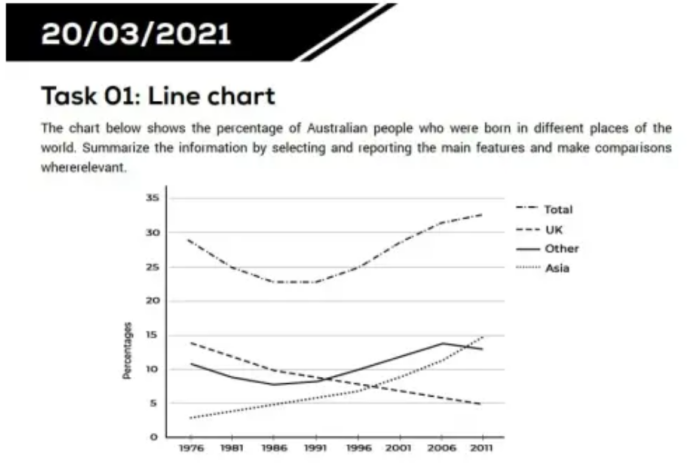
Đề bài: The chart below shows the percantage of Australian people who were born in different places of the world. Summarise the information by selecting and reporting the main features, and make comparisons where relevant
The chart below shows the percantage of Australian people who were born in different places of the world - mẫu 1
The line chart illustrates the proportion of Australian residents who were born in various regions of the world between 1976 and 2011. Overall, the total percentage of overseas-born Australians increased over the period, with a notable rise in those from Asia, while the proportion from the UK declined.
In 1976, around 27% of Australians were born overseas. This figure fell slightly to about 23% in 1986 but then rose steadily, reaching approximately 33% by 2011. The percentage of people born in the UK started at roughly 14% and showed a continuous decline throughout the period, dropping to around 5% in 2011.
By contrast, the proportion of Australians born in Asia grew significantly. It began at only 2% in 1976 and climbed steadily to nearly 12% by 2011. Meanwhile, the “Other” category fluctuated slightly, falling from 10% to 8% before rising again to around 13% in 2006, followed by a small decrease in 2011.
In summary, while the share of UK-born Australians decreased, the number of immigrants from Asia and other regions increased, contributing to the overall growth in Australia’s foreign-born population.
Hướng dẫn dịch:
Biểu đồ đường minh họa tỷ lệ cư dân Úc sinh ra ở các khu vực khác nhau trên thế giới từ năm 1976 đến năm 2011. Nhìn chung, tổng tỷ lệ người Úc sinh ở nước ngoài tăng lên trong giai đoạn này, với sự gia tăng đáng kể từ châu Á, trong khi tỷ lệ từ Vương quốc Anh giảm.
Năm 1976, khoảng 27% người Úc sinh ở nước ngoài. Con số này giảm nhẹ xuống khoảng 23% vào năm 1986 nhưng sau đó tăng đều, đạt khoảng 33% vào năm 2011. Tỷ lệ người sinh ở Anh bắt đầu khoảng 14% và giảm liên tục trong suốt giai đoạn, chỉ còn khoảng 5% vào năm 2011.
Ngược lại, tỷ lệ người Úc sinh ở châu Á tăng mạnh. Nó bắt đầu chỉ ở mức 2% năm 1976 và tăng đều lên gần 12% vào năm 2011. Trong khi đó, nhóm “Khác” dao động nhẹ, giảm từ 10% xuống 8% rồi tăng lên khoảng 13% vào năm 2006, sau đó giảm nhẹ vào năm 2011.
Tóm lại, trong khi tỷ lệ người Úc sinh ở Anh giảm, số lượng người nhập cư từ châu Á và các khu vực khác tăng, góp phần vào sự gia tăng tổng thể của dân số Úc sinh ở nước ngoài.
The chart below shows the percantage of Australian people who were born in different places of the world - mẫu 2
The chart compares the percentage of Australian people born in different parts of the world from 1976 to 2011. It is clear that the total proportion of overseas-born Australians rose over time, mainly due to an increase in Asian-born residents, whereas the figure for those from the UK declined.
In 1976, the total percentage of foreign-born Australians was about 27%, with the UK accounting for the largest share at 14%. Over the next decades, the UK figure fell steadily, reaching only 5% in 2011. In contrast, the proportion of people born in Asia grew continuously from 2% to 12%, becoming one of the most significant sources of immigration by the end of the period.
The “Other” category showed moderate fluctuations, starting at 10%, dropping slightly in the early years, and then peaking at around 13% in 2006 before declining marginally. Overall, the total proportion of overseas-born Australians increased to over 30% by 2011, reflecting Australia’s growing cultural diversity.
Hướng dẫn dịch:
Biểu đồ so sánh tỷ lệ người Úc sinh ra ở các khu vực khác nhau trên thế giới từ năm 1976 đến năm 2011. Rõ ràng rằng tổng tỷ lệ người Úc sinh ở nước ngoài tăng theo thời gian, chủ yếu do sự gia tăng của cư dân sinh ở châu Á, trong khi tỷ lệ từ Anh giảm.
Năm 1976, tổng tỷ lệ người Úc sinh ở nước ngoài khoảng 27%, trong đó Anh chiếm phần lớn với 14%. Trong những thập kỷ tiếp theo, con số này giảm đều, chỉ còn 5% vào năm 2011. Ngược lại, tỷ lệ người sinh ở châu Á tăng liên tục từ 2% lên 12%, trở thành một trong những nguồn nhập cư quan trọng nhất vào cuối giai đoạn.
Nhóm “Khác” dao động nhẹ, bắt đầu ở mức 10%, giảm nhẹ trong những năm đầu, rồi đạt đỉnh khoảng 13% vào năm 2006 trước khi giảm nhẹ. Nhìn chung, tổng tỷ lệ người Úc sinh ở nước ngoài tăng lên hơn 30% vào năm 2011, phản ánh sự đa dạng văn hóa ngày càng tăng của Úc.
Xem thêm các bài luận Tiếng Anh hay khác:

TÀI LIỆU CLC DÀNH CHO GIÁO VIÊN VÀ PHỤ HUYNH LỚP 9
Bộ giáo án, bài giảng powerpoint, đề thi file word có đáp án 2026 tại https://tailieugiaovien.com.vn/
Hỗ trợ zalo: VietJack Official
Tổng đài hỗ trợ đăng ký: 084 283 45 85
 Đề thi vào 10 các sở Hà Nội, Tp. Hồ Chí Minh...
41 tài liệu
Đề thi vào 10 các sở Hà Nội, Tp. Hồ Chí Minh...
41 tài liệu
 Giáo án Word 9
95 tài liệu
Giáo án Word 9
95 tài liệu
 Đề thi giữa kì, cuối kì 9
254 tài liệu
Đề thi giữa kì, cuối kì 9
254 tài liệu
 Chuyên đề dạy thêm Toán, Lí, Hóa... 9
71 tài liệu
Chuyên đề dạy thêm Toán, Lí, Hóa... 9
71 tài liệu
 Đề thi HSG 9
8 tài liệu
Đề thi HSG 9
8 tài liệu
 Bài giảng Powerpoint 9
42 tài liệu
Bài giảng Powerpoint 9
42 tài liệu
Công cụ giáo viên (2048.VN)
Tạo- trộn đề thi miễn phí từ file PDF, Word, Giao bài nhanh chóng, Hoàn toàn Free
- Đề thi lớp 1 (các môn học)
- Đề thi lớp 2 (các môn học)
- Đề thi lớp 3 (các môn học)
- Đề thi lớp 4 (các môn học)
- Đề thi lớp 5 (các môn học)
- Đề thi lớp 6 (các môn học)
- Đề thi lớp 7 (các môn học)
- Đề thi lớp 8 (các môn học)
- Đề thi lớp 9 (các môn học)
- Đề thi lớp 10 (các môn học)
- Đề thi lớp 11 (các môn học)
- Đề thi lớp 12 (các môn học)
- Giáo án lớp 1 (các môn học)
- Giáo án lớp 2 (các môn học)
- Giáo án lớp 3 (các môn học)
- Giáo án lớp 4 (các môn học)
- Giáo án lớp 5 (các môn học)
- Giáo án lớp 6 (các môn học)
- Giáo án lớp 7 (các môn học)
- Giáo án lớp 8 (các môn học)
- Giáo án lớp 9 (các môn học)
- Giáo án lớp 10 (các môn học)
- Giáo án lớp 11 (các môn học)
- Giáo án lớp 12 (các môn học)