Đề thi HSG Tiếng Anh 11 trường THPT Chuyên Bảo Lộc (Lâm Đồng) năm 2024
Bài viết Đề thi học sinh giỏi Tiếng Anh 11 trường THPT Chuyên Bảo Lộc, tỉnh Lâm Đồng năm 2024 đề xuất cho kì thi HSG Tiếng Anh 11 các trường THPT Chuyên khu vực Duyên hải và Đồng bằng Bắc Bộ. Mời các bạn đón đọc:
Đề thi HSG Tiếng Anh 11 trường THPT Chuyên Bảo Lộc (Lâm Đồng) năm 2024
Chỉ từ 200k mua trọn bộ Đề thi học sinh giỏi Tiếng Anh 11 bản word có lời giải chi tiết:
- B1: gửi phí vào tk:
1133836868- CT TNHH DAU TU VA DV GD VIETJACK - Ngân hàng MB (QR) - B2: Nhắn tin tới Zalo VietJack Official - nhấn vào đây để thông báo và nhận đề thi
|
HỘI CÁC TRƯỜNG THPT CHUYÊN VÙNG DH&ĐB BẮC BỘ TRƯỜNG THPT CHUYÊN BẢO LỘC ĐỀ THI ĐỀ XUẤT (Đề thi gồm 17 trang) |
KỲ THI CHỌN HỌC SINH GIỎI LẦN THỨ XV, NĂM 2024 ĐỀ THI MÔN: TIẾNG ANH - LỚP 11 Thời gian làm bài: 180 phút (không kể thời gian giao đề) |
I. LISTENING (50 points)
HƯỚNG DẪN PHẦN THI NGHE HIỂU
• Bài nghe gồm 4 phần; mỗi phần được nghe 2 lần, mỗi lần cách nhau 05 giây; mở đầu và kết thúc mỗi phần nghe có tín hiệu. Thí sinh có 20 giây để đọc mỗi phần câu hỏi.
• Mở đầu và kết thúc bài nghe có tín hiệu nhạc. Thí sinh có 03 phút để hoàn chỉnh bài trước tín hiệu nhạc kết thúc bài nghe.
• Mọi hướng dẫn cho thí sinh (bằng tiếng Anh) đã có trong bài nghe.
Bài nghe:
PART 1. You will hear a health expert talking about the benefits of losing weight on your body and brain. While you listen, decide whether each statement below is true (T) or false (F). (10 points)
1. It is more difficult to lose weight in the first week than it will be later on.
2. After some weeks, the decrease in body fat may lead to a fall in a hormone signaling fullness.
3. It is estimated that every 4-pound weight loss will result in one pound less pressure on knee joints.
4. One benefits of weight loss is a boost in memory.
5. After 9 months of weight-loss practice, people’s brain is usually more sensitive to motivation.
PART 2. You will hear part of a lecture on volcanic activity and its effect on the atmosphere. Answer the following questions. Write NO MORE THAN THREE WORDS AND/OR A NUMBER for each answer. (10 points)
6. When did Mt. Pinatubo erupt for the first time?
………………………………………………………………………………………………..
7. When was the earthquake measuring 7.8 recorded?
………………………………………………………………………………………………..
8. When did the experts begin to study Mt. Pinatubo?
………………………………………………………………………………………………..
9. What fell on the local villages on 2nd April?
………………………………………………………………………………………………..
10. What does a “Level 5” alert mean?
………………………………………………………………………………………………..
PART 3. You will hear part of a radio program about dancing. For each question, choose the correct answer (A, B, C or D) according to what you hear. (10 points)
11. What makes Shirley dance?
A. certain types of music
B. other people dancing
C. the beat of music
D. being in a good mood
12. How does Tony choose which song to play first?
A. according to the age of the crowd
B. according to the atmosphere in the place
C. according to musical fashions at the time
D. according to the type of event it is
13. According to Emma, why is dancing important to young people?
A. It gives them a sense of identity.
B. It reflects their cultural background.
C. They have more energy than older people.
D. They gain a greater understanding of music.
14. Emma believes that music taste
A. shows there are no barriers between people.
B. is a reflection of cultural influences.
C. reflects people’s political views.
D. shows how individual people are.
15. What is Tony’s opinion of dancing?
A. It brings all social classes together.
B. It makes young people happy.
C. It enables people to make friends.
D. It can be enjoyed by anyone.
PART 4. You will hear a designer talking about a material called ETFE that is used in construction. For questions 16-25, complete the sentences with a word or short phrase. (20points)
According to the designer, ETFE is a 16. _______________ building material.
In Belgium, ETFE forms part of a 17. _______________ converted from an old steelwork.
The tough polymer does not allow either 18. _______________ particles to build up on it.
No 19. _______________ are released during the manufacture of ETFE.
30,000 square meters of ETFE have been used to construct the 20. _______________ of the Eden Project.
ETFE foils can be fabricated in any size, 21. _______________ to meet the client’s needs.
It is possible to order ETFE foils with a variety of 22. _______________ printed on them.
Another feature of the polymer is that any 23. _______________ can be projected on it.
In the case of damage, ETFE can repaired by applying a 24. _______________ over the tear using intense heat.
Unfortunately, this material is not applicable to 25. _______________ projects.
II. LEXICO – GRAMMAR
PART 1. Choose the best option to complete each of the following sentences. (20 points)
26. He _________ around the track effortlessly and left the other runners trailing in his wake.
A. gouged
B. loped
C. rued D. milked
27. Her close personal friends never _________ in their belief in her, whatever was written in the press.
A. derided
B. taunted
C. faltered
D. reneged
28. He has a(n) _________ collection of butterflies which he bought from the local Natural History Museum.
A. reticent
B. ponderous
C. esoteric
D. reciprocal
29. Although he acts tough, _________.
A. his bark is worse than his bite
B. he’s a tough nut to crack
C. he’s learned the hard way
D. he isn’t up to scratch
30. It is one thing to simply tell a white lie, James, but you have been downright _________; I will never beable to trust you again.
A. prudent
B. reclusive
C. precipitous
D. mendacious
31. Carson was at first flattered by the _________ of his new colleagues, but he soon realized that their admiration rested chiefly on his connections, not his accomplishments.
A. reprisal
B. adulation
C. bulwark
D. retinue
32. Unanswered, the demands for nuclear deterrents have _________ fears of civil war.
A. flashed up
B. prognosticated
C. sidetracked
D. stoked up
33. Carson was at first flattered by the _________ of his new colleagues, but he soon realized that their admiration rested chiefly on his connections, not his accomplishments.
A. reprisal
B. adulation
C. bulwark
D. retinue
34. _________ that dynamic, departmental recommendations against using pepper spray on nonviolent arrestees may be needed.
A. in light of
B. At the forefront of
C. On the verge of
D. In accordance with
35. Because he was so _________, the athlete was able to complete the obstacle course in record time.
A. belligerent
B. nimble
C. demure
D. volatile
36. Harry had a terrible habit of boasting so much about his smallest accomplishments that his _________ became renowned throughout the small college campus.
A. vainglory
B. diffidence
C. tempestuousness
D. mockery
37. The building is _________. It’s been ruined and abandoned for years.
A. destabilized
B. derelict
C. defunct
D. despondent
38. The film is a _________ reminder of life in small town America in the 1960s.
A. preordained
B. pungent
C. poignant
D. protruding
39. When his manager went on a business trip, Mark stepped into the _________ and chaired the meeting.
A. hole
B. breach
C. pool
D. crack
40. During the day tigers usually lie_________, _________ in the long grass.
A. rested – hidden
B. rested – hiding
C. resting – hidden
D. resting – hide
41. In these remote regions the sage of men and animals was played_________.
A. along with
B. havoc with
C. down
D. out
42. Charles Babbage’s “difference engine” is widely regarded as the _________ of the computer.
A. ancestor
B. precursor
C. antecedent
D. premonition
43. I won’t _________ those children making a noise in my house!
A. allow
B. have
C. let
D. permit
44. The storm played _________ the cross-channel ferry crossings.
A. down
B. havoc with
C. cat and mouse with
D. along with
45. The community should take the doctor’s advice into consideration since he’s in _________ earnest about the epidemic.
A. mortally
B. fatally
C. deadly
D. gravely
PART 2. Write the correct form of word in each blank. (10 points)
46. He threw his bags _________ on the floor. (CEREMONY)
47. As the climate cools gradually, almost _________, with every few meters of altitude gained, so the full diversity of fauna and flora is revealed in all its splendor. (PERCEPTION)
48. Although he read them time and time again, he could not understand these _________ of these economic policies. (INTRICATE)
49. It's true that _________ originates from the Orient. (REFLEX)
50. Their ten-point lead put the team in an almost _________ position. (ASAIL)
51. Millions of people like _________ and property owners depend on the tourist industry for their livelihood. (HOTEL)
52. Although he is not a native speaker, his foreign accent seems almost______. (PERCEIVE)
53. The couple should discuss the specific problem in detail, taking care not to rake up old _________. (GRIEVE)
54. His book was appreciated for the detailed description of _________ characteristics of herbs. (THERAPY)
55. The locals are advised to stay away from _________ rioters. (CONFRONT)
III. READING
PART 1. OPEN CLOZE TEST. Think of ONE word that best completes each blank in the text below. (15 points)
People tend to amass possessions, sometimes without being aware of doing so. Indeed, they can have a delightful surprise when they find something useful which they did not know that they owned. Those who never have to change house become indiscriminate collectors of (56) _________ can only be described as clutter. They leave unwanted objects in drawers, cupboards and attics for years, in the (57) _________ that they may one day need just those very things. As they grow old, people also accumulate belongings for two other reasons, lack of physical and mental energy, both of which are essential in turning out and throwing away, and sentiment. Things owned for a long time are full of (58) _________ with the past, perhaps with relatives who are (59) _________, and so they gradually acquire a value (60) _________ their true worth.
Some things are collected deliberately in the home in an attempt to avoid (61) _________. Among these you could list string and brown paper, kept by thrifty people when a parcel has been opened, to save buying these two requisites. Collecting small items can easily become a mania. I know someone who always cuts out from newspapers sketches of model clothes that she would like to buy, (62) _________ she had the money. As she is not rich, the chances that she will ever be able to afford such purchases are (63) _________; but she is never sufficiently strong-minded to be able to stop the practice. It is a harmless habit, but it litters (64) _________ her desk to such an extent that every time she opens it, loose bits of paper fall out in every direction.
Collecting as serious hobby is quite different and has may advantages since this is seen as a good way of occupying spare time constructively. Collecting can make a person (65) _________, with no time for boredom.
PART 2: Read the following passage and decide the best answer (A, B, C, or D) to each question 66-75. (10 points)
What leaders really do
Leadership is different from management, but not for the reasons most people think. Leadership isn’t mystical and mysterious. It has nothing to do with having “charisma” or other exotic personality traits. It is not the province of a chosen few. Nor is leadership necessarily better than management or a replacement for it.
Rather, leadership and management are two distinctive and complementary systems of action. Each has its own function and characteristic activities. Both are necessary for success in an increasingly complex and volatile business environment.
Most corporations today are over-managed and under-led. They need to develop their capacity to exercise leadership. Corporations that are aware of this fact don’t simply sit around waiting for leaders to come along. They actively seek out people with leadership potential and expose them to career experiences designed to develop that potential. Indeed, with careful selection, nurturing and encouragement, dozens of people can play important leadership roles in a business organization.
But while improving their ability to lead, companies should remember that strong leadership with weak management is no better, and is sometimes actually worse, than the reverse. The real challenge is to combine strong leadership and strong management and use each to balance the other.
Of course, not everyone can be good at both leading and managing. Some people have the capacity to become excellent managers but not strong leaders. Others have great leadership potential but, for a variety of reasons, have great difficulty becoming strong managers. Smart companies value both kinds of people and work hard to make them a part of the team.
When it comes to preparing people for executive jobs, such companies rightly ignore the recent literature that says people cannot manage and lead. They try to develop leader-managers. Once companies understand the fundamental difference between leadership and management, they can begin to groom their top people to provide both.
Management is about coping with complexity. Its practices and procedures are largely a response to one of the most significant developments of the twentieth century: the emergence of large organizations. Without good management, complex enterprises tend to become chaotic in ways that threaten their very existence. Good management brings a degree of order and consistency to key dimensions like the quality and profitability of products.
Leadership, by contrast, is about coping with change. Part of the reason it has become so important in recent years is that the business world has become more competitive and more volatile. Faster technological change, greater international competition, the deregulation of markets, overcapacity in capital-intensive industries, and an unstable oil cartel are among the many factors that have contributed to this shift. The result is that doing what was done yesterday is no longer a formula for success. Major changes are more and more necessary to compete effectively in this new environment. And more changes always demand more leadership.
Consider a simple military analogy: A peacetime army can usually survive with good administration and management up and down the hierarchy, coupled with good leadership concentrated at the very top. A wartime army, however, needs competent leadership at all levels. No one yet has figured out how to manage people effectively into battle: they must be led.
These two different functions – coping with complexity and coping with change – shape the characteristic activities of management and leadership. Each system of action involves deciding what needs to be done, creating networks of people and relationships that can accomplish an agenda, and then trying to ensure that those people actually do the job. But each accomplishes these three tasks in different ways.
Companies manage complexity first by planning and budgeting – setting targets or goals for the future (typically for the next month a year), establishing detailed steps for achieving those targets, and then allocating resources to accomplish those plans. By contrast, leading an organization to constructive change begins by setting a direction – developing a vision of the future (often the distant future) along with strategies for producing the changes needed to achieve that vision.
Management develops the capacity to achieve its plan by organizing and staffing – creating an organizational structure and set of jobs for accomplishing plan requirements, staffing the jobs with qualified individuals, communicating the plan to those people, delegating responsibility for carrying out the plan, and devising systems to monitor implementation. The equivalent leadership activity, however, is aligning people. This means communicating the new direction to those who can create conditions that understand the vision and are committed to its achievement.
Finally, management ensures plan accomplishment by controlling and problem solving – monitoring results versus the plan in some detail, both formally and informally, by means of reports, meetings, and other tools, identifying deviations, and then planning and organizing to solve the problems. But for leadership, achieving a vision requires motivating and inspiring – keeping people moving in the right direction, despite major obstacles to change – by appealing to basic but often untapped human needs, values and emotions.
66. In the first two paragraphs, the writer compares leadership to management in order to ____________.
A. show that only a few selected people can be good leaders.
B. indicate that leadership is not impossible without charisma.
C. debunk some misconceptions about the two functions.
D. stress the necessity of management in the workplace.
67. Modern corporations that wish to develop leadership ____________.
A. take the initiative in the recruitment and training of leaders.
B. try to encourage existing staff to become leaders.
C. consciously hire fewer managers and more leaders.
D. look for people who can be trained to become managers.
68. In order to train people to be both managers and leaders, companies must ____________.
A. avoid misinterpreting recent literature on leadership.
B. understand that leadership and management are distinct.
C. learn to value managers and leaders equally.
D. realize that not almost nobody can be good at both.
69. Leadership has recently grown in importance because ____________.
A. doing business has become more complicated.
B. technology has changed beyond recognition.
C. the oil market has become unpredictable.
D. several markets have become deregulated.
70. The writer draws the military analogy in paragraph 9 in order to ____________.
A. illustrate the necessity of leadership in times of instability.
B. show why it is essential to manage armies effectively.
C. give an example of a business that needs to be managed.
D. draw a comparison between leadership and management.
71. While management sets goals for the near future, leadership ____________.
A. assists management with planning.
B. contributes foresight for the long term.
C. tries to change the way we work.
D. finds ways to improve management.
72. By “this shift”, the author indicates the ____________.
A. competiveness of international entrepreneurs.
B. challenges in accessing new markets
C. demand for more flexible administration
D. unpredictability of present business world
73. In order to make a vision come true, leadership ____________.
A. has become involved in problem-solving.
B. evaluates results and changes its plan accordingly.
C. concerns itself with people’s levels of motivation.
D. makes sure management stays in the right direction.
74. According to paragraph 3, what problems most large companies are facing these days?
A. the scarcity of capable managers with leadership skills
B. an imbalance between leadership and management abilities
C. the disparity in treatment towards leaders and managers
D. the inequality in investment in staff’s necessary skills
75. The word “aligning” in paragraph 12 could be best replaced by ____________.
A. recruiting
B. orientating
C. ameliorating
D.scrutinizing
PART 3: Read the passage and answer the questions that follow. (13 points)
Striking Back at Lightning with Lasers
Seldom is the weather more dramatic than when thunderstorms strike. Their electrical fury inflicts death or serious injury on around 500 people each year in the United States alone. As the clouds roll in, a leisurely round of golf can become a terrifying dice with death – out in the open, a lone golfer maybe a lightning bolt’s most inviting target. And there is damage to property too. Lightning damage costs American power companies more than $100 million a year.
But researchers in the United States and Japan are planning to hit back. Already in laboratory trials they have tested strategies for neutralizing the power of thunderstorms, and this winter they will brave real storms, equipped with an armory of lasers that they will be pointing towards the heavens to discharge thunderclouds before lightning can strike.
The idea of forcing storm clouds to discharge their lightning on command is not new. In the early 1960s, researchers tried firing rockets trailing wires into thunderclouds to set up an easy discharge path for the huge electric charges that these clouds generate. The technique survives to this day at a test site in Florida run by the University of Florida, with support from the Electrical Power Research Institute (EPRI), based in California. EPRI, which is funded by power companies, is looking at ways to protect the United States’ power grid from lightning strikes. “We can cause the lightning to strike where we want it to using rockets,” says Ralph Bernstein, manager of lightning projects at EPRI. The rocket site is providing precise measurements of lightning voltages and allowing engineers to check how electrical equipment bears up.
Bad behavior
But while rockets are fine for research, they cannot provide the protection from lightning strikes that everyone is looking for. The rockets cost around $1,200 each, can only be fired at a limited frequency and their failure rate is about 40 per cent. And even when they do trigger lightning, things still do not always go according to plan. “Lightning is not perfectly well behaved,” says Bernstein. “Occasionally, it will take a branch and go someplace it wasn’t supposed to go.”
And anyway, who would want to fire streams of rockets in a populated area? “What goes up must come down,” points out Jean-Claude Diels of the University of New Mexico. Diels is leading a project, which is backed by EPRI, to try to use lasers to discharge lightning safely – and safety is a basic requirement since no one wants to put themselves or their expensive equipment at risk. With around $500,000 invested so far, a promising system is just emerging from the laboratory.
The idea began some 20 years ago, when high-powered lasers were revealing their ability to extract electrons out of atoms and create ions. If a laser could generate a line of ionization in the air all the way up to a storm cloud, this conducting path could be used to guide lightning to Earth, before the electric field becomes strong enough to break down the air in an uncontrollable surge. To stop the laser itself being struck, it would not be pointed straight at the clouds. Instead, it would be directed at a mirror, and from there into the sky. The mirror would be protected by placing lightning conductors close by. Ideally, the cloud-zapper (gun) would be cheap enough to be installed around all key power installations, and portable enough to be taken to international sporting events to beam up at brewing storm clouds.
A stumbling block
However, there is still a big stumbling block. The laser is no nifty portable: it’s a monster that takes up a whole room. Diels is trying to cut down the size and says that a laser around the size of a small table is in the offing. He plans to test this more manageable system on live thunderclouds next summer.
Bernstein says that Diels’s system is attracting lots of interest from the power companies. But they have not yet come up with the £5 million that EPRI says will be needed to develop a commercial system, by making the lasers yet smaller and cheaper. “I cannot say I have money yet, but I’m working on it,” says Bernstein. He reckons that the forthcoming field tests will be the turning point – and he’s hoping for good news. Bernstein predicts “an avalanche of interest and support” if all goes well. He expects to see loud-zappers eventually costing £50,000 to £100,000 each.
Other scientists could also benefit. With a lightning “switch” at their fingertips, materials scientists could find out what happens when mighty currents meet matter. Diels also hopes to see the birth of “interactive meteorology” – not just forecasting the weather but controlling it. “If we could discharge clouds, we might affect the weather,” he says.
“And perhaps,” says Diels, “we’ll be able to confront some other meteorological menaces”. “We think we could prevent hail by inducing lightning,” he says. Thunder, the shock wave that comes from a lightning flash, is thought to be the trigger for the torrential rain that is typical of storms. A laser thunder factory could shake the moisture out of clouds, perhaps preventing the formation of the giant hailstones that threaten crops. With luck, as the storm clouds gather this winter, laser-toting researchers could, for the first time, strike back.
Questions 76-78. Choose the correct letter, A, B, C or D.
76. The main topic discussed in the text is ____________.
A. the damage caused to US golf courses and golf players by lightning strikes.
B. the effect of lightning on power supplies in the US and in Japan.
C. a variety of methods used in trying to control lightning strikes.
D. a laser technique used in trying to control lightning strikes.
77. According to the text, every year lightning ____________.
A. does considerable damage to buildings during thunderstorms.
B. kills or injures mainly golfers in the United States.
C. kills or injures around 500 people throughout the world.
D. damages more than 100 American power companies.
78. Researchers at the University of Florida and at the University of New Mexico ____________.
A. receive funds from the same source.
B. are using the same techniques.
C. are employed by commercial companies.
D. are in opposition to each other.
Questions 79-81. Complete the sentences below. Choose NO MORE THAN TWO WORDS from the passage for each answer.
79. EPRI receives financial support from _________________.
80. The advantage of the technique being developed by Diels is that it can be used _________________.
81. The main difficulty associated with using the laser equipment is related to its _________________.
Questions 82-85. Complete the summary using the list of words, A-I, below.
In this method, a laser is used to create a line of ionization by removing electrons from 82 ____________. This laser is then directed at 83. ____________in order to control electrical charges, a method which is less dangerous than using 84. ____________. As a protection for the lasers, the beams are aimed firstly at 85. ____________.
|
A cloud-zappers B atoms C storm clouds D mirrors E technique F ions G rockets H conductors I thunder |
Questions 86-88. Do the following statements agree with the information given in the Reading Passage? Write:
YES if the statement agrees with the claims of the writer
NO if the statement contradicts the claims of the writer
NOT GIVEN if it is impossible to say what the writer thinks about this
86. Power companies have given Diels enough money to develop his laser.
87. Obtaining money to improve the lasers will depend on tests in real storms.
88. Weather forecasters are intensely interested in Diels’s system.
PART 4: You will read an article about disappearing languages. Some paragraphs have been removed from the text. Add them from the paragraphs (A-G). There is one paragraph you do not need to use. (7 points)
Vanishing Voices
The world’s languages are disappearing at in unprecedented rate, but does it matter as people can communicate? David Crystal explains why linguistic diversity is the key to our survival.
In 1995, linguist Bruce Connell, was doing some field work in Cameron. He found a language called Kasabe, which no westerner had studied before. It had just one speaker left, a man called Bogon. Connell had no time on that visit, so he decided to return to Cameron a year late. He arrived in the early winter, only to learn that Bogon had died on November 5.
89 |
There is nothing unusual about Bogon’s story. Communities have come and gone throughout history, taking their languages with them. But, judged by the standards of the past, what is happening today is extraordinary. There are now about 6,000 languages in the world. Of these, about half are going to die out during the next century.
90 |
Many things can kill a language, from natural disasters to cultural assimilation and genocide. On July 17 1998, an earthquake in Papua New Guinea, killed more than 2,200 people and displaced a further 10,000; several villages were destroyed. As the survivors of have moved away, will these communities (and thus their languages) survive the trauma of displacement?
91 |
This is often accompanied by a feeling of shame about using the old language. Those families that do continue to use it tend to do so in an idiosyncratic manner, resulting in “family dialect”. Within a generation, healthy bilingualism within can slip into self-conscious semiligualism, and thence into monolingualism.
92 |
Many different skills and characteristics enable a species to survive in different environments, and the need to maintain linguistic diversity stands on the shoulders of this arguments. Encapsulated within a language is most of a community’s history, a large part of its cultural identity and a wealth of knowledge which the rest of the world can access.
93 |
Not everyone appreciates these things. Some people accept the Babel myth: that the multiplicity of the world’s languages is a curse rather than a blessing. If only we had just one language in the world, we would be betteroff. World peace would be established.
94 |
In fact, a dying language will cause conflict rather than eliminate it, albeit not between countries but rather within the individuals who have abandoned their ancestors’ language. The first generation is, typically, not so concerned, as its members are still struggling to establish their new social position and master new language. It is their children, secure in the new language and in a much better socioeconomic position, with battles over land claims and civil rights behind them, who begin to reflect on (and feel unbearable guilt over) the heritage they have lost.
95 |
Can we save a few thousand languages, just like that? Yes, though it would not be easy. To save a language you must get linguists into the field, support the community with language teachers, publish grammars and dictionaries – and all over a period of several years. But these difficulties do not mean we can ignore the death of languages. Regretting the loss in the future would be pointless. When a spoken language dies, it leaves to archaeology. It is as if it has never been.
A However, all the big trouble spots of the world in recent decades have been monolingual countries – Cambodia, Rwanda, Burundi, Yugoslavia, Northern Ireland. And all big monolingual countries have had their civil wars. If people want to fight each other, it takes more than a common language to stop them.
B Even if people stay put, their language may still die as a result of cultural assimilation. At first, there is pressure on the people to speak the dominant language. Then there is a period of bilingualism. Finally, bilingualism starts to decline, with the old language giving way to the new. This leads to the third stage, in which the younger generation finds its old language less and less relevant.
C On November 4, Kasabe existed as one of the world’s languages; on November 6, it did not. The event might have caused a stir in Bogon’s village. If you are the last speaker of a language, you are often considered special in your community. But outside the village, who knew or mourned the passing of what he stood for?
D Breton, in north-east France, is a classic example of a language reducing dramatically in numbers. At the beginning of the 20th century it was spoken by a million people; it is now down to less than a quarter of that. Breton can be saved if enough effort is made – the kind of effort that has already helped Welsh to recover from a dramatic decline – otherwise it could be gone in 50 years.
E The full statistics are frightening. There are 51 languages with only one speaker left – 28 in Australia alone. There are more than 3,000 with fewer than 10,000 speakers; and a staggering 5,000 languages with fewer than 100,000 speakers. Ninety-six percent of the world’s languages are spoken by only 4% of its people. No wonder so many are in danger of dying.
F Sometimes what we learn from a language is eminently practical, as when we discover new medical treatments from the folk medicine of an indigenous people. Sometimes it is intellectual, as when the links between languages tell us something about the movements of early civilizations. And of course, every often it is linguistic: we learn something new about language itself – the behavior that makes us truly human.
G The common reaction among these people is: “If only my grandparents’ generation had …” Indeed, if a modicum of effort had been devoted to language preservation, it would have left the option open for future generations to make their own choice.
H Is language death such a disaster? As long as a few hundred or even a couple of thousand languages survive, you might say, that is sufficient. It is not. We should care about dying languages for the same reason that we care when a species of animal or plant dies. It reduces the diversity of our planet. In the case of language, we are talking about intellectual and cultural diversity, not biological diversity, but the issues are the same.
PART 5: You are going to read an article with 7 sections (A-G) about body reactions. Which section mentions a mechanical response of the body that .......? (15 points)
96. is caused by, among the other things, fatigue? ………..
97. is the result of over-exertion experienced predominantly by athletes? ………..
98. is responsible for preventing the transmission of a particular sensation? ………..
99. may occur soon after the intake of food of one engages in physical activity? ………..
100. functions in a similar fashion to physical activity? ………..
101-102. involves an increase in the provision of oxygen to the muscles? ………..
………..
103. provides one with a satisfying sense of relief? ………..
104. aims to counteract the effects brought on by a decrease in temperature? ………..
105. occurs due to a decrease in fluid pressure?………..
What happens when you …
A Blush
When feeling threatened or embarrassed we tend to blush. Embarrassment causes us anxiety which charges our bodies with adrenaline to either fight a threat or run away from it. It is the substance that makes the heart pound faster to ensure a plentiful supply of oxygen to the muscles. But it also has the effect of making us hotter. To cool ourselves down, we sweat and blood flows through capillaries at the skin’s surface to cause redness (blushing) – more pronounced in the face because there are more blood vessels there.
B Scratch an Itch
From insect bites to skin rash, everyone knows there’s nothing like a good scratch to get rid of an annoying itch. When you get an itch, for example from an insect bite, cells in the skin released a chemical called histamine. Nearby nerve cells respond to the histamine and transmit the signal to the spinal cord. From there, it’s sent into the brain’s thalamus. The thalamus transmits the signal to the cerebral cortex that in turn creates the itching sensation. Scratching switches off nerve cells in the spinal cord that normally transmit the sensation of itching up to the brain.
C Get a twitchy eyelid
Perhaps the most irritating involuntary muscle twitch is the twitching eyelid. But what causes it? In general, it is a benign condition. It can be brought on by stress and tiredness, which cause nervous, involuntary muscle tics. The muscles that control the eyelid are tiny and very sensitive to effects that can give you the shakes – like stress, tiredness and caffeine. Too much of any of these can bring on nervous, involuntary twitches. The condition is normally temporary, passing after anything from days to a few weeks.
D Crack knuckles
It’s not just your knuckles that you can crack – your elbows, knees, neck and even the breastbone have the ability to make the same cracking sound. But what’s making the noise? Rather than your bones popping in and out of their sockets, it’s actually caused by gas escaping from fluid in your joints. The cracking is caused by bubbles that form from the gas dissolved in the lubricating synovial fluid, inside all the joints. Stretching a joint lowers the fluid pressure inside it and this is what makes the bubbles appear – in exactly the same way that bubbles form in a bottle of fizzy drink when you open it.
E Shiver
It’s not something you’re likely to worry about all year round, but when the icy mornings of January arrive again, you will. So why does the cold make our teeth chatter and our muscles shake? The answer is that it helps us to keep warm. It works in the same way that exercise makes us hot and sweaty. By making our muscles tremble, the body is exploiting the same mechanism to generate much-needed heat when we’re cold. Shivering can be sustained for a relatively long period of time assuming the cold stress isn’t too severe and your body temperature isn’t decreasing too rapidly.
F Get a lump in your throat
When the body is stressed; as it is when you’re emotional, your heart beats faster to supply your muscles with oxygen, so your body forces open your windpipe to facilitate easy breathing. That’s fine until you need to swallow, like when you’re on the verge of tears. Tears flow from the tear duct into the nasal cavity and then down your throat and must be swallowed. This requires you to close your windpipe temporarily – in order to stop what you’re swallowing from entering your lungs. The result is a conflict between holding the airway open and the swallowing impulse trying to force it shut, which you perceive as a lump in your throat.
G Cramp
Cramp is a painful “knotting up” of your muscles. It usually strikes the calf, but it can also hit the soles of your feet and even under the jaw when yawning. Cramps happen for all sorts of reasons. During intense exercise, the build-up of chemicals such as lactic acid can send a muscle into spasm, leading to cramp – common in long-distance runners and swimmers. Low levels of electrolytes, which carry the signals controlling muscle action, calcium and potassium in particular, are another trigger. A “side cramp” or “stitch”, which you sometimes get when exercising too soon after eating, is different. It’s thought to be caused by the weight of your organs pulling down on the diaphragm.
SECTION D. WRITING (60 points)
PART 1. Read the following text and use your own words to summarize it. Your summary should be about 100-120 words long. You MUST NOT copy the original. (15 points)
Education is a dynamic and multifaceted field, constantly evolving to meet the needs of society. Currently, public education is facing significant challenges, driven by political debates and differing ideologies. In the U.S., for instance, there's a growing tension between maintaining traditional public education systems and the push towards privatization through mechanisms like education savings accounts. These accounts allow parents to allocate public funds towards private schooling or other educational expenses, thereby reducing reliance on public schools. This shift has sparked debates about the future and purpose of public education, raising questions about access, equity, and the role of schools in society.
In the realm of higher education, institutions are also grappling with their own set of challenges and opportunities. The increasing integration of technology in education is reshaping how learning occurs. Trends like blended learning, online education, and the use of artificial intelligence are becoming more prevalent, offering new ways to enhance student engagement and learning outcomes. These technological advancements are seen as potential solutions to issues of accessibility and personalized learning, providing opportunities for students from diverse backgrounds to succeed.
Moreover, the COVID-19 pandemic has accelerated many of these changes, pushing educational institutions to adapt quickly to remote and hybrid learning environments. This sudden shift has highlighted the importance of digital literacy and the need for robust technological infrastructure in schools and universities. As we move forward, the focus is on creating more resilient and adaptable educational systems that can better serve the needs of all students, regardless of their circumstances.
Overall, the landscape of education is one of transformation, driven by technological innovation, political ideologies, and societal needs. The future of education lies in balancing these forces to create inclusive, effective, and forward-thinking learning environments.
...................................................................................................................................................
...................................................................................................................................................
...................................................................................................................................................
PART 2. Report writing (15 points)
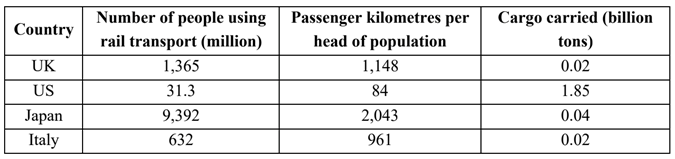
The table below gives information about rail transport in four countries in 2023.
Summarize the information by selecting and reporting the main features, and makecomparisons where relevant.
Write at least 105 words.
...................................................................................................................................................
...................................................................................................................................................
...................................................................................................................................................
PART 3. Write an essay (30 points)
Write about the following topic:
Some people think only parents are responsible for teaching children how to behave. Others think the main responsibility lies wit schools and the government.
Discuss both these views and give your own opinion.
Write at least 205 words.
...................................................................................................................................................
...................................................................................................................................................
...................................................................................................................................................
THE END
................................
................................
................................
Xem thêm đề thi học sinh giỏi Tiếng Anh lớp 11 hay khác:
Đề thi học sinh giỏi Tiếng Anh 11 trường THPT Chuyên Huỳnh Mẫn Đạt (Kiên Giang) năm 2024
Đề thi học sinh giỏi Tiếng Anh 11 trường THPT Chuyên Lào Cai (Lào Cai) năm 2023-2024
Đề thi học sinh giỏi Tiếng Anh 11 trường THPT Chuyên Lê Hồng Phong (Nam Định) năm 2024
Đề thi học sinh giỏi Tiếng Anh 11 trường THPT Chuyên Lam Sơn (Thanh Hóa) năm 2024
Đề thi học sinh giỏi Tiếng Anh 11 trường THPT Chuyên Lê Khiết (Quảng Ngãi) năm 2024
Đề thi học sinh giỏi Tiếng Anh 11 trường THPT Chuyên Hùng Vương (Bình Dương) năm 2023-2024
TÀI LIỆU CLC DÀNH CHO GIÁO VIÊN VÀ PHỤ HUYNH LỚP 9
Bộ giáo án, bài giảng powerpoint, đề thi file word có đáp án 2026 tại https://tailieugiaovien.com.vn/
Hỗ trợ zalo: VietJack Official
Tổng đài hỗ trợ đăng ký: 084 283 45 85
 Đề thi vào 10 các sở Hà Nội, Tp. Hồ Chí Minh...
41 tài liệu
Đề thi vào 10 các sở Hà Nội, Tp. Hồ Chí Minh...
41 tài liệu
 Giáo án Word 9
95 tài liệu
Giáo án Word 9
95 tài liệu
 Đề thi giữa kì, cuối kì 9
254 tài liệu
Đề thi giữa kì, cuối kì 9
254 tài liệu
 Chuyên đề dạy thêm Toán, Lí, Hóa... 9
71 tài liệu
Chuyên đề dạy thêm Toán, Lí, Hóa... 9
71 tài liệu
 Đề thi HSG 9
8 tài liệu
Đề thi HSG 9
8 tài liệu
 Bài giảng Powerpoint 9
42 tài liệu
Bài giảng Powerpoint 9
42 tài liệu
Công cụ giáo viên (2048.VN)
Tạo- trộn đề thi miễn phí từ file PDF, Word, Giao bài nhanh chóng, Hoàn toàn Free
Bộ đề thi các lớp các môn học được Giáo viên nhiều năm kinh nghiệm tổng hợp và biên soạn theo Thông tư mới nhất của Bộ Giáo dục và Đào tạo, được chọn lọc từ đề thi của các trường trên cả nước.
- Đề thi lớp 1 (các môn học)
- Đề thi lớp 2 (các môn học)
- Đề thi lớp 3 (các môn học)
- Đề thi lớp 4 (các môn học)
- Đề thi lớp 5 (các môn học)
- Đề thi lớp 6 (các môn học)
- Đề thi lớp 7 (các môn học)
- Đề thi lớp 8 (các môn học)
- Đề thi lớp 9 (các môn học)
- Đề thi lớp 10 (các môn học)
- Đề thi lớp 11 (các môn học)
- Đề thi lớp 12 (các môn học)
- Giáo án lớp 1 (các môn học)
- Giáo án lớp 2 (các môn học)
- Giáo án lớp 3 (các môn học)
- Giáo án lớp 4 (các môn học)
- Giáo án lớp 5 (các môn học)
- Giáo án lớp 6 (các môn học)
- Giáo án lớp 7 (các môn học)
- Giáo án lớp 8 (các môn học)
- Giáo án lớp 9 (các môn học)
- Giáo án lớp 10 (các môn học)
- Giáo án lớp 11 (các môn học)
- Giáo án lớp 12 (các môn học)