Đề thi HSG Tiếng Anh 11 trường THPT Chuyên Lê Khiết (Quảng Ngãi) năm 2024
Bài viết Đề thi học sinh giỏi Tiếng Anh 11 trường THPT Chuyên Lê Khiết, tỉnh Quảng Ngãi năm 2024 đề xuất cho kì thi HSG Tiếng Anh 11 các trường THPT Chuyên khu vực Duyên hải và Đồng bằng Bắc Bộ. Mời các bạn đón đọc:
Đề thi HSG Tiếng Anh 11 trường THPT Chuyên Lê Khiết (Quảng Ngãi) năm 2024
Chỉ từ 200k mua trọn bộ Đề thi học sinh giỏi Tiếng Anh 11 bản word có lời giải chi tiết:
- B1: gửi phí vào tk:
1133836868- CT TNHH DAU TU VA DV GD VIETJACK - Ngân hàng MB (QR) - B2: Nhắn tin tới Zalo VietJack Official - nhấn vào đây để thông báo và nhận đề thi
|
TRƯỜNG THPT CHUYÊN LÊ KHIẾT ĐỀ GIỚI THIỆU (Đề gồm có 20 trang) |
KÌ THI CHỌN HỌC SINH GIỎI KHU VỰC DUYÊN HẢI VÀ ĐỒNG BẰNG BẮC BỘ LẦN THỨ XV-NĂM 2024 MÔN: TIẾNG ANH 11 Thời gian 180 phút (Không kể thời gian giao đề) |
SECTION A: LISTENING (50 points)
HƯỚNG DẪN PHẦN THI NGHE HIỂU
• Bài nghe gồm 04 phần, mỗi phần thí sinh nghe 02 LẦN. Lần một cách lần hai 10 giây.
• Nội dung bài nghe dài 35 phút, kết thúc bài nghe có tín hiệu nhạc.
• Trước khi nghe, thí sinh có 03 phút để đọc đề phần nghe; sau khi nghe, thí sinh có 05 phút để trả lời các câu hỏi.
(Mọi hướng dẫn chi tiết cho thí sinh (bằng tiếng Anh) đã có trong bài nghe.)
Bài nghe:
Part 1. For questions 1-5, listen to a talk about depression among students and decide whether these statements are True (T) or False (F) according to what you hear. Write your answers in the corresponding numbered boxes provided. (10 pts)
1. The number of students with anxiety increased by 135% in eight years.
2. College students experiencing several mental health problems doubled by over 60%.
3. According to Dr Lipson, traditional college years, a key developmental time, coincides with the age of onset for lifelong mental illnesses.
4. Most people suffering from their mental health crises will have them after 24.
5. In the COVID-19 pandemic, lockdowns and school closures have resulted in many students worrying about their uncertain future.
Part 2. For questions 6 –10, you will hear a radio news report about ‘Google’, a popular Internet search engine. Listen and answer the questions. Use NO MORE THAN FIVE WORDS for each answer in the corresponding numbered boxes provided. (10 pts)
6. What way did Google rely on to market its product?
_____________________________________________________________
7. What position did Google achieve last week as the Internet search engine for America Online?
_____________________________________________________________
8. What group of people was mentioned to favor Google as a search engine?
_____________________________________________________________
9. What verb is the word ‘google’ said to be replacing?
_____________________________________________________________
10. Who invented the original term ‘googol’?
_____________________________________________________________
Part 3. For questions 11–15, you will hear part of a radio discussion about the sport of Indoor Climbing. Listen and select the best answer A, B, C or D. (10 pts)
11. According to Tom, young people are attracted to indoor climbing in the USA because ____________.
A. they have been specifically targeted by gyms.
B. there has been a growth in available facilities.
C. it isn't regarded as a highly competitive activity.
D. it offers a grounding in traditional climbing techniques.
12. What does Amy see as the main benefit of the game she describes?
A. It gives climbers of varying abilities the chance to climb together.
B. It helps climbers remember specific moves they have to make.
C. It keeps more experienced climbers focused on a clear goal.
D. It allows novice climbers to build up their strength.
13. Tom is keen to point out that in his experience, indoor climbing ____________.
A. is just as demanding as traditional outdoor rock climbing.
B. offers the thrill of outdoor climbing in a safer environment.
C. lacks the element of fear present in traditional rock climbing.
D. requires a higher level of concentration than outdoor climbing.
14. Amy feels that compared with other kinds of workout, indoor climbing ____________.
A. focuses on one particular group of muscles.
B. does not require such a regular commitment.
C. represents more than solely a physical challenge.
D. offers a more appropriate form of training for other sports.
15. When asked which type of climbing he prefers, Tom is ____________.
A. keen to stress that he enjoys both types equally.
B. careful to avoid saying which he actually favors.
C. reluctant to admit that he likes outdoor climbing better.
D. critical of people who feel a need to take sides on the issue.
Part 4. For questions 16–25, listen to a piece of news and fill in the missing information. Write ONE WORD taken from the recording for each answer in the spaces provided. (20 pts)
His novel, Les Misérables
● It has been adapted for theatre and cinema.
● We know more about its overall (16)___________ than about its author.
His early career
● In Paris, his career was successful and he led the Romantic movement.
● He spoke publicly about social issues, such as (17)___________ and education.
● Napoleon III disliked his views and exiled him.
● Victor Hugo had to live elsewhere in (18)___________
● He used his income from the sale of some (19)___________ he had written to buy a house on Guernsey.
His house on Guernsey
● Victor Hugo lived in this house until the end of the Empire in France.
● The ground floor contains portraits, (20)___________and tapestries that he valued.
● He bought cheap (21)___________ made of wood and turned this into beautiful wall carvings.
● The first floor consists of furnished areas with wallpaper and (22)___________ that have a Chinese design.
● The library still contains many of his favourite books.
● He wrote in a room at the top of the house that had a view of the (23)___________
● He entertained other writers as well as poor (24)___________ in his house.
● Victor Hugo’s (25)___________ gave ownership of the house to the city of Paris in 1927.
PART B: LEXICO- GRAMMAR (30pts)
PART I: Choose the correct answer (A, B, C or D) to complete each of the following sentences. ( 20pts)
1. Baking soda is considered the best home _______________for acne as it sooths itching and inflammation around spots.
A. dealing
B. medicine
C. remedy
D. substance
2. It was _______________easy for him to learn baseball because he had been a cricket player.
A. purposefully
B. exceedingly
C. relatively
D. normally
3. It’s a secret. Try not to let the cat out of the _______________.
A. hat
B. bag
C. shirt
D. cage
4. When I got struck in the elevator, I was scared out of my _______________.
A. brains
B. head
C. wits
D. nerve
5. Thousands of fans _______________on the stadium to watch the match.
A. convened
B. conversed
C. converged
D. conjoined
6. Would you like to pay _______________to all musicians who made this wonderful concert possible.
A. praise
B. reward
C. tribute
D. thanks
7. I was proud to be _______________out for special praise for my performance.
A. selected
B. singled
C. separated
D. distinguished
8. My secretary left me in the _______________last month and I haven’t found a replacement yet.
A. rock
B. lurch
C. face
D. fire
9. Linda’s encouraging words gave me _______________to undertake the demanding task once again.
A. a point
B. an incentive
C. a resolution
D. a target
10. Having made his first film earlier this year, he is _______________starring in a new musical.
A. actually
B. currently
C. lately
D. recently
11. Ever since we quarreled in the office, Janice and I have been _______________enemies.
A. assured
B. confirmed
C. defined
D. guaranteed
12. He seemed very quiet, but it would be a mistake to _______________his intelligence.
A. devalue
B. depreciate
C. underrate
D. minimize
13. Paul’s been in Alice’s bad _______________ever since he offended her at the party.
A. eyes
B. books
C. likes
D. treats
14. We should participate in the movements _______________the natural environment.
A. organizing to conserve
B. organized conserving
C. which organize to conserve
D. organized to conserve
15. It is the recommendation of the consultants that the patient _______________under medical supervision.
A. treating
B. treated
C. be treated
D. is treated
16. Since switching to a vegetarian diet, Jenny’s the _______________of good health
A. model
B. picture
C. image
D. appearance
17. According to the forecast, it will be mostly cloudy with _______________of rain in the north.
A. times
B. bursts
C. outbreaks
D.elements
18. During the COVID-19 pandemic, access to online learning remains _______________uneven, especially with disadvantaged children.
A. dominantly
B. woefully
C. idly
D. pathetically
19. This is _______________software, and you have no right to copy it without a license from the owner.
A. propitious
B. propriety
C. propitiatory
D. proprietary
20. The run-down areas in the city have _______________thanks to the new infrastructure.
A. come up in the world.
B. made a world of difference.
C. done the world of good.
D. had the world of their feet.
Part 2: For questions 1-10, write the correct form each bracketed word in each sentence in the corresponding numbered boxes provided. (10 pts)
1. I find it impossible to guide such a wild and _______________person like her. (STRONG)
2. He threatened to _______________his eldest son if he chooses to give up the family business. (HEIR)
3. Because we had to arrive on time, our ship had no choice but to _______________the congested area. (NAVIGATE)
4. The differences were _______________to all but the most trained eye. (PERCEIVE)
5. Mary has just given birth yesterday so she is currently on _______________leave. (MOTHER)
6. His recent ups and downs made the criminal more _______________than ever. (BITE)
7. At all events, it was this group of the _______________that gave the first successful impetus to the Revolution. (POSSESS)
8.The mayor was determined that he would do everything in his power to _______________the murder case. (MYSTERY)
9.The government stressed it was not abandoning its tough _______________policies. (INFLATE)
10. The woman detected her _______________conditions soon after she felt ill in her body. (CANCER)
III. READING: (60 points)
Part 1: Read the passage and fill each of the following numbered blanks with ONE suitable word. Write your answers in the corresponding numbered spaces provided.(10pts)
After the devastating fire at the factory of Bishops Packaging, fire experts have now carried (1)_______________a full investigation. They (2) _______________out to discover why the fire had started and why it moved so rapidly through the premises. The company had put (3) _______________the idea that someone must have started the fire deliberately. So, the investigators (4)_______________into this possibility first but it was soon (5) _______________out as there was no evidence to support this theory. The fire report, which was delivered last week, makes it quite (6) _______________that the fire was definitely due to a fault in the electrical wiring. They (7) _______________at the conclusion that the wiring was old and therefore did not meet current safety standards and should have been replaced two years ago. The company (8) _______________issue with this and pointed out that they had had the whole factory re-wired only the previous year. Taking this into (9) _______________, the fire investigation team double-checked their findings, but they did not change their conclusion: the wiring was definitely old and had not been replaced. Bishops Packaging are now looking to (10) _______________the electrical company that did the work last year.
Part 2. For questions 1-10, read a passage on the Atlantic cod fishery and choose the answer A, B, C, or D which fits best according to the text. Write your answers in the corresponding numbered boxes. (10pts)
1. Off the northeastern shore of North America, from the island of Newfoundland in Canada south to New England in the United States, there is a series of shallow areas called banks. Several large banks off Newfoundland are together called the Grand Banks, huge shoals on the edge of the North American continental shelf, where the warm waters of the Gulf Stream meet the cold waters of the Labrador Current. As the currents brush each other, they stir up minerals from the ocean floor, providing nutrients for plankton and tiny shrimp—like creatures called krill, which feed on the plankton. Herring and other small fish rise to the surface to eat the krill. Groundfish, such as the Atlantic cod, live in the ocean’s bottom layer, congregating in the shallow waters where they prey on krill and small fish. This rich environment has cod by the millions and once had a greater density of cod than anywhere else on Earth.
2. Beginning in the eleventh century, boats from the ports of northwestern Europe arrived to fish the Grand Banks. For the next eight centuries, the entire Newfoundland economy was based on Europeans arriving. catching fish for a few months in the summer, and then taking fish back to European markets. Cod laid out to dry on wooden "flakes" was a common sight in the fishing villages dotting the coast. Settlers in the region used to think the only sea creature worth talking about was cod, and in the local speech the word “fish” became synonymous with cod. Newfoundland's national dish was a pudding whose main ingredient was cod.
3. By the nineteenth century, the Newfoundland fishery was largely controlled by merchants based in the capital at St. John's. They marketed the catch supplied by the fishers working out of more than 600 villages around the long coastline. In return, the merchants provided fishing equipment, clothing, and all the food that could not be grown in the island S thin, rocky soil. This system kept the fishers in a continuous state of debt and dependence on the merchants.
4. Until the twentieth century, fishers believed in the cod's ability to replenish itself and thought that overfishing was impossible. However, Newfoundland’s cod fishery began to show signs of trouble during the 1930s when cod failed to support the fishers and thousands were unemployed. The slump lasted for the next few decades. Then, when an international agreement in 1977 established the 200-mile offshore fishing limit, the Canadian government decided to build up the modern Grand Banks fleet and make fishing a viable economic base for Newfoundland again. All of Newfoundland's seafood companies were merged into one conglomerate. By the 1980s, the conglomerate was prospering, and cod were commanding excellent prices in the market. Consequently, there was a significant increase in the number of fishers and fish-processing plant workers.
5. However, while the offshore fishery was prospering, the inshore fishermen found their catches dropping off. [1] In 1992 the Canadian government responded by closing the Grand Banks to groundfishing. [2] Newfoundland’s cod fishing and processing industries were shut down in a bid to let the vanishing stocks recover. [3] The moratorium was extended in 1994, when all of the Atlantic cod fisheries in Canada were closed, except for one in Nova Scotia, and strict quotas were placed on other species of groundfish. [4] Canada’s cod fishing industry collapsed and around 40,000 fishers and other industry workers were put out of work.
6. Atlantic cod stocks had once been so plentiful that early explorers joked about walking on the backs of the teeming fish. Today, cod stocks are at historically low levels and show no signs of imminent recovery, even after drastic conservation measures and severely that stocks started rebuilding in Norway, raising the possibility that the cod had migrated. Still, no one can predict whether and when the cod will return to the Grand Banks.
1. The word “shoals” in paragraph 1 is closest in meaning to_______________.
A. shallows
B. currents
C. mountains
D. islands
2. What physical process occurs in the region of the Grand Banks?
A. Underwater hot springs heat the water.
B. Warm and cold currents come together.
C. Nutrient—rich water flows in from rivers.
D. Tides transport plankton and small fish.
3. Why does the author mention “Newfoundland’s national dish” in paragraph 2?
A. To encourage the development of tourism in Newfoundland
B. To describe the daily life of people in Newfoundland
C. To stress the economic and cultural significance of cod
D. To show that Newfoundland used to be a separate country
4. All of the following statements characterized Newfoundland’s cod fishery in the past EXCEPT:
A. Fishers were dependent on merchants in the capital.
B. Cod were the foundation of the island’s economy.
C. Fishers competed with farmers for natural resources.
D. Cod were placed on wooden “flakes” for drying.
5. The word “replenish” in paragraph 4 is closest in meaning to _______________.
A. defend
B. repair
C. reproduce
D. improve
6. What event first signaled the overfishing of the Atlantic cod?
A. The failure of cod to support thousands of fishers in the 1930s
B. The merging of seafood companies into one huge conglomerate
C. An increase in the number of fishers and fish–processing plants
D. The government moratorium on cod fishing during the 1990s
7.Why did the Canadian government decide to build up the Grand Banks fishing fleet?
A. The 200–mile limit was seen as an economic opportunity.
B. There had not been enough boats to handle all the fish.
C. The shipbuilding sector of the economy was in a slump.
D. Canada faced stiff competition from other fishing nations.
8.The word “commanding” in paragraph 4 is closest in meaning to_______________.
A. suggesting
B. missing
C. defying
D. receiving
9. Which of the following square brackets, [1], [2], [3] and [4] best indicates where in paragraph 5 the sentence “They suspected this was because the offshore draggers were taking so many cod that the fish did not have a chance to migrate inshore to reproduce.” can be inserted?
A. [1]
B. [2]
C. [3]
D. [4]
10. It can be inferred from paragraph 6 that the author most likely believes which of the following about the future of the Atlantic cod fishery?
A. The fishery will improve if the government lifts the fishing ban.
B. It may be a long time before cod stocks recover from overfishing.
C. The center of the Atlantic cod fishery will shift to Norway.
D. The cod will return to the Grand Banks if seal hunting is allowed.
Part 3.Read the following passage and do the tasks that follow.(10pts)
Finding out about the world from television news
In The Ideological Octopus (1991), Justin Lewis points to an important issue concerning the formal structure of television news. As he notes, television news lacks the narrative element which, in other genres, serves to capture viewer interest and thus motivate viewing. Lewis posits this as one of the key reasons why television news often tails to interest people and why, when they do watch it, people often cannot understand it. Lewis argues that one fundamental problem with watching television news is that its narrative structure means that the viewer is offered the punchline before the joke - because the main point (the headline) comes right at the beginning, after which the programme, by definition, deals with less and less important things. Thus, in television news our interest is not awakened by an enigma which is then gradually solved, to provide a gratifying solution - as so often happens in fictional narratives. In Lewis’s terms, in television news there is no enigma, the solution of which will motivate the viewing process. As he baldly states, ‘If we decided to try to design a television programme with a structure that would completely fail to capture an audience’s interest, we might (finally) come up with the format of the average television news show’ (Lewis 1991).
What Lewis also does is offer an interesting contrast, in this respect, between the high-status phenomenon of television news and the low-status genre of soap opera. The latter, he observes, offers the most highly developed use of effective narrative codes. To that extent soap opera, with its multiple narratives, could be seen, in formal terms, as the most effective type of television for the cultivation of viewer interest, and certainly as a far more effective form than that of television news for this purpose. Clearly, some of Lewis’s speculation here is problematic. There are counter-examples of his arguments (e.g. instances of programmes such as sports news which share the problematic formal features he points to but which are nonetheless popular - at least among certain types of viewers). Moreover, he may perhaps overstress the importance of structure as against content relevance in providing the basis for programme appeal. Nonetheless, I would suggest that his argument, in this respect, is of considerable interest.
Lewis argues not only that soap opera is more narratively interesting than television news, in formal terms, but, moreover, that the world of television fiction in general is much closer to most people’s lives than that presented in the news. This, he claims, is because the world of television fiction often feels to people like their own lives. They can, for example, readily identify with the moral issues and personal dilemmas faced by the characters in a favourite soap opera. Conversely, the world of television news ismuch more remote in all senses; it is a socially distant world populated by another race of special or ‘elite persons the world of ‘them’ not ‘us’. This is also why ‘most people feel more able to evaluate TV fiction than TV news… because it seems closer to their own lives and to the world they've in… [whereas] the world of television news… might almost be beamed in from another planet’ (Lewis 1991). It is as if the distant world of ‘the news’ is so disconnected from popular experience that it is beyond critical judgement for many viewers. Hence, however alienated they feel from it, they nonetheless lack any alternative perspective on the events it portrays.
One consequence of this, Lewis argues, is that precisely, because of this distance, people who feel this kind of alienation from the ‘world of news’ nonetheless use frameworks to understand news items which come from within the news themselves. This, he argues, is because in the absence of any other source of information or perspective they are forced back on using the media’s own framework. Many viewers are simply unable to place the media’s portrayal of events in any other critical framework (where would they get it from?). To this extent, Lewis argues, Gerber and his colleagues (see Gerber et al. 1986; Signorielli and Morgan 1990) may perhaps be right in thinking that the dominant perspectives and ‘associative logics’ offered by the media may often simply be soaked up by audiences by sheer dint of their repetition. This is not to suggest that such viewers necessarily believe, or explicitly accept, these perspectives, but simply to note that they have no other place to start from, however cynical they may be, at a general level, about ‘not believing what you see on television’, and they may thus tend, in the end, to fall back on ‘what it said on TV’. In one sense, this could be said to be the converse of Hall’s ‘negotiated code’ (1980), as taken over from Parkin (1973). Parkin had argued, that many working-class people display a ‘split-consciousness’, whereby they accept propositions from the ‘dominant ideology’ at an abstract level, but then ‘negotiate’ or ‘discount’ the application of these ideological propositions to the particular circumstances of their own situation. Here, by contrast, we confront a situation where people often express cynicism in general (so that ‘not believing what you see in the media’ is no more than common sense), but then in any particular case they often find themselves pushed back into reliance on the mainstream media’s account of anything beyond the realm of their direct personal experience, simply for lack of any alternative perspective.
For questions 1-7, complete the summary below using words from the box. Write your answers in the corresponding numbered spaces provided.
upsetting contrary crucial repetitive creative opinionated storytelling informative secondary routine
additional related controversial step-by-step overwhelming
confusing fast-moving informal mysterious diverse
The structure of television news.
Justin Lewis says that television news does not have the (1) _______________feature that other types of the programme have. As a result, many viewers do not find it interesting and may find it (2) _______________.
This is because the (3) _______________ information comes first and after that (4) _______________matters are covered, in television news, there is no (5) _______________progress towards a conclusion and nothing (6) _______________to find out about. In fact, he believes that television news is an example of how the (7) _______________process in the field of television could result in something that is contrary to what constitutes an interesting programme.
For question 8-13, decide whether the following statements are True (T), False (F), or Not Given (NG). Write your answers in the corresponding numbered boxes.
8. Lewis concentrates more on the structure of programmes than on what is actually in them.
9. Lewis regrets viewers’ preference for soap operas over television news.
10. Lewis suggests that viewers sometimes find that television news contradicts their knowledge of the world.
11. Lewis believes that viewers have an inconsistent attitude towards the reliability of television news.
12. Parkin states that many working class people see themselves as exceptions to general beliefs.
13. The writer of the text believes that viewers should have a less passive attitude towards what they are told by the media.
Part 4. In the passage below, seven paragraphs have been removed. Read the passage and choose from the paragraphs A-H the one which fits each gap. There is ONE extra paragraph which you do not need to use. Write your answers in the corresponding numbered box provided.(10pts)
Just at that turning between Market Road and the lane leading to the chemist's shop he had his 'establishment'. At eight in the evening you would not see him, and again at ten you would see nothing, but between those times he arrived, sold his goods and departed. Those who saw him remarked thus, 'Lucky fellow! He has hardly an hour's work a day and he pockets ten rupees - even graduates are unable to earn that! Three hundred rupees a month!' He felt irritated when he heard such glib remarks and said, 'What these folks do not see is that I sit before the oven practically all day frying all this ...'
1 |
At about 8.15 in the evening he arrived with a load of stuff. He looked as if he had four arms, so many things he carried about him. His equipment was the big tray balanced on his head with its assortment of edibles, a stool stuck in the crook of his arm, a lamp in another hand and a couple of portable legs for mounting his tray. He lit the lamp, a lantern which consumed six pies' worth of kerosene every day, and kept it near at hand, since he had to guard a lot of loose cash and a variety of miscellaneous articles.
2 |
He always arrived in time to catch the cinema crowd coming out after the evening show. A pretender to the throne, a young scraggy fellow, sat on his spot until he arrived and did business, but he did not let that bother him unduly. In fact, he felt generous enough to say, 'Let the poor rat do his business when I am not there.' This sentiment was amply respected, and the pretender moved off a minute before the arrival of the prince among caterers.
3 |
Though so much probing was going on, he knew exactly who was taking what. He knew by an extaordinary sense which of the jukta drivers was picking up chappatis at a given moment - he could even mention the license number. He knew that the stained hand nervously coming up was that of a youngster who polished the shoes of passers-by. And he knew exactly at what hour he would see the wrestler's arm searching for the perfect duck's egg. His custom was drawn from the population swarming the pavement: the boot polish boys, for instance, who wandered to and fro with brush and polish in a bag, endlessly soliciting 'Polish, sir, polish!' Rama had a soft spot for them.
4 |
It rent his heart to see their hungry hollow eyes. It pained him to see the rags they wore. And it made him very unhappy to see the tremendous eagerness with which they came to him. But what could he do? He could not run a charity show, that was impossible. He measured out their half-glass of coffee correct to a fraction of an inch, but they could cling to the glass for as long as they liked.
5 |
He lived in the second lane behind the market. His wife opened the door, throwing into the night air the scent of burnt oil which perpetually hung about their home. She snatched from his hand all the ecumbrances and counted the cash immediately.
6 |
After dinner, he tucked a betel leaf and tobacco in his cheek and slept. He had dreams of traffic constables bullying him to move on and health inspectors saying he was spreading all kinds of disease and depopulating the city. But fortunately in actual life no one bothered him very seriously. The health officer no doubt came and said, 'You must put all this under a glass lid, otherwise I shall destroy it some day... Take care!'
7 |
Rama no doubt violated all the well-accepted canons of cleanliness and sanitation, but still his customers not only survived his fare but seemed actually to flourish on it, having consumed it for years without showing signs of being any the worse for it.
Paragraphs
A. Rama prepared a limited quantity of snacks for sale, but even then he had to carry back remnants. He consumed some of it himself, and the rest he warmed up and brought out for sale the next day.
B. All the coppers that men and women of this part of the universe earned through their miscellaneous jobs ultimately came to him at the end of the day. He put all his money into a little cloth bag dangling from his neck under his shirt, and carried it home, soon after the night show had started at the theatre.
C. No one could walk past his display without throwing a look at it. A heap of bondas, which seemed puffed and big but melted in one's mouth; dosais, white, round, and limp, looking like layers of muslin; chappatis so thin you could lift fifty of them on a little finger; duck's eggs, hard-boiled, resembling a heap of ivory balls; and perpetually boiling coffee on a stove. He had a separate alluminium pot in which he kept chutney, which went gratis with almost every item.
D. His customers liked him. They said in admiration, 'Is there another place where you can get six pies and four chappatis for one anna?' They sat around his tray, taking what they wanted. A dozen hands hovered about it every minute, because his customers were entitled to pick up, examine, and accept their stuff after proper scrutiny.
E. They gloated over it. 'Five rupees invested in the morning has produced another five...' They ruminated on the exquisite mystery of this multiplication. Then it was put back for further investment on the morrow and the gains carefully separated and put away in a little wooden box.
F. But he was a kindly man in private. 'How the customers survive the food, I can't understand. I suppose people build up a sort of immunity to such poisons, with all that dust blowing on it and the gutter behind.'
G. He got up when the cock in the next house crowed. Sometimes it had a habit of waking up at three in the morning and letting out a shriek. 'Why has the cock lost his normal sleep?' Rama wondered as he awoke, but it was a signal he could not miss. Whether it three o'clock or four, it was all the same to him. He had to get up and start his day.
H. When he saw some customer haggling, he felt like shouting, 'Give the poor fellow a little more. Don't begrudge it. If you pay an anna more he can have a dosai and a chappati.'
Part 5. You are going to read sections (marked A, B, C, D, E and F) from a blog about going to the theatre. Read them and do the task that follows. Write your answers in the corresponding numbered blanks.
A. Theatregoing is something most people see as a purely social activity, so much so that there are even organisations catering for people who feel uncomfortable at the idea of going to a show unaccompanied. Even professionals like me – critics – are routinely issued with a pair of tickets. All this seems to proclaim you are a little strange if you actually prefer being on your own. It may well make me odd, but I enjoy nothing more. Considering I spend most of my life on the road reviewing plays and performances, this is probably for the best. People are continually complaining about the ever-increasing price of theatre attendance, but they are usually including other costs too, particularly meals before or after the show. Not me. As far as I’m concerned, it’s all about the performance.
B. While eating out in restaurants is the one activity where being alone feels too exposed for comfort, to me at least, I strongly believe not just theatre, but all forms of art are best experienced alone. It appears that I’m less and less alone in that view. This may be behind the proliferation of theatre discussion groups gathering in someone’s house to talk about a production they’ve all been to see, although this is frankly often just an excuse to meet up for a gossip. In London this summer, I was gratified to see quite a few loners like myself in the audiences. Surely not all of them could have been reviewers.
C. When you visit a museum or a gallery in company, you are never free to go at your own pace. Everything slows down, or speeds up, to suit the other person (and they probably feel the same way too). In a cinema and theatre it is impossible to avoid your companion. They’re at your side for at least two hours and you will soon know, from their fidgeting and muttering, if they are not having the time of their life – embarrassing if they are your guest. Alone, however, you are able to give the performance the attention it deserves. You can also indulge in bad habits which a more sophisticated companion would probably frown at – eating chocolate peanuts being my personal vice.
D. Perhaps I’m being too negative here. I’m well aware that being with other people when everyone is really enjoying themselves is one of the great pleasures of life. It’s one reason why everyone should take their children out to the theatre while they are young enough to fully give themselves up to the experience, and to instill in them a lifelong love of the art. If the play is good enough, though, the solitary theatregoer can still be carried along by the excitement of the whole audience. Some of the most joyous times I’ve ever had at the theatre were at pantomimes, cheering the hero at the top of my voice along with all the other children.
E. I’ve just got home from the Scottish Festival of Culture, where demand means even critics are only issued with singles, so I had no choice but to attend everything alone, or rather in the company of strangers, whether I liked it or not. Being without a friendly face for three weeks did feel like a lonely existence after a while, it’s true, but while queueing for hours or when slipping in to my seat to see something, more often than not I would find myself lifted by conversations with people I’d never met before, something that would have been extremely unlikely had I been accompanied. As a bonus, I frequently found these strangers to be very knowledgeable indeed about the theatre.
F. At the festival, I was bombarded with advice on what to see, and what not to; I have given and received opinions on productions seen, had invitations to stay at a hotel for free should I happen to be reviewing anywhere near Inverness, and several times found myself involved in intense debates about the true meaning of theatre as an art form. Like the lone traveller who will be invited in and made welcome by those he meets on his way, the lone theatregoer will also enjoy the comfort of strangers.
Choose from the section (A–F). The extract may be chosen more than once. In which paragraph does the writer……
1. mention evidence of other people sharing her views ?
2. describe experiences that improved her mood ?
3. compare her situation to another type of person ?
4. admit to doubts about her arguments ?
5. describe a situation where she prefers company ?
6. show how people can avoid being alone at the theatre ?
7. give the impression of feeling trapped ?
8. explain that she is only interested in one thing when going to the theatre ?
9. describe behaviour that others might disapprove of ?
10. mention a lack of choice in theatre companions ?
WRITING (60 points)
Part 1: In 100-120 words, write the summary of the following passage
What's Killing Pacific Whales?
Tourists come here from around the world to watch whales. It's common to see humpbacks leaping out of the water and fin whales slapping the waves with their flukes. But all is not well here this year. Gray whales are dying in large numbers. Since January, at least 167 North Pacific gray whales have washed ashore dead from Mexico to Alaska. The number of known deaths is high enough that the National Oceanic and Atmospheric Administration has declared an "unusual high mortality event"-a pronouncement that has sent scientists scrambling to figure out what's going.
Each spring, gray whales migrate roughly 5,000 miles from their birthing grounds in the warm, shallow lagoons of Baja California in Mexico to their feeding grounds in the frigid waters of the Bering Sea off the Alaska coast, where they feast daily on up to 1.3 tons of mostly small crustaceans called amphipods. When these whales returned to their Baja breeding grounds in early spring this year, they arrived weeks late. Now, not only do some of the adults seem to be malnourished as they pass by on their return trip to the Arctic, but we are also seeing about one- third fewer calves than we did in last year's count. Baby whales need 50 gallons of milk a day, with a fat content of 50 percent, which means their mothers need to be well fed.
Isolating the cause of this year's mysterious deaths is a tremendous challenge. Interdisciplinary teams of scientists have begun sifting through a profusion of data-for example, sca ice extent, ocean temperature, food availability, entanglement in fishing gear, marine pollution, toxic algae blooms, collisions with large ships and predation by killer whales. In a sense, this is old-fashioned detective work, but the world they are working in is mostly hidden and inaccessible, where everything is moving all the time.
Our research on whales is focused on listening. Using an underwater microphone, we can eavesdrop on whales, orcas and dolphins. Because they live in a largely dark world, they use sound to find food. navigate and communicate. We are monitoring changes in their communications over time to learn about their populations and the ecosystem they rely upon.
...................................................................................................................................................
...................................................................................................................................................
...................................................................................................................................................
Part 2: CHART DESCRIPTION
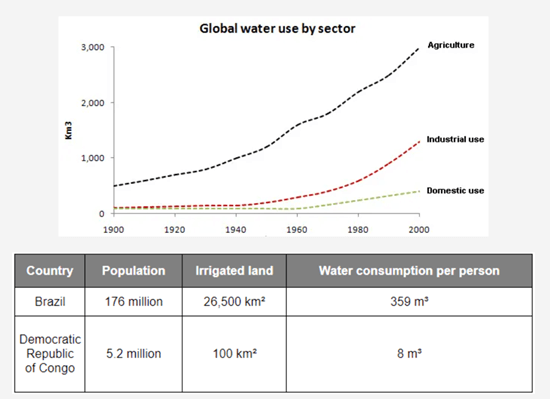
The graph and table below give information about water use worldwide and water consumption in two different countries. Summarize the information by selecting and reporting the main features and make comparisons where relevant.
...................................................................................................................................................
...................................................................................................................................................
...................................................................................................................................................
Part 4. Essay writing (30 p)
Some people think that a school teacher’s role is to motive and inspire students. However, others believe that a teacher’s primary role is to pass on knowledge.
What is your opinion?
Write an essay of 300 - 350 words to highlight your opinion on this matter. Give reasons and specific examples to support your opinion.
...................................................................................................................................................
...................................................................................................................................................
...................................................................................................................................................
THE END
................................
................................
................................
Xem thêm đề thi học sinh giỏi Tiếng Anh lớp 11 hay khác:
Đề thi học sinh giỏi Tiếng Anh 11 trường THPT Chuyên Bảo Lộc (Lâm Đồng) năm 2024
Đề thi học sinh giỏi Tiếng Anh 11 trường THPT Chuyên Lào Cai (Lào Cai) năm 2023-2024
Đề thi học sinh giỏi Tiếng Anh 11 trường THPT Chuyên Lê Hồng Phong (Nam Định) năm 2024
Đề thi học sinh giỏi Tiếng Anh 11 trường THPT Chuyên Lam Sơn (Thanh Hóa) năm 2024
Đề thi học sinh giỏi Tiếng Anh 11 trường THPT Chuyên Hùng Vương (Bình Dương) năm 2023-2024
Đề thi học sinh giỏi Tiếng Anh 11 trường THPT Chuyên Thái Nguyên (Thái Nguyên) năm 2024
TÀI LIỆU CLC DÀNH CHO GIÁO VIÊN VÀ PHỤ HUYNH LỚP 9
Bộ giáo án, bài giảng powerpoint, đề thi file word có đáp án 2026 tại https://tailieugiaovien.com.vn/
Hỗ trợ zalo: VietJack Official
Tổng đài hỗ trợ đăng ký: 084 283 45 85
 Đề thi vào 10 các sở Hà Nội, Tp. Hồ Chí Minh...
41 tài liệu
Đề thi vào 10 các sở Hà Nội, Tp. Hồ Chí Minh...
41 tài liệu
 Giáo án Word 9
95 tài liệu
Giáo án Word 9
95 tài liệu
 Đề thi giữa kì, cuối kì 9
254 tài liệu
Đề thi giữa kì, cuối kì 9
254 tài liệu
 Chuyên đề dạy thêm Toán, Lí, Hóa... 9
71 tài liệu
Chuyên đề dạy thêm Toán, Lí, Hóa... 9
71 tài liệu
 Đề thi HSG 9
8 tài liệu
Đề thi HSG 9
8 tài liệu
 Bài giảng Powerpoint 9
42 tài liệu
Bài giảng Powerpoint 9
42 tài liệu
Công cụ giáo viên (2048.VN)
Tạo- trộn đề thi miễn phí từ file PDF, Word, Giao bài nhanh chóng, Hoàn toàn Free
Bộ đề thi các lớp các môn học được Giáo viên nhiều năm kinh nghiệm tổng hợp và biên soạn theo Thông tư mới nhất của Bộ Giáo dục và Đào tạo, được chọn lọc từ đề thi của các trường trên cả nước.
- Đề thi lớp 1 (các môn học)
- Đề thi lớp 2 (các môn học)
- Đề thi lớp 3 (các môn học)
- Đề thi lớp 4 (các môn học)
- Đề thi lớp 5 (các môn học)
- Đề thi lớp 6 (các môn học)
- Đề thi lớp 7 (các môn học)
- Đề thi lớp 8 (các môn học)
- Đề thi lớp 9 (các môn học)
- Đề thi lớp 10 (các môn học)
- Đề thi lớp 11 (các môn học)
- Đề thi lớp 12 (các môn học)
- Giáo án lớp 1 (các môn học)
- Giáo án lớp 2 (các môn học)
- Giáo án lớp 3 (các môn học)
- Giáo án lớp 4 (các môn học)
- Giáo án lớp 5 (các môn học)
- Giáo án lớp 6 (các môn học)
- Giáo án lớp 7 (các môn học)
- Giáo án lớp 8 (các môn học)
- Giáo án lớp 9 (các môn học)
- Giáo án lớp 10 (các môn học)
- Giáo án lớp 11 (các môn học)
- Giáo án lớp 12 (các môn học)