20+ Đề thi học sinh giỏi Tiếng Anh 11 năm 2026 (có đáp án)
Tuyển tập Đề thi học sinh giỏi Tiếng Anh 11 có đán án, chọn lọc năm 2026 mới nhất giúp học sinh ôn tập và đạt kết quả cao trong bài thi HSG Tiếng Anh 11.
20+ Đề thi học sinh giỏi Tiếng Anh 11 năm 2026 (có đáp án)
Chỉ từ 200k mua trọn bộ đề thi HSG Tiếng Anh 11 bản word có lời giải chi tiết:
- B1: gửi phí vào tk:
1133836868- CT TNHH DAU TU VA DV GD VIETJACK - Ngân hàng MB (QR) - B2: Nhắn tin tới Zalo VietJack Official - nhấn vào đây để thông báo và nhận giáo án
Đề thi học sinh giỏi Tiếng Anh 11 trường THPT Chuyên Bắc Giang (Bắc Giang) năm 2024
Đề thi học sinh giỏi Tiếng Anh 11 trường THPT Chuyên Lê Quý Đôn (Điện Biên) năm 2023-2024
Đề thi học sinh giỏi Tiếng Anh 11 trường THPT Chuyên Huỳnh Mẫn Đạt (Kiên Giang) năm 2024
Đề thi học sinh giỏi Tiếng Anh 11 trường THPT Chuyên Bảo Lộc (Lâm Đồng) năm 2024
Đề thi học sinh giỏi Tiếng Anh 11 trường THPT Chuyên Lào Cai (Lào Cai) năm 2023-2024
Đề thi học sinh giỏi Tiếng Anh 11 trường THPT Chuyên Lê Hồng Phong (Nam Định) năm 2024
Đề thi học sinh giỏi Tiếng Anh 11 trường THPT Chuyên Lam Sơn (Thanh Hóa) năm 2024
Đề thi học sinh giỏi Tiếng Anh 11 trường THPT Chuyên Lê Khiết (Quảng Ngãi) năm 2024
Đề thi học sinh giỏi Tiếng Anh 11 trường THPT Chuyên Hùng Vương (Bình Dương) năm 2023-2024
Đề thi học sinh giỏi Tiếng Anh 11 trường THPT Chuyên Thái Nguyên (Thái Nguyên) năm 2024
Phòng Giáo dục và Đào tạo .....
Đề thi khảo sát Học sinh giỏi
năm 2025
Bài thi môn: Tiếng Anh 11
Thời gian làm bài: phút
(Đề số 1)
I. LISTENING (50 points)
Part 1. Listen to a talk about a chance to rethink the world and decide whether these statements are True (T), False (F) or Not Given (NG). Write your answers in the corresponding numbered boxes provided. (10 points)
1. Deserts make up nearly one-third of Earth's total landmass and can be found on all seven continents.
2. Subtropical deserts, located along the equator, experience nighttime temperatures that can reach up to 120 degrees Fahrenheit.
3. Semi-arid deserts are typically formed through the rain shadow effect caused by tall mountain ranges blocking moisture.
4. The saguaro cactus has long and shallow root systems to efficiently absorb minimal moisture present in the desert ground.
5. Desertification is an irreversible process primarily driven by deforestation and poor agricultural practices in affected regions.
Part 2: For questions 6-10, listen to the recording and answer the questions. Write NO MORE THAN THREE WORDS AND/OR A NUMBER taken from the recording. (10 points)
6. What process is facilitated by the lungs during breathing?
______________________________
7. Where does air from the nose and mouth get delivered to?
______________________________
8. What structures in the lungs end in alveoli?
______________________________
9. Through what do oxygen and carbon dioxide pass in the alveoli?
______________________________
10. What type of design helps the lungs stay strong?
______________________________
Part 3. For questions 11-15, listen to a conversation about laughter therapy. Choose the correct answer A, B, C or D which fits best according to what you hear. Write your answers in the corresponding numbered boxes provided.
11. What do Stella and Rick see as the main explanation for the popularity of what are called ‘laughter clubs?’
A. They allow people to share their problems with others.
B. They don’t require people to make a long-term commitment.
C. They are a cost effective way for people to access professional help.
D. They appeal to people who may be sceptical about other forms of therapy.
12. Rick feels that the main role of a laughter therapist is to _____________.
A. ensure that people get sufficient rest and relaxation.
B. help people to escape from one pattern of behaviour.
C. make people aware of the consequences of depression.
D. investigate the causes if people’s emotional problems.
13. What does Rick regard as the principal benefit of the laughter therapy session he runs?
A. They enable people to feel less inhibited.
B. They stop people taking life too seriously.
C. They give people a good physical workout.
D. They encourage people to form lasting bonds.
14. Rick’s interest in laughter therapy initially arose from _____________.
A. first-hand experience of another method.
B. participation in his wife’s group sessions.
C. a desire to help his clients more effectively.
D. his mistrust of other alternative approaches.
15. Why does Rick tell us about a client who had problems giving presentations?
A. to suggest an alternative remedy for work-related stress.
B. to highlight the way in which essential oils affect the senses.
C. to show how stress can affect a person’s level of performance.
D. to support Stella’s point about making time for certain activities.
Part 4: For question 16-25 listen to the recording and then complete the summary below by writing NO MORE THAN THREE WORDS AND/OR A NUMBER for each answer. Write your answers in the corresponding numbered boxes provided. (20 points)
- The proposed opening of the new Burger World has provoked strong (16) _____________ in the local community.
- Mr. Brownlea thinks it will harm the young people and the local (17) _____________.
- He would prefer a new restaurant offering (18) _____________.
- He admits that Burger World prices are (19) _____________.
- He believes that fast food chains are causing the disappearance of food (20) _____________ around the world.
- Mrs. Masters argues that preventing the new outlet’s opening in Manley will not (21) _____________ of changing food habit worldwide.
- Mr. Brownlea is worried that the new fast food will increase the problem of (22) _____________.
- This will make older residents feel (23) _____________.
- Mrs. Masters feels that it will be beneficial for young people to use Burger World as a (24) _____________.
- She believes the new restaurant will boost the (25) _____________ of the town.
II. LEXICO- GRAMMAR (30 points)
Part 1. For questions 26-45, choose the correct answer A, B, C, or D to complete each of the following questions. Write your answers in the corresponding numbered boxes provided. (20 points)
26. The CEO's decision to step down came as a _____________ to everyone in the company.
A. revelation
B. cataclysm
C. debacle
D. conundrum
27. Despite his _____________ efforts, he couldn't secure the deal.
A. concerted
B. sporadic
C. haphazard
D. meticulous
28. The team's _____________ victory in the championship surprised everyone.
A. emphatic
B. lackluster
C. tentative
D. ambivalent
29. It's crucial to _____________ a balance between work and personal life for overall well-being.
A. hit
B. strike
C. beat
D. clash
30. The CEO's speech was _____________ with optimism about the company's future.
A. fraught
B. laden
C. filled
D. fraught
31. The new law imposes _____________ restrictions on freedom of speech.
A. draconian
B. lenient
C. stringent
D. permissive
32. Despite the team's best efforts, their attempts to secure the deal went down in _____________.
A. flames
B. smoke
C. water
D. dust
33. She realized that trying to change his mind was a _____________ cause.
A. lost
B. doomed
C. hopeless
D. forsaken
34. She has been working on this project for months and now she wants to abandon it. Talk about throwing in the _____________.
A. towel
B. sponge
C. napkin
D. cloth
35. The defendant's alibi was shaky at best; it was a house of _____________.
A. straw
B. sand
C. cards
D. glass
36. The politician's promises were nothing more than _____________ in the eyes of the skeptical public.
A. panacea
B. rhetoric
C. actuality
D. candor
37. The scientist's groundbreaking discovery turned conventional wisdom on its _____________.
A. axis
B. foundation
C. head
D. end
38. She was warned not to count her chickens before they hatched, but her _____________ nature led her to make premature plans.
A. impetuous
B. frivolous
C. audacious
D. tempestuous
39. He was known for his candor, never shying away from _____________ even the most sensitive issues.
A. excoriating
B. obfuscating
C. broaching
D. repudiating
40. Sheila was known for her sharp wit and ability to cut to the _____________ in any conversation.
A. chase
B. heart
C. bone
D. core
41. Despite their best efforts, the committee was unable to come to a(n) _____________ on the controversial issue.
A. concession
B. consensus
C. compromise
D. confrontation
42. The company's success can be attributed to its ability to stay ahead of the _____________ in technology.
A. competition
B. curve
C. trend
D. wave
43. The team's performance this season has been a rollercoaster ride, full of _____________ victories and unexpected losses.
A. crushing
B. decisive
C. resounding
D. staggering
44. The chef’s _____________ with rare spices gives her dishes a distinctive flavor.
A. fondness
B. infatuation
C. obsession
D. penchant
45. The company’s decision to downsize was a _____________ to its reputation as a stable employer.
A. bane
B. boon
C. reprieve
D. debacle
Part 2. For questions 46-55, write the correct form of each bracketed word in each sentence. Write your answers in the boxes provided. (10 points)
46. The implementation of comprehensive _____________ frameworks is crucial for ensuring the stability and integrity of financial markets. (REGULATE)
47. The new therapeutic approach proved _____________ in treating previously resistant cases of the autoimmune disease. (EFFICACY)
48. After years of legal disputes, the mediator finally _____________ the complex web of conflicting interests among the stakeholders. (TANGLE)
49. The museum's latest exhibition will _____________ rare artifacts from ancient civilizations, providing a comprehensive insight into their cultural and historical significance. (SHOW)
50. Her _____________ victory in the election reflected widespread support and marked a significant turning point in local political dynamics. (SOUND)
51. The restaurant offers _____________ vouchers for loyal customers, which can be used towards future dining experiences or special promotions. (DEEM)
52. The scandalous tabloid article was criticized for its blatant _____________, crossing ethical boundaries and causing public outrage across the community. (DECENT)
53. The _____________ agreement allowed for immediate implementation of the project pending final approval from the board. (VISION)
54. It would be _____________ to overlook his achievements based on a single mistake in judgment. (COMMEND)
55. The _____________ advancements in quantum computing have the potential to revolutionize fields such as cryptography and materials science. (MIND)
III. READING (60 points)
Part 1. For questions 56 – 65, read the passage and fill each of the following numbered blanks with ONE suitable word. Write your answers in the boxes provided. (15 points)
Globalization is not a wholly new phenomenon. Empires throughout history have sought to extend their dominion and influence (56) _____________ their immediate horizons. European colonialism reflected a similar imperialist impulse, inaugurating political, social, economic and cultural imbalances that have persisted into the new millennium. Yet contemporary globalization is (57) _____________ a different order to such historical anticipations. Recent decades have witnessed an (58) _____________ enmeshment of national economies and cultural expressions, (59) _____________ rise to new challenges and opportunities. Communication networks have shrunk or abolished distance, to the (60) _____________ of some and the exclusion of others. Travel has never been so rapid and convenient, while remaining beyond the (61) _____________ of many. In a world in which the possibilities of intercultural contact have multiplied, linguistic diversity and many other forms of cultural expression are in decline. How then is globalization to be viewed in (62) _____________ of its impacts on cultural diversity?
Globalization is often conceived as potentially antithetical to cultural diversity, in the (63) _____________ of leading to the homogenization of cultural models, values, aspirations and lifestyles, to the standardization of tastes, the impoverishment of creativity, uniformity of cultural expressions and so (64) _____________. The reality, however, is more complex. While it is true that globalization induces forms of homogenization, it cannot be regarded as inimical to human creativity, which continues to engender new forms of diversity, constituting a perennial challenge to featureless (65) _____________.
Part 2: For questions 66-75, read the following text and choose the correct answer A, B, C or D. Write your answers in the boxes provided. (10 points)
Multiple-intelligence (Ml) theories have emerged for two reasons. First, many psychologists reject the notion that IQ tests accurately assess general intelligence or measure a person's full intellectual capacity. Second, the common belief that IQ predicts success in both academic and professional spheres has led researchers to suspect that there may be even better predictors. For these reasons, US psychologists Howard Gardner and Robert Sternberg have proposed two different theories based on the idea of multiple intelligences.
Gardner argues that IQ testing is too limited with its focus on verbal and logical skills. He claims that this narrow view of intelligence leads to the labeling of truly gifted people as underachievers. Moreover, he points out that these "underachievers" do not benefit from the advantages a high [Q score may provide. Such benefits include positive evaluations by schoolteachers aod employment in fitms where IQ screening is part of the application process. In addition, IQ-equivalent entrance exams such as the Scholastic Achievement Test (SAT) effectively qualify students for college and university programs in the US.
Gardner's MI theory is based on brain research. Through an extensive study of braindamaged individuals, he mapped nine regions of the brain and found that each governed specific areas ofintellectual behavior. Accordingly, he related each brain region to one of his nine proposed intelligences. These include verbal, logical-mathematical, musical, visual, bodily-kinesthetic, interpersonal, intrapersonal, naturalistic, and existential intelligence. The esteemed psychologist explains that individuals possess the aptitude for all nine but that each person has a specific intelligence profile. That is, most people are strong in about three areas.
These strengths also reflect preferred working styles and career direction for individuals. For instance, people with verbal intelligence are more naturally suited to professions such as journalism or language instruction. On the other hand, those with mathematical or logical intelligence may find satisfaction in fields like engineering or science. Individuals who display musical intelligence make skiUed composers or conductors; those with bodily intelligence excel as dancers or athletes; and those with spatial intelligence shine in artistic fields. People who have interpersonal intelligence gravitate toward positions requiring people skills, whereas those with self-awareness perform well as counselors or entrepreneurs. Darwin, famous for his theory ofevolution, was an example ofa person with ample naturalistic intelligence. Likewise, Aristotle, the well-known philosopher, possessed existential intelligence in good measure.
Based upon social and environmental-rather than neurological factors. Sternberg's Theory ofSuccessfitl Intelligence includes three sub-intelligences: analytic, creative, and practical. Analytic intelligence involves skill in analyzing ru1d evaluating various options. It refers to the ability to perform academic problem-solving tasks that have one correct answer, much like those found on standard IQ tests. People with analytic intelligence often do well in school and are thus considered "book smart.'' In contrast, those with creative intelligence have the means to generate unique but appropriate solutions to novel problems. An individual with creative intelligence can often resolve one issue in a variety ofacceptable formats. These people are "idea smart.'' Art, music, and even inventive business solutions are all products of creative intelligence. Finally, people with practical intelligence or "street smruts" have the ability to successfully deal with everyday problems. They learn what they need to know in order to adapt to their environments. One study cites Brazilian children who used practical intelligence in learning all ofthe math needed to operate their street business. Interestingly, they failed their school math exams and would likely receive low scores on a typical IQ test.
Sternberg describes successful intelligence as the power to achieve a personal definition of success within a specific social and cultural milieu. (A) He explains that analytic intelligence or IQ does a good job at measuring academic achievement but that the ability to generate ideas and plain common sense play a much more significant role in the real world. (B) In his view, success begins with an assessment ofpersonal strengths and weaknesses. (C) Afterwards, a person needs to use this knowledge to make the most oftheir strengths and overcome limitations in order to create optimal life circumstances within a particular environment. (D)
66. According to paragraph l, what do many cognitive psychologists believe about IQ tests?
A. They measure a person's general intelligence.
B. They are too limited in their focus.
C. They don't represent the entire range of intelligence.
D. They should be adapted to assess multiple intelligence
67. According to paragraph 1, the word professional is closest in meaning to _____________.
A. authoritative
B. career
C. practiced
D. qualified
68. According to paragraph 2, what can be inferred about university entrance exams?
A. They are required by all colleges and universities.
B. Each school has its own entrance exam.
C. They attempt to measure intelligence.
D. They are the same as employment screening exams.
69. According to paragraph 2, why does the author mention positive evaluations by school teachers and employment?
A. To provide examples regarding the benefits of a good IQ test result
B. To illustrate how academic and professional success are related to IQ
C. To show how truly gifted individuals are labeled as underachievers
D. To demonstrate the common use of IQ testing in academic and professional spheres
70. According to paragraph 3, why did Gardner propose nine intelligences?
A. Over time, he came to realize his original estimate of seven intelligences was incorrect.
B. Each one corresponded to a different brain-damaged individual he studied.
C. In studying a map ofthe brain, he learned there were a total of nine separate regions.
D. They related to nine different areas of the brain
71. According to paragraph 3, the word each refers to _____________.
A. brain
B. individual
C. region
D. study
72. According to paragraph 4, the word gravitate is closest in meaning to _____________.
A. generate
B. move
C. descend
D. waffe
73. According to paragraph 5, why does the author mention neurological factors?
A. To demonstrate that Gardner's theory has a sounder basis than Sternberg's.
B. To clarify that Gardner and Sternberg have little in common.
C. To show that social and environmental factors are more important than neurological factors.
D. To emphasize that Sternberg's theory has a different basis from Gardner's.
74. According to paragraph 5, what is true regarding solutions that require creative intelligence?
A. They apply primarily to the realms of art and music.
B. They involve adapting to the environment in novel ways.
C. They often have more than one answer.
D. Answers are typically not found in books.
75. Look at the four gaps that indicate where the following sentence could be added to the passage.
Creating a list of specific abilities and individual short comings would be extremely helpful.
Where would the sentence best fit?
(A) (B) (C) (D)
Part 3. For questions 76 - 88, read the following passage and do the tasks that follow. (13 points)
The Fort Berthold Reservation in western North Dakota is a vast area where advances in drilling and extraction technology have made it possible to remove oil from deep, widely dispersed deposits. Since early 2006. production from what's known as the Bakken formation has increased nearly 150-fold, to more than 660,000 barrels a day, moving North Dakota into second place among US states, ahead of Alaska.
No one but a handful of industry insiders saw that coming. Now some optimistic oilmen predict that the state's daily output could eventually close in on that of Texas - at two million barrels. The number of wells could increase from the roughly 8,000 operating today to between 40,000 and 50,000. By the time the frenzy ends, perhaps 20 years from now, as many as 14 billion barrels of high-quality crude may have been removed. Until more pipelines are built in this landlocked rural region, most of the oil and water will be transported by truck. So will everything else needed for swift, large-scale development: gravel, construction materials, tools, machinery. The prairie is being industrialised.
Change of such scope and intensity is bound to raise questions. Thousands of people are converging on the area, looking for work, looking for redemption, looking for trouble. And jobs are plentiful. In Williston, in the heart of the oil patch, the unemployment rate is less than one per cent. But how does a region of farms weather the human onslaught? Another risk is environmental damage. Most attention has focused on hydraulic fracturing, or fracking, by which large amounts of fresh water combined with sand and smaller amounts of other substances, some toxic, are driven under high pressure down wells drilled into deep layers of shale, creating cracks through which bubbles of trapped oil and natural gas can escape into the well. Where will all the clean water come from? How will the dirty water that's pumped out be prevented from contaminating groundwater, as has happened in other parts of the country? Stepping back for a broader view, can the inestimable values of the prairie - silence, solitude - be preserved in the face of full-throttle, regionwide development, of extracting as much oil as possible as fast as possible?
The implications are already reverberating far beyond North Dakota. Bakken-like shale formations occur across the US, indeed, across the world. The extraction technology refined in the Bakken is in effect a skeleton key that can be used to open other fossil fuel treasure chests.
North Dakota has boomed before, in the 1950s and 1980s. But besides being much larger and likely to last much longer, the current boom differs from earlier ones because it initially coincided with an economic recession. For refugees from its ravages, the Bakken is a chance - often the last chance - to escape ruin.
So it was for truck driver Susan Connell. While we head for the disposal site on a two-lane highway chewed up by truck traffic, she describes how she came to be behind the wheel of a Kenworth Anteater. The trouble started in 2009, when she and her husband could no longer find construction work in south-western Montana, where they still live. By the fall they were three months behind on their house payments. The bank sent threatening letters. Then Connell heard that truckers were needed in North Dakota. Earlier in her career, the Delaware native had driven a commercial bus between Philadelphia and Atlantic City, also an airport transit bus in Portland, Oregon. How much harder could an 18-wheeler be? But to qualify she would have to upgrade her licence, and for that she would need to attend a special training program. Cost: $4,000. At a time when Connell and her husband could scarcely buy groceries for their kids, they charged the fee to a credit card. 'It was a big gamble,' she says, referring less to the likely availability of work than to the reception she would almost certainly get in such a male-dominated environment.
Trucking is one of the most lucrative enterprises in North Dakota. Driving an 18-wheeler tank truck can bring in $40,000 a month - if everything goes right. One night during the training program in early April 2011, waiting out the 'umpteenth blizzard' of the season with two dozen oil and water drivers at a gas station in Parshall, Connell insinuated herself into conversations, inquiring about jobs and collecting phone numbers of trucking firms. Someone asked her where she'd abandoned her vehicle. It turned out that Connell, the only female driver in the room, was also the only one who hadn't gone off the road during the storm. One of the guys, the owner of a small water-hauling company based in Killdeer, was so impressed he cold-called and offered her a job next day. Her pay jumped from $600 a week to $2,000. There would be no more worrisome letters from the bank. She'd saved the family house.
Complete the table below.
Choose NO MORE THAN THREE WORDS from the text for each answer.
Fracking in North Dakota
|
US state which currently produces more oil: |
76. _____________ |
|
Estimated daily amount of oil that Dakota might eventually produce: |
77. _____________ |
| Key type of infrastructure currently lacking in the region: |
78. _____________ |
|
Traditional economic activity of the region: |
79. _____________ |
|
Main material introduced into wells during fracking: |
- water - 80. ____________ |
|
Name given to the waste material produced: |
81. _____________ |
Do the following statements agree with the information given in the text? Write
TRUE if the statement agrees with the information
FALSE if the statement contradicts the information
NOT GIVEN if there is no information on this
82. Extraction of oil from shale is likely to spread to other areas.
83. North Dakota is seeing rapid economic development for the first time.
84. Susan Cornell sold her home in order to move to North Dakota.
85. Susan has recently trained as a professional driver.
86. Susan found her special training course more challenging than she expected.
87. Susan was concerned about whether she would be accepted by other drivers in the industry.
88. Susan had to do a bad weather driving test as part of her job application.
Part 4: In the passage below, seven paragraphs have been removed. For questions 89-95, read the passage and choose from the paragraphs A-H the one which fits each gap. There is ONE extra paragraph which you do not need to use. Write your answers in the corresponding numbered boxes provided. (7 points)
It’s a cold, frosty morning in Marchton and all over town men and women of all ages and backgrounds are rising bright and early, eaderly leaving behind their dream-filled slummer. No hitting the snooze button for them; no snuggling under warm blankets begging in muffled drowsiness for “just five more minutes ...” These are people filled with a sense of purpose, spurred on by a sense of loyalty to routine and in turn rewarded with a ready flow of endorphins.
|
89. |
Specifically, I’m referring to the ninety members of the new fitness club situated in central Marchton. Not only are these participants given the opportunity to attend a wide variety of fitness classes or follow personal fitness programmes in state-of-the-art weight rooms, but they also have at their disposal two heated swimming pools and four squash courts, from which a choice can be made by even the most amateur of budding fitness hopefuls. So how do you join?
|
90. |
However, as beneficial and tempting as all this may sound, it’s really no good if you have little or no staying power. Getting back to the current members, I quite simply posed the following question: how does one manage to get fit and then stay fit? What folk of mettle keep going and persevere throughout snowy January, drizzly April, and lazy August ...?
|
91. |
It almost seems unfair, doesn’t it, such a decision first thing in the morning! We may be faced with that early morning state of drowsiness, but this is where the fight for fitness is either won or lost. It requires strength of mind long before you concern yourself with matters of the body. For beware! As you awake, a little voice suggests to you from your pillow that you don’t really have to get up early and go to the gym ... just five more minutes ...
|
92. |
Sadlly now added that although it takes 30 days to make a habit, it takes just three to break it. Missing one workout makes it all too easy to miss the next one ... and the one after that. Soon enough it seems acceptable to be going once a week nstead of three tomes and then you’re just around the corner from joining once-a-month crowd. Before you know it you have reached the point of no return and daren’t show your face at that ‘wretched place’.
|
93. |
Well, don’t lose heart. Do you realise that nobody in fact ever feels like working out? It doesn’t matter who you are, those first five minutes on the treadmill are always a killer. It’s around the middle of your workout that you start to get into the swing of things and maybe even enjoy it, and by the end you feel like you could conquer the world!
|
94. |
Needless to say, however, there are a few instances when you should miss a workout and it’s very important to listen to what your body is telling you. It is also seriously unwise to take up any form of strenuous physical activity without first consulting your general practitioner. Equally, you should provide your personal fitness trainer with details of your medical history so you can be advised accordingly on a suitable fitness programme.
|
95. |
Whatever you age or health condition, however, the same message seems to be loud and clear; some form of physical activity is essential if we are to lead productive, fulfilling, stress-free lives.
Missing Paragraphs:
A Marchton Sport Club boasts two types of annual membership that offer a wide range of facilities depending on personal preference, making it the most versatile fitness membership in the southwest. Options are also available for weekly or monthly passes, in addition to student and OAP concessions. There are also many specialised programmes if you want to try out something more specific or trendy like yoga, weight-watchers of ‘parents and babies’. It sounds attractice, doesn’t it?
B The center is our largest and newest facility, offering everything that a private club might provide including cafeterias, a four-star restaurant and conference rooms. These amenities are well above the standard to which provincial towns have previously been accustomed, and I would recommd taking up membership to anyone interested in the well-eing of Marchton.
C The Director reassures us that, should someone feel distressed or unwell during a training session, this is promptly communicated to a club representative, and that there are always qualified nursing staff on hand ready to administer first aid if the need arises.
D Now everybody knows that it’s good to work out ... that we should work out. But who are these people who actually partake in the ritual? How can they have so much energy, so little stress, and why don’t they look like super-models? Well, they are in fact no more than normal, everyday people, to whom some refer as ‘the chosen ones’ or to be more precise ‘the ones who have chosen’ – chosen to live a healthy balanced lifestyle by exercising on a regular basis.
E But this is precisely the moment when you need to insist in no uncertain terms that such a suggestion is plainly ridiculous, and has been so from the day on which you purchased that membership! Believe it or not, this is one battle that is won in the bedroom and if you can just make it out of bed, (or out of the office or out of the house, depending on what time of day you prefer ...) you’re halfway there!
F Says Sally, one such persevering member: “Well, to help you keep that new habit fresh, you need a frame of mind that should help you to stay on track and discover a lifetime fitness freedom. I think the key moment comes as soon as the alarm goes off. This is when the decision is made, in those first seconds of early morning when the sub-conscious is grinding its gears and facing the first challenge of the day: getting our of bed. You must be tough with yourself.”
G There’s a reason for that which I’ve already mentioned, and they’re called ‘endorphins’. They result from a chemical reaction that takes place in your body after your workout and their main purpose if ... to make you feel good! This is a hormone whose soel function is to create a feeling of well-being. In other words, it’s your body’s way of thanking you for taking care of it.
H “If you do miss one morning, don’t berate yourself, just go the next day,” she says. “What you need to be telling yourself is this: okay, this is it. I am choosing right now to have an active lifestyle.” So, are we really up to it? We live after all in a world of ease where physical activity is avoided, even shunned. Imagine the TV without the remote, going any distance on foot or even carrying the supermarket shopping all the way home. Is there really anyone who wants to work out that much?
Part 5. For questions 96-105, you are going to read an article about the future of genetic engineering. Choose from the sections (A-E) the correct answer to each of the question. The sections may be chosen more than once. Write your answers in the corresponding boxes provided. (15 points)
A. Samuel
It's a common misconception that those of us who have jobs which involve clocking up air miles are the lucky ones. There is nothing worse than spending countless nights in a string of faceless hotels, because no matter what the standard is, they are still totally devoid of that essential element of homeliness which is present in your own environment or even when being put up by friends. The night-time accommodation is only one of the aspects of imposed travel that I abhor. I always travel Business or First, the intention being that I lose no unnecessary time catching up on sleep and the dramatic shifts from day to night have minimal impact on my sleep patterns. But no level of comfort can compensate for regular sleep! There is no way round the fact that if on a weekly basis you change time zone four times, - and we're not talking just a couple of hours' time difference -you are going to feel and see the side effects. Bloating, bad skin, hormonal imbalances, not to mention fatigue. Added to that, the disagreeable reality that office work left behind has to be dealt with on my return. No, when my holiday comes round, the prospect of an exotic destination holds zero appeal. I'd rather cycle round the park.
B. Phoebe
I'm definitely a traveller, not a tourist. My ultimate aim when seeking new travel experiences is to expand my understanding of different cultures. To that end, hotels are out for me. I don't care much for them anyway and on the kind of budgets that I move around on, they are not really accessible. I tend to find accommodation with local families; that way I get a better understanding of the real people, their habits, customs and the accepted forms of behaviour for me and them. It also allows exposure to language in a different way. I might hear unrestricted slang used in a real context. You'd never find that in a language learning book. Language and culture are my passion and the more I travel, the more I see connections. It's true we are all somehow connected. I would never have realised half of these things from reading books. I've worked with small indigenous communities on four continents and in ten different countries. Every single experience has been unique, precious and taught me something new about myself. It's a cliche, but travel really does broaden the mind.
C. Myriam
Destination is of little importance, what matters to me is the setting when I reach it. Coastal, hot, clean, luxurious, those are the boxes that must be ticked. Aside from that, it really is irrelevant. My requirements are a holiday involving relaxation, comfort and security. I go away up to three times a year but always on all-inclusive deals which offer good value for money. The prospect of leaving the resort or complex holds no appeal for me. Do I sound ignorant, uncultured, chauvinistic even? Not at all, I'm a working mum! My everyday life is a hellfire of fatigue and a relentless treadmill of activities. When I get my time off, all I want to do is put my feet up and enjoy the cocktails, no visiting, cooking, cleaning, worrying. The kids love the kids' clubs and I love the sun. When I come to the end of my holidays, I feel rested and ready to go again. I have friends who holiday independently with their offspring, only to come back and need a week's recovery period. What's the point of that? Holidays are for unwinding. Try out my tried-and-tested formula before you criticise.
D. Marvin
Honesty seems to have come with age. Were I absolutely truthful with myself, then I would admit that any holiday or trip is always greatly improved by hindsight. When I look back at photos or read my travel diary or discuss experiences with old travelling companions, I realise that the memories are better than the actual reality. Travelling is tiresome. Flying is exhausting. Constantly making whimsical decisions on what to visit, where to eat, how to choose is irritating because you feel a constant pressure: Is this the right thing to do? Are we missing something? Are we being swindled or taken for a ride? All these insecurities of the traveller are swept away when we think back, but when we're living them, we ask ourselves why we took steps to immerse ourselves in an alien culture, with an alien language and peculiar customs. Perhaps it's because we want to force ourselves to battle with new experiences and manage, or maybe it simply serves as a point of reference from which we can safely conclude that home is best and we are truly lucky. Travel is an essential part of life, if only to see what we are not missing.
Which person expresses each of these opinions about travel?
96. ______________ Travel undertaken through necessity is never pleasurable.
97. ______________ Staying with friends is preferable to hotel accommodation.
98. ______________ Extensive travel takes its toll on the body.
99. ______________ Holidays are pointless if you can't recharge your batteries.
100. _____________ Travel is a truly educational exploit.
101. _____________ The logistics of travel are rarely enjoyable.
102. _____________ Travel makes us appreciate our lot.
103. _____________ It must provide respite from the daily grind.
104. _____________ It is a means to encounter unusual minority groups.
105. _____________ Not showing an interest in other cultures is frowned upon.
IV. WRITING (60 points)
Part 1. Read the following extract and use your own words to summarize it. Your summary should be between 100 and 120 words. (15 points)
The world’s consumption of fossil fuels climbed to a record high last year, driving emissions to more than 40 gigatonnes of CO2 for the first time, according to a global energy report. Despite a record rise in the use of renewable energy in 2023, consumption of fossil fuels continued to increase too, an annual review of world energy by the Energy Institute found. Juliet Davenport, the president of the Energy Institute, said the report had revealed “another year of highs in our energy-hungry world” including a record high consumption of fossil fuels, which rose by 1.5% to 505 exajoules. The findings threaten to dash hopes held by climate scientists that 2023 would be recorded as the year in which annual emissions peaked before the global fossil fuel economy begins a terminal decline. The Energy Institute, the global professional body for the energy sector, found that while energy industry emissions may have reached a peak in advanced economies, developing economies are continuing to increase their reliance on coal, gas and oil. Overall, fossil fuels made up 81.5% of the world’s primary energy last year, down only marginally from 82% the year before, according to the report, even as wind and solar farms generated record amounts of clean electricity. The report, authored by consultants at KPMG and Kearney, found that wind and solar power climbed by 13% last year to reach a new record of 4,748 terawatt hours in 2023. But that was not enough to match the world’s growing consumption of primary energy, which rose 2% last year to a record high of 620 exajoules and led to more fossil fuel use. The review found that the world’s appetite for gas remained steady in 2024 while consumption of coal climbed by 1.6% and oil demand rose by 2% to reach 100m barrels a day for the first time. Simon Virley, the UK head of energy and natural resources at KPMG, said: “In a year where we have seen the contribution of renewables reaching a new record high, ever increasing global energy demand means the share coming from fossil fuels has remained virtually unchanged at just over 80% for yet another year.” Nick Wayth, the Energy Institute’s chief executive, added that the “slow” progress of the energy transition “masks diverse energy stories playing out across different geographies”. “In advanced economies, we observe signs of demand for fossil fuels peaking, contrasting with economies in the global south for whom economic development and improvements in quality of life continue to drive fossil growth,” said Wayth. The report found that, in India, fossil fuel consumption climbed by 8% last year, matching the increase in overall energy demand to make up 89% of all energy use. This meant that, for the first time, more coal was used in India than Europe and North America combined, it said. In Europe, fossil fuels fell to below 70% of primary energy use for the first time since the Industrial Revolution, driven by falling demand and the growth of renewable energy. Europe’s demand for gas in particular has continued to tumble since Russia’s full-scale invasion of Ukraine in 2022, which caused pipeline gas imports into Europe to collapse. Overall gas demand fell by 7% in 2023, according to the report, after a fall of 13% the previous year.
..................................................................................................................................
..................................................................................................................................
..................................................................................................................................
..................................................................................................................................
Part 2. The chart show the album sales in the USA in 2020 and data on BTS top hits streams worldwide in March 2020. Summarize the information by selecting and reporting the main features, and make comparisons where relevant.
Write at least 150 words.
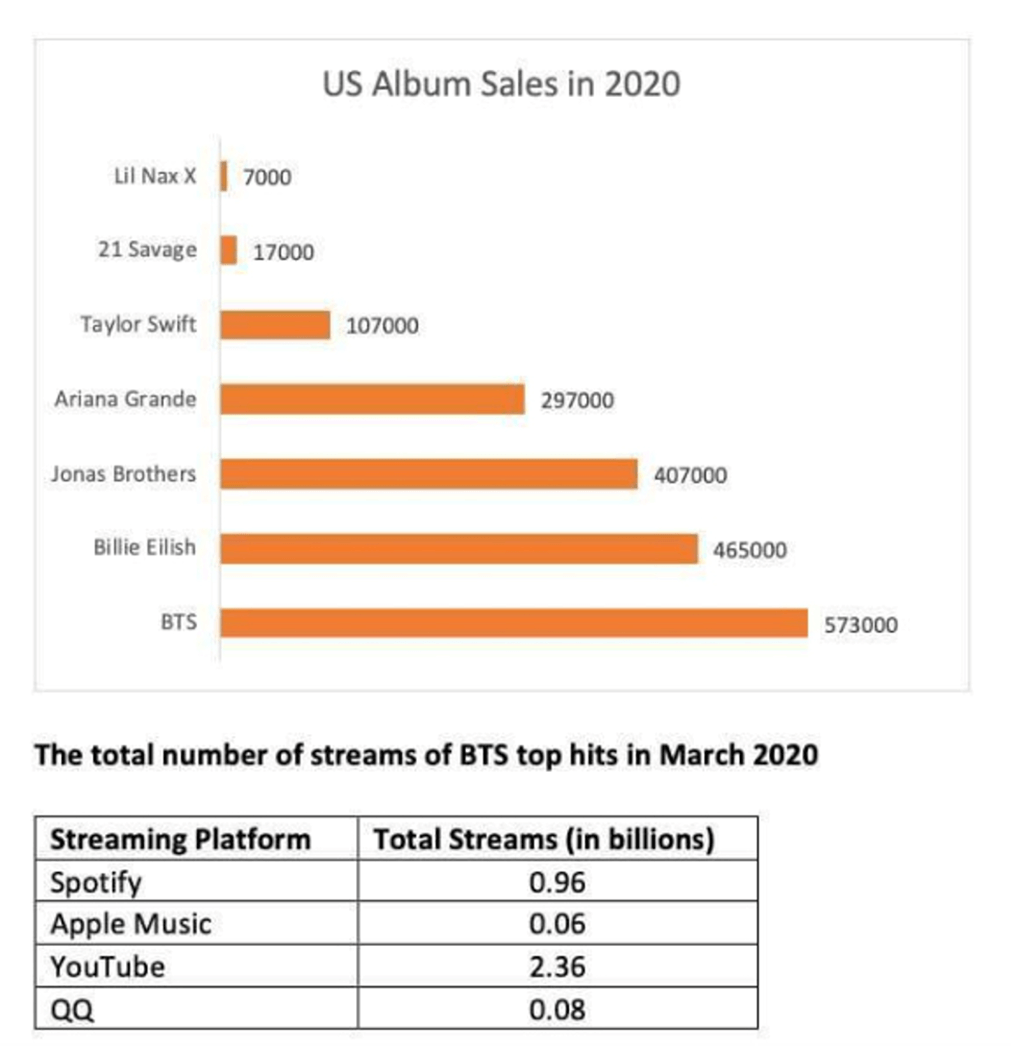
..................................................................................................................................
..................................................................................................................................
..................................................................................................................................
..................................................................................................................................
-------------- HẾT --------------
(Thí sinh không được sử dụng tài liệu. Cán bộ coi thi không giải thích gì thêm.)
Phòng Giáo dục và Đào tạo .....
Đề thi khảo sát Học sinh giỏi
năm 2025
Bài thi môn: Tiếng Anh 11
Thời gian làm bài: phút
(Đề số 2)
SECTION 1: LISTENING (50 points)
Part 1: For question 1-5, listen to the recording and decide whether the following statements are true (T) or false (F). Write your answers in the corresponding boxes provided.
1. Circular reporting mainly bases on the primary evidence or source.
2. Not all the information on Wikipedia is true
3. A rise in the quantity of children affected by childhood illnesses like measles
4. Should verify the reliability of the original source to ensure it is not merely sourced from platforms like Wikipedia, Facebook, or the media.
5. Checking the sources of information is necessary
Part 2: For questions 1-5. You hear a conversation between a father and his son. Choose the correct answer (A, B, C or D) which fits best according to what you hear.
1. In what way does the father admit to being mistaken?
A. He was surprised how he was able to stay resolute for the benefit of his family.
B. What happened between the two men was in direct contrast to what he had expected to happen.
C. He thought his own children would have taken the news in a considerably worse fashion.
D. The effect that the incident had on him was more severe than he thought it would be.
2. What view does the son express towards his father?
A. Despite the incident he should have been more attentive to the needs of his children during the ordeal.
B. That he has the ability to process matters such as a death in an admirable way.
C. How he regrets the manner in which he reacted to the incident with his mother.
D. That the father is considered to be a stoic character.
3. What change in behavior does the father recognise after his wife's emergency?
A. He quickly became emotionally withdrawn from the rest of his family.
B. He started to develop relationship issues outside of his personal relationships.
C. He started to become observant of members of his own family.
D. He noticed how he became more emotionally dependent on others from this time.
4. What is the biggest loss according to the father?
A. An inability to do the activities that they felt brought them closer.
B. A loss of how the two are able to interact with one another.
C. Their ability to experience their golden years in a state of rest and relaxation.
D. The loss of being in contact with others outside of the family.
5. To what does the father confess?
A. That he is emotionally damaged by trauma and continuing hardships of caring for a stroke victim.
B. That he is overcome with guilt as he feels he is inadequately able to care for his wife.
C. He is concerned as to how his proposal to hire professional help will be perceived by the rest of the family.
D. He lacks the ability to manage the situation without the aid of others.
Part 3: For questions 1-5. Listen and give short answers to the questions. Write NO MORE THAN THREE WORDS AND/OR A NUMBER taken from the recording.
1. What is the aim of the national charity community mentioned?
………………………………………………………………………..
2. Who was the first to describe the development of phobic behavior systematically?
………………………………………………………………………..
3. When does the onset of social phobias typically occur?
………………………………………………………………………..
4. What physiological factors contribute to social anxiety?
………………………………………………………………………..
5. Where can individuals find details of local events and counseling?
………………………………………………………………………..
Part 4: For questions 1-10. Listen to a piece of BBC news about Popping knuckles and fill in the missing information. Write NO MORE THAN THREE WORDS taken from the recording for each answer in the spaces provided.
POPPING KNUCKLES
If you pop or crack your (1) _______________, you probably do. What happens to our joints when we crack them? And is it bad for you? (2) _______________ in this (3) _______________ that’s found in between your joints. It kind of looks like an (4) _______________. So as you stretch out your joint, you're releasing gas, which generates a bubble that compresses and busts. To break the same knuckle again, you must wait around 20 minutes for the gas to return to the fluid. So, how does that vary from the pop you hear when you stand up suddenly? The sound you’re probably hearing then is the (5) _______________ make when sliding between muscles or over bones. When a joint moves, the tendon snaps quickly over, producing a popping sound. So, is the knuckle-cracking habit safe? Donald Unger was most likely a (6) _______________ who chose to pop the joints in one hand for 60 years but not the other. And he wanted to find out if popping your knuckles would actually give you (7) _______________. After 60 years of doing it, he found that he didn’t have any more arthritis in one hand than in the other. But there’s still a chance it’s not good for you. One 1990 did find that (8) _______________ over a long period of time led to (9) _______________ and decreased (10) _______________, but there hasn’t been any follow-up research on that. So while cracking your knuckles might not be bad for you, there’s still no guarantee that your popping habit won’t annoy the people around you.
SECTION II. LEXICO-GRAMMAR (30 points)
Part 1: Choose the word or phrase that best completes each of the following sentences.
1. Family relationships later _______________ a much significance on his life
A. took on
B. kept up
C. take up
D. take on
2. When John was arrested for drunken driving, he expected to lose his driving license, but he was _______________ with a fine.
A. let through
B. let off
C. let out
D. let down
3. Had I been told that the subject of finance _______________ at the next meeting, I wouldn’t have mentioned it.
A. would have been brought up
B. was going to bring up
C. was to be brought up
D. would have brought up
4. I didn’t _______________ out to be a millionaire – I just wanted to run a successful business.
A. set
B. go
C. begin
D. watch
5. I’m not sure if I’m doing it right, but I’ll try to _______________ ahead with it anyway.
A. drive
B. bang
C. touch
D. press
6. The _______________ workers were expecting thousands of refugees to turn up at the camps over the next few weeks.
A. concern
B. agency
C. social
D. relief
7. This course _______________ no previous knowledge of the subject.
A. assembles
B. assumes
C. assigns
D. assures
8. Luckily my wallet was handed in to the police with all its contents _______________.
A. preserved
B. unscathed
C. contained
D. intact
9. According to a Government spokesman, further _______________ in the public sector are to be expected.
A. cutbacks
B. breakdowns
C. outtakes
D. layouts
10. The two sides are entrenched and any meeting between them is unlikely to _______________ a result.
A. summit
B. force
C. yield
D. concede
11. In terms of protocol, the President takes _______________ over all others in the country.
A. priority
B. the lead
C. precedence
D. the head
12. When several companies showed intere always st in buying the film rights to his novel, he knew he had _______________.
A. upped the ante
B. scooped the bag
C. caught the fat one
D. hit the jackpot
13. I can’t go out wearing something like that. I’d be the _______________ of the neighbourhood.
A. make-me-laugh
B. laughing stock
C. laughter maker
D. laughing gas
14. Tom's controversial new research has brought him back into the public _______________.
A. floodlights
B. footlights
C. limelight
D. lowlight
15. The criminal knows the _______________ of successful robberies.
A. trash and treasure
B. part and parcel
C. ins and outs
D. close all
16. _______________ to have stolen credit cards, he has been investigated for days.
A. Suspecting
B. Suspected
C. Having suspected
D. To be suspected
17. It’s curious that he _______________ her to come after they had that bitter quarrel last week.
A. should ask
B. would ask
C. might ask
D. asked
18. What if I _______________ you that there's a good chance I can get tickets for the concert?
A. have told
B. were to tell
C. were telling
D. would to tell
19. Morton says his parents kicked him out, but his brother says this isn't _______________.
A. that
B. it
C. so
D. there
20. We are aware that he has tried his best; _______________, his work is just not good enough.
A. let alone
B. albeit
C. be that as it may
D. come what may
Part 2: Complete each space in the text with a correct formed from the word in. Write your answers in the space provided.
1. In some courts, audio recordings are considered _______________ evidence. (ADMIT)
2. Diets rich in bean are used to helps with a variety of health issues including lowering cholesterol level, improving blood sugar control in _______________. (DIABETES)
3. Like many _______________ of his generation, he was fascinated by the Internet. (TECHNOLOGY)
4. They owned a _______________ orchard near the river so they didn’t have to take care of it often. (MAINTAIN)
5. _______________ of East and West Germany began in 1900 when the Berlin Wall came down. (UNITY)
6. Russia still manufactures a large range of consumer products, including food, clothing, automobiles and household _______________. (ENDURE)
7. Many people consider taking a gap year to travel before college is an _______________ experience. (EYE)
8. Are you doing this just to _______________ me? (FURIOUS)
9. The car rolled down a railway _______________ and hit a tree. (BANK)
10. Several broadcasters have been criticized for failing to give _______________ treatment to all the parties during the election campaign. (HAND)
SECTION III. READING COMPREHENSION (60 points)
Part 1: For each gap, choose the correct answer A, B, C or D which best fits the context. (15pts)
WE REALLY CAN TELL IF WE ARE BEING WATCHED
Stories about how people somehow know when they are being watched have been going around for years. However, few (1) _______________ have been made to investigate the phenomenon scientifically. Now, with the completion of the largest ever study of the so-called staring effect, there is impressive evidence that this is a recognizable and (2) _______________ sixth sense. The study involved hundreds of children. For the experiments, they sat with their eyes (3) _______________ so they could not see, and with their backs to other children, who were told to either stare at them or look away. Time and time again the results showed that the children who could not see were able to tell when they were being stared at. In a total of more than 18,000 trials carried out worldwide, the children (4) _______________ sensed when they were being watched almost 70% of the time. The experiment was repeated with the (5) _______________ precaution of putting the children who were being watched outside the room, (6) _______________ from the starers by the windows. This was done just in case there was some (7) _______________ going on with the children telling each other whether they were looking or not. This prevented the possibility of sounds being (8) _______________ between the children. The results, though less impressive, were more or less the same. Dr Sheldrake, the biologist who designed the study, believes that the results are (9) _______________ enough to find out through further experiments (10) _______________ how the staring effect might actually come about.
1.
A. tries
B. tests
C. attempts
D. aims
2.
A. genuine
B. accepted
C. received
D. sure
3.
A. shaded
B. wrapped
C. masked
D. covered
4.
A. exactly
B. correctly
C. thoroughly
D. perfectly
5.
A. attached
B. added
C. connected
D. increased
6.
A. separated
B. parted
C. split
D. divided
7.
A. pretending
B. lying
C. cheating
D. deceiving
8.
A. delivered
B. transported
C. transmitted
D. distributed
9.
A. satisfying
B. convincing
C. concluding
D. persuading
10.
A. really
B. carefully
C. definitely
D. precisely
Part 2: Read the following passage then circle the best choice to the statement. Identify your answer by circling the corresponding letter A, B, C or D. (10pts)
MOBILE PHONES
We love them so much that some of us sleep with them under the pillow, yet we are increasingly concerned that we cannot escape their electronic reach. We use them to convey our most intimate secrets, yet we worry that they are a threat to our privacy. We rely on them more than the Internet to cope with modern life, yet many of us don’t believe advertisements saying we need more advanced services.
Sweeping aside the doubts that many people feel about the benefits of new third generations phones and fears over the health effects of phone masts, a recent report claims that the long-term effects of new mobile technologies will be entirely positive so long as the public can be convinced to make use of them. Research about users of mobile phones reveals that the mobile has already moved beyond being a mere practical communications tool to become the backbone of modern social life, from love affairs to friendship to work.
The close relationship between user and phone is most pronounced among teenagers, the report says, who regard their mobiles as an expression of their identity. This is partly because mobiles are seen as being beyond the control of parents. But the researchers suggest that another reason may be that mobiles, especially text messaging was seen as a way of overcoming shyness. The impact of phones, however, has been local rather than global, supporting existing friendship and networks, rather than opening users to a new broader community. Even the language of texting in one area can be incomprehensible to anybody from another area.
Among the most important benefits of using mobiles phones, the report claims, will be a vastly improved mobile infrastructure, providing gains throughout the economy, and the provision of a more sophisticated location-based services for users. The report calls on government to put more effort into the delivery of services by mobile phone, with suggestion including public transport and traffic information and doctors’ text messages to remind patients of appointments. There are many possibilities. At a recent trade fair in Sweden, a mobile navigation product was launched. When the user enters a destination, a route is automatically downloaded to their mobile and presented by voiced, pictures and maps as they drive. In future, these devices will also be able to plan around congestion and road works in real time. Third generation phones will also allow for remote monitoring of patients by doctors. In Britain scientists are developing an asthma management solution using mobiles to detect early signs of an attack.
Mobile phones can be used in education. A group of teachers in Britain use third generation phones to provide fast internet service to children who live beyond the reach of terrestrial broadband services and can have no access to online information. ‘As the new generation of mobile technologies takes off, the social potential of the vastly increase,’ the report argues.
1. What does the writer suggest in the first paragraph about our attitudes to mobile phones?
A. We can’t live without them.
B. We are worried about using them so much.
C. We have contradictory feelings about them.
D. We need them more than anything else to deal with modern life.
2. What does “them” in paragraph 2 refer to?
A. long-term effects
B. new mobile technologies
C. doubts
D. benefits
3. What is the connection between social life and mobile phones?
A. Modern social life relies significantly on the use of mobile phones
B. Mobile phones makes romantic communication easier
C. Mobile phones encourage people to make friends.
D. Mobile phones enable people to communicate while moving around
4. Why do teenagers have such a close relationship with their mobile phones?
A. They use text messages more than any other group
B. They feel independent when they use them
C. They are more inclined to be late than older people
D. They tend to feel uncomfortable in many situations
5. Which of the following is NOT true?
A. Mobile phone is considered as a means for the youth to show their characters.
B. Mobile phones are playing a wide range of roles in people’s life.
C. People can overcome shyness by using texting to communicating things that make them uncomfortable.
D. There is no need to suspect the harmfulness of mobile phones.
6. In what sense has the impact of phones been “local” in paragraph 3?
A. People tend to communicate with people they already know.
B. Users generally phone people who live in the same neighborhood.
C. It depends on local dialects.
D. The phone networks use different systems.
7. How might mobile phones be used in the future?
A. To give the address of the nearest doctor’s surgery
B. To show bus and train timetables
C. To arrange deliveries
D. To cure diseases
8. The navigation product launched in Sweden is helpful for drivers because _______________.
A. it can suggest the best way to get to a place
B. it provides directions orally
C. it tells them which roads are congested
D. it shows them how to avoid road works
9. What is the general attitude of the report described here?
A. Manufacturers need to produce better equipment.
B. The government should take over the mobile phone networks.
C. There are problems with mobile phones that cannot be overcome.
D. Mobile phones can have a variety of very useful applications.
10. The word “pronounced” in paragraph 3 is closest in meaning to _______________.
A. obvious
B. serious
C. voiced
D. overwhelmed
Part 3: Read the passage and fill in one word that best fits each space. Write your answers in the space provided. (15pts)
Be ware of those who use the truth to deceive. When someone tells you something that is true, but leaves (1) _______________ important information that should be included, he can create a false (2) _______________. For example, someone might say, “I just won a hundred dollars on the lottery. It was great. I (3) _______________ that dollar ticket back to the store and turned it in for one hundred dollars!” This guy’s a winner, right? Maybe, maybe not. We (4) _______________ discover that he bought two hundred tickets, and only one was a winner. He’s really a big (5) _______________! He didn’t say anything that was false, but he deliberately omitted important information. That’s (6) _______________ a half-truth. Half-truths are not technically lies, but they are just as dishonest. Untrustworthy candidates in political campaigns often use this tactic. Let’s say that during Governor Smith’s last term, her state lost one million jobs and gained three million jobs. Then she seeks (7) _______________ term. One of her opponents runs an ad saying, “During Governor Smith’s term, the state lost one million jobs!” That’s true. (8) _______________ an honest statement would have been, “During Governor Smith’s term, the state had a net gain of two million jobs.”
Advertisers will sometimes use half-truths. It’s against the law to make false claims so they try to mislead you with the (9) _______________. An ad might boast, “Nine out of ten doctors recommend Yucky Pills to cure nose pimples.” It fails to mention that they only asked ten doctors and nine of them work for the Yucky Corporation.
This kind of (10) _______________ happens too often. It’s a sad fact of life: Lies are lies, and sometimes the truth can lie as well.
Part 4: Read the following passage and choose the correct headings for each paragraph from the list of headings below. Write the correct number (A – I) in the space provided. (10pts)
|
List of Headings A. The benefits of simple language B. A necessary tool C. A lasting way of concealing disasters D. The worst offenders E. A deceptively attractive option F. Differing interpretations G. Publicizing new words H. Feeling shut out I. Playing with words |
JARGON
0. _F_ Jargon is a loaded word. One dictionary defines it, neatly and neutrally, as ‘the technical vocabulary or idiom of a special activity or group’, but this sense is almost completely overshadowed by another: ‘obscure and often pretentious language marked by a roundabout way of expression and use of long words’. For most people, it is this second sense which is at the front of their minds when they think about jargon. Jargon is said to be a bad use of language, something to be avoided at all costs. No one ever describes it in positive terms (‘that was a delightful piece of rousing jargon’). Nor does one usually admit to using it oneself: the myth is that jargon is something only other people employ.
1. ___ The reality, however is that everyone uses jargon. It is an essential part of the network of occupations and pursuits that make up society. All jobs present an element of jargon, which workers learn as they develop their expertise. All hobbies require mastery of a jargon. Each society grouping has its jargon. The phenomenon turns out to be universal – and valuable. It is the jargon element which, in a job, can promote economy and precision of expression, and thus help make life easier for the workers. It is also the chief linguistic element which shows professional awareness (‘know-how’) and social togetherness (‘shop-talk’).
2. ___ When we have learned to command it, jargon is something we readily take pleasure in, whether the subject area is motorcycles, knitting, cricket, baseball or computers. It can add pace, variety and humour to speech – as when, with an important event approaching, we might slip into NASA-speak, and talk about countdown, all systems go, and lift-off. We enjoy the mutual showing-off which stems from a fluent use of terminology, and we enjoy the in-jokes which shared linguistic experience permits. Moreover, we are jealous of this knowledge. We are quick to demean anyone who tries to be part of our group without being prepared to take on its jargon.
3. ___ If jargon is so essential a part of our lives, why then has it had such a bad press? The most important reason stems from the way jargon can exclude as well as include. We may not be too concerned if we find ourselves faced with an impenetrable wall of jargon when the subject matter has little perceived relevance to our everyday lives, as in the case of hydrology, say, or linguistics. But when the subject matter is one where we feel implicated, and think we have a right to know, and the speaker uses words which make it hard for us to understand, then we start to complain; and if we suspect that the obfuscation is deliberate policy, we unreservedly condemn, labeling it gobbledegook and calling down public derision upon it.
4. ___ No area is exempt, but the fields of advertising, politics and defence have been especially criticized in recent years by the various campaigns for Plain English. In these domains, the extent to which people are prepared to use jargon to hide realities is a ready source of amusement, disbelief and horror. A lie is a lie, which can be only temporarily hidden by calling it an ‘inoperative statement’ or ‘an instance of plausible deniability’. Nor can a nuclear plant explosion be suppressed for long behind such phrases as ‘energetic disassembly’, ‘abnormal evolution’ or ‘plant transient’.
5. ___ While condemning unnecessary or obscuring jargon in others, we should not forget to look out for it in ourselves. It is so easy to ‘slip into’ jargon, without realizing that our own listeners/readers do not understand. It is also temptingly easy to slip some jargon into our expression, to ensure that others do not understand. And it is just as easy to begin using jargon which we ourselves do not understand. The motivation to do such apparently perverse things is not difficult to grasp. People like to be ‘in’, to be part of an intellectual or technical elite; and the use of jargon, whether understood or not, is a badge of membership. Jargon, also, can provide a lazy way into a group or an easy way of hiding uncertainties and inadequacies: when terminology slips plausibly from the tongue, it is not essential for the brain to keep up. Indeed some people have developed this skill to professional levels. And certainly, faced with a telling or awkward question, and the need to say something acceptable in public, slipping into jargon becomes a simple way out, and can soon become a bad habit.
For questions 6-10: Complete the summary using the list of words A – L below. Write the correct letter (A – L) in the space provided.
|
A. judgement |
D. efficiency |
G. contempt |
J. pleasure |
|
B. jokes |
E. know-how |
H. feeling |
K. fear |
|
C. shop-talk |
F. command |
I. possessiveness |
L. humour |
The Up Side of Jargon
Jargon plays a useful part in many aspects of life including leisure. For example, when people take up pastimes they need to develop a good (0) ________F_______ of the relevant jargon. During discussion of these of other areas of interest, conversation can become more exciting and an element of (6) _______________ can be introduced by the use of shared jargon.
Jargon is particularly helpful in the workplace. It leads to more (7) _______________ in the way colleagues communicate during work hours. Taking part in (8) _______________ during moments of relaxation can also help them to bond better.
It is interesting that members of a group, whether social or professional, often demonstrate a certain (9) _______________ towards the particular linguistic characteristics of their subject area and tend to regard new people who do not wish to learn the jargon with (10) _______________.
Part 5: The reading passage below has 5 paragraphs (A-E). Which paragraph focuses on the information below? Write the appropriate letters (A-E) before the questions 1-5. (10pts)
Notes: Write only ONE letter for each answer.
_______ 1. The way parameters in the mind help people to be creative.
_______ 2. The need to learn rules in order to break them.
_______ 3. How habits restrict us and limit creativity.
_______ 4. How to train the mind to be creative.
_______ 5. How the mind is trapped by the desire for order.
The creation myth
A. It is a myth that creative people are born with their talents: gifts from God or nature. Creative genius is, in fact, latent within many of us, without our realizing. But how far do we need to travel to find the path to creativity? For many people, a long way. In our everyday lives, we have to perform many acts out of habit to survive, like opening the door, shaving, getting dressed, walking to work, and so on. If this were not the case, we would, in all probability, become mentally unhinged. So strongly ingrained are our habits, though this varies from person to person, that sometimes, when a conscious effort is made to be creative, automatic response takes over. We may try, for example, to walk to work following a different route, but end up on our usual path. By then it is too late to go back and change our minds. Another day, perhaps. The same applies to all other areas of our lives. When we are solving problems, for example, we may seek different answers, but, often as not, find ourselves walking along the same well-trodden paths.
B. So, for many people, their actions and behaviour are set in immovable blocks, their minds clogged with the cholesterol of habitual actions, preventing them from operating freely, and thereby stifling creation. Unfortunately, mankind’s very struggle for survival has become a tyranny- the obsessive desire to give order to the world is a case in point. Witness people’s attitude to time, social customs and the panoply of rules and regulations by which the human mind is now circumscribed.
C. The groundwork for keeping creative ability in check begins at school. School, later university and then work teach us to regulate our lives, imposing a continuous process of restrictions, which is increasing exponentially with the advancement of technology. Is it surprising then that creative ability appears to be so rare? It is trapped in the prison that we have erected. Yet, even here in this hostile environment, the foundations for creativity are being laid, because setting off on the creative path is also partly about using rules and regulations. Such limitations are needed so that once they are learnt, they can be broken.
D. The truly creative mind is often seen as totally free and unfettered. But a better image is of a mind, which can be free when it wants, and one that recognises that rules and regulations are parameters, or barriers, to be raised and dropped again at will. An example of how the human mind can be trained to be creative might help here. People’s minds are just like tense muscles that need to be freed up and the potential unlocked. One strategy is to erect artificial barriers or hurdles in solving a problem. In this way, they are obliged to explore unfamiliar territory, which may lead to some startling discoveries. Unfortunately, the difficulty in this exercise, and with creation itself, is convincing people that creation is possible, shrouded subliminal, as deviating from the safety of one’s own thought patterns is very much akin to madness. But, open Pandora’s box, and a whole new world unfolds before your eyes.
E. Lifting barriers into place also plays a major part in helping the mind to control ideas rather than letting them collide at random. Parameters act as containers for ideas, and thus help the mind to fix on them. When the mind is thinking laterally, and two ideas from different areas of the brain come or are brought together, they form a new idea, just like atoms floating around and then forming a molecule. Once the idea has been formed, it needs to be contained or it will fly away, so fleeting is its passage. The mind needs to hold it in place for a time so that it can recognise it or call it again. And then the parameters can act as channels along which the ideas can flow, developing and expanding. When the mind has brought the idea to fruition by thinking it through to its final conclusion, the parameters can be brought down and the idea allowed to float off and come in contact with other ideas.
Questions 6-10: Do the statements below agree with the information in the Reading Passage?
Write:
Yes if the statement agrees with the information in the passage.
No if the statement contradicts the information in the passage.
Not given if there is no information about the statement in the passage.
_______ 6. Rules and regulations are examples of parameters.
_______ 7. The truly creative mind is associated with the need for free speech and a totally free society.
_______ 8. One problem with creativity is that people think it is impossible.
_______ 9. The act of creation is linked to madness.
_______ 10. Parameters help the mind by holding ideas and helping them to develop.
SECTION IV: WRITING (60 points)
Part 1: Read the following extract and use your own words to summarize it. Your summary should be no more than 100 words long. You MUST NOT copy the original.
Cultural Evolution
The history of life is the story of biological evolution on a changing planet, and at no time has change ever been as rapid as in the age of humans. The evolution of humans and their culture has had enormous consequences, making humans a new force in the history of life.
Cultural evolution has occurred in stages, beginning with the nomads who hunted and gathered food on the African grasslands two million years ago. These hunter-gatherers made tools, organized communal activities, and divided labour. Next came the development of agriculture in several parts of the world 10 to 15 thousand years ago. Agriculture led to permanent settlements, the first cities, and trade among societies. An important cultural leap was the Industrial Revolution, which began in the eighteenth century. Since then, new technology has escalated exponentially, and so has the human impact on the planet.
Throughout this cultural evolution, from simple hunter-gatherers to high-tech societies, humans have not changed much biologically. Our knowledge is stored not in our genes but in the product of thousands of years of human experience. Cultural evolution has enabled us to defy our physical limitations and shortcut biological evolution. We no longer have to wait to adapt to our environment through natural selection; we simply change the environment to meet our needs. We are the dominant species of life and bring environment change whenever we go.
.....................................................................................................................................
.....................................................................................................................................
.....................................................................................................................................
.....................................................................................................................................
Part 2: The table below gives information about management positions held by womenin a European country in 2016.
Summarise the information by selecting and reporting the main features, and make comparisons where relevant.
Write at least 150 words.
The proportions of management roles held by women in four industries (20216)
|
|
Finance |
Manufacturing |
IT |
Hospitality |
|
Managers |
16,39% |
9,00% |
16,04% |
33,14% |
|
Excutives |
4,58% |
1,98% |
12,82% |
19,9% |
|
CEOs |
1,98% |
1,21% |
6,58% |
20,6% |
.....................................................................................................................................
.....................................................................................................................................
.....................................................................................................................................
.....................................................................................................................................
THE END
................................
................................
................................
Trên đây tóm tắt một số nội dung miễn phí trong bộ Đề thi học sinh giỏi Tiếng Anh 11 năm 2026 mới nhất, để mua tài liệu trả phí đầy đủ, Thầy/Cô vui lòng xem thử:
Xem thêm Đề thi học sinh giỏi lớp 11 các môn học khác:
- Đề thi học sinh giỏi Toán 11
- Đề thi học sinh giỏi Văn 11
- Đề thi học sinh giỏi Hóa học 11
- Đề thi học sinh giỏi Sinh học 11
Xem thêm đề thi lớp 11 các môn học có đáp án hay khác:
Tài liệu giáo án lớp 11 các môn học chuẩn khác:
TÀI LIỆU CLC DÀNH CHO GIÁO VIÊN VÀ PHỤ HUYNH LỚP 9
Bộ giáo án, bài giảng powerpoint, đề thi file word có đáp án 2026 tại https://tailieugiaovien.com.vn/
Hỗ trợ zalo: VietJack Official
Tổng đài hỗ trợ đăng ký: 084 283 45 85
 Đề thi vào 10 các sở Hà Nội, Tp. Hồ Chí Minh...
41 tài liệu
Đề thi vào 10 các sở Hà Nội, Tp. Hồ Chí Minh...
41 tài liệu
 Giáo án Word 9
95 tài liệu
Giáo án Word 9
95 tài liệu
 Đề thi giữa kì, cuối kì 9
254 tài liệu
Đề thi giữa kì, cuối kì 9
254 tài liệu
 Chuyên đề dạy thêm Toán, Lí, Hóa... 9
71 tài liệu
Chuyên đề dạy thêm Toán, Lí, Hóa... 9
71 tài liệu
 Đề thi HSG 9
8 tài liệu
Đề thi HSG 9
8 tài liệu
 Bài giảng Powerpoint 9
42 tài liệu
Bài giảng Powerpoint 9
42 tài liệu
Công cụ giáo viên (2048.VN)
Tạo- trộn đề thi miễn phí từ file PDF, Word, Giao bài nhanh chóng, Hoàn toàn Free
Bộ đề thi các lớp các môn học được Giáo viên nhiều năm kinh nghiệm tổng hợp và biên soạn theo Thông tư mới nhất của Bộ Giáo dục và Đào tạo, được chọn lọc từ đề thi của các trường trên cả nước.
- Đề thi lớp 1 (các môn học)
- Đề thi lớp 2 (các môn học)
- Đề thi lớp 3 (các môn học)
- Đề thi lớp 4 (các môn học)
- Đề thi lớp 5 (các môn học)
- Đề thi lớp 6 (các môn học)
- Đề thi lớp 7 (các môn học)
- Đề thi lớp 8 (các môn học)
- Đề thi lớp 9 (các môn học)
- Đề thi lớp 10 (các môn học)
- Đề thi lớp 11 (các môn học)
- Đề thi lớp 12 (các môn học)
- Giáo án lớp 1 (các môn học)
- Giáo án lớp 2 (các môn học)
- Giáo án lớp 3 (các môn học)
- Giáo án lớp 4 (các môn học)
- Giáo án lớp 5 (các môn học)
- Giáo án lớp 6 (các môn học)
- Giáo án lớp 7 (các môn học)
- Giáo án lớp 8 (các môn học)
- Giáo án lớp 9 (các môn học)
- Giáo án lớp 10 (các môn học)
- Giáo án lớp 11 (các môn học)
- Giáo án lớp 12 (các môn học)