Đề thi HSG Tiếng Anh 11 trường THPT Chuyên Lào Cai (Lào Cai) 2023-2024
Bài viết Đề thi học sinh giỏi Tiếng Anh 11 trường THPT Chuyên Lào Cai, tỉnh Lào Cai năm 2023-2024 đề xuất cho kì thi HSG Tiếng Anh 11 các trường THPT Chuyên khu vực Duyên hải. Mời các bạn đón đọc:
Đề thi HSG Tiếng Anh 11 trường THPT Chuyên Lào Cai (Lào Cai) 2023-2024
Chỉ từ 200k mua trọn bộ Đề thi học sinh giỏi Tiếng Anh 11 bản word có lời giải chi tiết:
- B1: gửi phí vào tk:
1133836868- CT TNHH DAU TU VA DV GD VIETJACK - Ngân hàng MB (QR) - B2: Nhắn tin tới Zalo VietJack Official - nhấn vào đây để thông báo và nhận đề thi
TRƯỜNG THPT CHUYÊN LÀO CAI |
ĐỀ ĐỀ XUẤT DUYÊN HẢI 2023-2024 KHỐI 11 MÔN TIẾNG ANH |
A. LISTENING (60 pts)
HƯỚNG DẪN PHẦN THI NGHE HIỂU
● Bài nghe gồm 4 phần, mỗi phần được nghe 2 lần, mỗi lần cách nhau 20 giây, mở đầu và kết thúc mỗi phần nghe có tín hiệu.
● Mở đầu và kết thúc bài nghe có tín hiệu nhạc. Thí sinh có 3 phút để hoàn chỉnh bài trước tín hiệu nhạc kết thúc bài nghe.
● Mọi hướng dẫn cho thí sinh (bằng tiếng Anh) đã có trong bài nghe.
Part 1. For questions 1-5, listen to a talk about the effects stopping smoking habit. Then, decide whether the following sentences are True (T) or False (F) according to what you hear. Write your answers in the box provided. (10 pts)
Bài nghe:
1. The fact that smoking can release approximately 7,000 chemicals per time makes it one of the most lethal habits worldwide.
2. Smokers' hands and feet become colder for the rest of the day after having stopped smoking recently.
3. Regular smokers tend to contract numerous myocardial illnesses.
4. Abstinence from smoking results in signs such as migraines, nausea, and cramps a long with mental symptoms at the 72-hour mark.
5. Fortunately, one’s lung diseases will be fully recovered after quitting smoking.
Part 2. You will hear a lecture about primate behavior. Listen and answer questions 6-10, using NO MORE THAN THREE words for each answer. (10 points)
Bài nghe:
6. What can humans use to learn more about their ancestors from the living primates?
_______________________________________
7. What does the lecturer refer to via an example of an animal hitting the nut?
_______________________________________
8. Apart from altruism, what characteristic is also mentioned to prove primates’ conscious thoughts?
_______________________________________
9. What feature of baboons does the lecturer mention by giving several examples to illustrate?
_______________________________________
10. What is about primates’ friends that can interest them more than the color of pencils?
_______________________________________
Part 3. For questions, 11-15, listen to an interview in which two academics, Julia Ford and Stuart Cameron, discuss human memory, and choose the answer (A, B, C, or D) which fits best according to what you hear. Write your answers in the corresponding numbered boxes provided. (10 pts)
Bài nghe:
11. Julia and Stuart both think that concerns about the reliability of shared memories are
A. over-emphasized in some studies.
B. reasonable in some situations.
C. underestimated by some psychologists.
D. unfounded in legal contexts.
12. What surprised Stuart about how older couples remembered information?
A. the marked difference in the success of their approach
B. the few signs of personal disagreement
C. the great variety in the memories recalled
D. the evidence of the use of similar processes.
13. Julia and Stuart agree that the least effective sharing of memories occurred when one person ____________.
A. ignored the knowledge of the other person.
B. tried to control the direction of the conversation.
C. knew a lot more about the topic than the other person.
D. contradicted information given by the other person.
14. Julia contrasts humans with animals in order to ____________.
A. illustrate human social independence.
B. suggest humans abuse their privileges.
C. emphasize the carelessness of some humans.
D. explain how humans are vulnerable.
15. When talking about the nature of change in human memory, Julia and Stuart reveal ____________.
A. their respect for art history.
B. their insistence on scientific evidence.
C. their interest in cultural explanations.
D. their differences regarding philosophical claims.
Part 4. For questions, 16-25, listen to a talk about the desert Poplar and supply the blanks with the missing information. Write NO MORE THAN THREE WORDS taken from the recording for each answer in the space provided. (20 pts)
Bài nghe:
Desert Poplar
This unusual, (16) ________________ tree may be the most punk-rock plant this side of tertiary - literally adaptable to any weather conditions, be it a dry spell, freezing-cold winters, blistering-hot summers, or (17) ________________ soils.
Leading a hectic but ephemeral life, desert Poplars are (18) ________________, for they grow instinctively and exclusively in deserts that are (19) _________________.
Desert Poplar is a (20) ________________, part of the Salicaceae family better known as The Willows. Sprouting up to 15 meters tall, with maximum widths of over 2 meters provided apt conditions, these trees are true Rebels, from root to (21) _______________. Their (22) _______________ leaves meant that, unlike other (23) ______________, they aren’t restricted to a single shape.
Despite living in the desert, desert Poplars are (24) ______________, meaning that they grow on the banks of rivers. Understandably, one may also conjure up images of some (25) ______________ aside from luxuriant palm trees.
B. LEXICO AND GRAMMAR (20 pts)
Part 1. Choose the answer A, B, C, or D that best completes each of the following sentences. Write your answers in the corresponding numbered boxes. (20 pts)
1. Vigilius was ultimately able to banish his rival to Pandataria, where the rest of his life was spent in _________.
A. obscurity
B. outrage
C. abode
D. overthrow
2. An illness brought on by _________ and privation forced him to leave his work to others for nearly a year.
A. caprice
B. toil
C. abolition
D. allegiance
3. German legend Ermanaric became the typical cruel _________, and referred to his crimes abound in German epic and in Anglo-Saxon poetry.
A. tyrant
B. brethren
C. allegiance
D. compatriot
4. Abagha was a peaceful ruler and endeavoured by wise administration to give order and prosperity to a country torn _________ by a long period of intestine war and the Mongol invasion.
A. tritely
B. fervently
C. asunder
D. headlong
5. They make a virtue of the nature of B-movie qualities, with cheesy special effects, less-than-stellar actors, _________ plot lines, and a list of titles that is amazing in its range of science fiction stereotypes.
A. trite
B. fervent
C. painstaking
D. hermetic
6. The test is used to ________ candidates who may be unsuitable.
A. hover out
B. filter out
C. grapple with
D. cling to
7. He could not ________ his actions, be lauded as they were by half the world, and so he had to reject truth, goodness, and all humanity.
A. bayonet
B. abide
C. remonstrate
D. disavow
8. In 1666, the Rajah Palakkah, whose father and grandfather had been murdered by the family of Hassan, the tyrant of Sumatra, made ________ cause with the Dutch against that despot.
A. common
B. similar
C. transactional
D. wretched
9. Reed's chapter on Gibson's brief sally into social psychology makes interesting but _________ reading.
A. painstaking
B. forensic
C. tantalizing
D. apt
10. In a _________ relationship, one organism benefits while the other is generally unaffected.
A. euphemistic
B. idiosyncratic
C. subtle
D. commensal
11. Senior Tories who dismissed the tax guarantee as a __________ to fortune will feel justified by Mr Hague's backdown.
A. toil
B. hostage
C. caprice
D. bayonet
12. The plane ___________ the runway before making a smooth landing.
A. hovered over
B. barrelled through
C. filtered out
D. grappled with
13. It is also intended to remove the ________ of people doing similar jobs being paid different amounts.
A. wretchedness
B. transaction
C. anomaly
D. oppression
14. Is my will only the toughest _______ in all the world, that it can stand out against the battery of the word?
A. just
B. backbone
C. sinew
D. abode
15. One of the first towns in the Netherlands to embrace the reformed religion and to throw off the ________ of Spain was in 1572 the meeting place of the deputies who asserted the independence of the United Provinces.
A. whim
B. yoke
C. slog
D. overthrow
16. Our company will have spent $2 million on developing it ________.
A. by the time the software goes on sale next month
B. after the software goes on sale next month
C. as soon as the software has gone on sale
D. immediately after the software went on sale
17. _______ the age of 21, the couple got married in a small chapel in Las Vegas.
A. When reached
B. Reached
C. As reaching
D. Upon reaching
18. Many lists of “Wonders of the World” ________ during the Middle Age.
A. said to be existed
B. are said to exist
C. said to exist
D. are said to have existed
19. Laos has a land area ________ are members of hill tribes ensconced in the virtually inaccessible mountain valleys of the north.
A. about the same as Great Britain but a population of only four million people, many of them
B. comparable to that of Great Britain but a population of only four million people, many of whom
C. comparable to the size of Great Britain, but only four million in population, and many of them
D. of about the same size as Great Britain is, but only four million in population, and many of whom
20. ___________, she was quite confident the first time she practiced this sport.
A. Though a disabled girl
B. Because she was unable to walk
C. In spite of disabling girl
D. She was a disabled girl
Part 2. Give the correct form of each bracketed word in each sentence. (10 pts)
1. The capacity to inhibit ___________, impulsive, or negative social behavior is also a reflection of a child's social skills. (EGO)
2. ___________ is a substance that produces psychological effects that tend to be associated with phenomena such as dreams or religious exaltation or with mental disorders such as schizophrenia. (HALLUCINATE)
3. Most children with these disorders seem to have a biological vulnerability to stress, making them more susceptible to environmental ___________ than the rest of the population. (STIMULATION)
4. He bore throughout his career the reputation of an intelligent and ___________ public servant. (RIGHT)
5. After the ___________ of Louis Philippe in February 1848, Pasquier retired from active life and set to work to compile the notes and reminiscences of his long and active career. (THROW)
6. Mr Schreiner ultimately addressed, as prime minister, a sharp ___________ to President Steyn for allowing his burghers to invade the colony. (REMONSTRATE)
7. It will be found an ___________ and unwise jealousy to deprive a man of his natural liberty upon a supposition he may abuse it. (JUST)
8. Here's the good news - there really is only one way to mess up a design project, and that is to go ___________ into it without any planning. (HEAD)
9. When the majority shall at length vote for the ___________ of slavery, it will be because they are indifferent to slavery, or because there is but little slavery left to be abolished by their vote. (ABOLISH)
10. When the queen was dead, and some rumors of the king's intentions got abroad, the public indignation was so great that Henry of Richards councilors had to warn him to _________ the Richmond projected marriage if he wished to retain single land at adherent (supporter). (DISAVOWAL)
III. READING (60 pts)
Part 1. Read the text below and think of the word which best fits each space. Use only ONE WORD in each space. Write your answers in the space provided. (15 pts)
Minecraft is an example of a ‘sandbox game’, in (1) _________ gamers roam around and change a virtual world at will. (2) _________ of having to pass through numbered levels to reach certain places, there’s full access from start to finish. The original version can be adapted to (3) _________ which characters and content are left in. Each student can then be allocated tasks – such as house-building, locating items or problem-solving – which they (4) _________ complete within the game. Elements of more general skills can (5) _________ subtly incorporated into the lessons, such as online politeness and safety, teamwork and resolving differences. Edwards feels that presenting (6) _________ lessons in the context of a game students probably already know and enjoy enables him to connect with them at greater depth, and in more motivational (7) _________.
Bolstered by his success, Edwards introduced his (8) _________ to another school nearby. He recalls that the first couple of sessions didn’t live (9) _________ to his expectations. (10) _________ who had played Minecraft before were keen for others to adopt their own style of play.
Part 2. Read the following passage and choose the best answer. Write your answers in the corresponding numbered boxes. (10 pts)
Could the short movies on video-sharing sites such as YouTube ever rival movies at the cinema?
In parallel with its own exponential growth, my fascination with YouTube has galloped into a raging obsession. Whole evenings, theoretically dedicated to writing, have been hijacked by a terrible need to click onto the Internet browser, and from there the lure of YouTube is inevitable. What’s not to be fascinated by? However slick or however rickety, the best of these mini-movies have an unmediated quality, a realness that is completely lacking in anything available in the cinema or on TV.
For a growing number of people, time spent surfing the web exceeds the time spent watching TV, so who knows if this way of making and watching movies might not become a huge and serious rival to the mainstream. Many contemporary filmmakers have become fascinated by the video aesthetic, and by camera work with a deadpan surveillance feel, which has risen in parallel to this Internet revolution.
The cinema, though, does have something in common with the confessional, video blog aspect of YouTube. The popularity of the horror film The Blair Witch Project was inflamed by a vast, grassroots Internet campaign which mischievously suggested that the film’s horrors were real. Plus there’s a cousin to this blurring of fact and fiction in YouTube – confessional blogs which turn out to be faked by ingenious actors. In the past, some documentaries that you could see on TV or at the cinema had YouTube qualities, in that the footage was shot by the participants themselves, although they needed a professional cinema practitioner to bring it to light. If the unhappy heroes of these films were making their videos now, they would probably bypass these directors and take them straight to YouTube.
Where straight cinema and YouTube come more closely into parallel is the use of the continuous shot: the persistent, unjudging, almost uncomprehending gaze; an unedited, deep-focus scene in which our attention as audience is not coerced or directed. The true YouTube gems are not the digitally carpentered mini-features. The most gripping material is raw, unedited footage in one continuous take. Outstanding examples range from domestic events in the home to windows on international events. Watching these, and going through the events in real time, is riveting yet disturbing at the same time.
Many film directors have tried exploiting this eerie, hypnotic, disquieting quality. But they should look further than this, as they might all be fascinated by, and even learn something from, what I think of as YouTube’s comedy genre: bizarre things captured more by accident than design, which often has a sublime quality. One such clip of a woman falling down a hole was captured by CCTV; the camera is apparently fixed above a bar in a busy pub. Someone opens up a trap door directly behind a woman serving drinks, with results that Buster Keaton himself would have admired. The scene is shot and framed with unshowy formal perfection; a professional director and crew could work for months on a slapstick scene and not get it as right as this. It’s something in the way the woman disappears so utterly from view.
Unlike the cinema, where we have to wait for reviews, you can get your material reviewed on YouTube instantly since there is a ratings and comments section for each video. Just as the videos are more real than movies, this type of reviewing is also more honest. Cinema reviews make comments on predictable elements, such as plot, setting, actors, etc., but YouTube reviews are boiled down to the essence of entertainment appeal. Are you interested enough to watch it to the end? Would you recommend it to your friends? Do you go back in and watch it again?
The cinema of YouTube has, at its best, an appealing amateurism, unrestricted by the conventions of narrative interest or good taste. It is a quality to be savored, and quite different from documentaries or attempts at realism in feature films. What makes it so involving is that the viewers extend this amateur process in choosing, playing, and sharing the files. Consequently, they supplement production with a new type of distribution. It’s this that makes YouTube so addictive and unless the cinema learns from it, it may be outclassed.
1. What does the writer say about his interest in YouTube?
A. He enjoys watching YouTube while he is writing.
B. He prefers short films on YouTube to the cinema.
C. He finds it hard to resist watching YouTube films.
D. He likes the fact that the films on YouTube are short.
2. The writer suggests YouTube will become more popular because ______.
A. The films capture people when they are unaware.
B. People have changed how they use their leisure time.
C. People no longer have time to watch full-length films.
D. The films on it mimic real life with real people
3. The word “unmediated” is closest in meaning to ______.
A. direct
B. surreal
C. of high standard
D. mesmerizing
4. In the third paragraph, the writer says the similarity between YouTube videos and commercial films is that ______.
A. They both produce realistic horror films.
B. They both have directors who are also actors.
C. They both depend on the Interest for publicity.
D. They are both effective at faking reality.
5. The word “coerced” is closest in meaning to ______.
A. pressed
B. terrorized
C. forced
D. bullied
6. The word “eerie” is closest in meaning to ______.
A. awesome
B. strange
C. obliging
D. dominant
7. What does the writer say is the appeal of the continuous shot?
A. That nobody is managing the events on screen.
B. That it can be used effectively in any setting.
C. That we can see things we wouldn’t otherwise see.
D. That the camera acts as our eyes on the event.
8. In the fifth paragraph, the writer uses the example of the woman falling to show that ______.
A. YouTube uses a range of sources for its films.
B. it is difficult to replicate real-life comedy.
C. YouTube has funnier films than those at the cinema.
D. it is better when participants are unaware they are being filmed.
9. Why does the writer use questions in the sixth paragraph?
A. To suggest what question cinema review should contain.
B. To illustrate how YouTube reviews have a single focus.
C. To guide the reader about what a review should contain.
D. To show be broad range of views on YouTube.
10. The writer concludes that YouTube is addictive because ______.
A. it has so many potential viewers.
B. it offers films which have unique qualities.
C. it shows better films than those available commercially.
D. it has become part of the process of making films.
Part 3. Read the passage and do the tasks that follow. (13 pts)
STARS WITHOUT THE STRIPES
Managing cultural diversity is a core component of most master's programs these days. The growth of Japanese corporations in the sixties and seventies reminded us that there were other models of business than those taught by Harvard professors and US-based management consultants. And the cultural limits to the American model have more recently been underlined by developments in Russia and central Europe over the past decade.
Yet in Britain, we are still more ready to accept the American model of management than most other European countries. As a result, UK managers often fail to understand how business practices are fundamentally different on the Continent. One outcome is that many mergers and acquisitions, strategic alliances, and joint ventures between British and European companies do not achieve their objectives and end in tears. Alternatively, managers may avoid a merger or joint venture which makes sense from a hard-nosed strategic point of view because they fear that different working practices will prevent their goals from being achieved.
Essentially, Anglo-Saxon companies are structured on the principles of project management. In the eighties, companies were downsized, with tiers of management eliminated. In the nineties, management fashion embraced the ideas of business process re-engineering, so organizations were broken down into customer-focused trading units. Sometimes these were established as subsidiary companies, at other times as profit-and-loss or cost centers.
Over the past ten years, these principles have been applied as vigorously to the UK public sector as to private-sector corporations. Hospitals, schools, universities, social services departments, as well as large areas of national government, now operate on project management principles — all with built-in operational targets, key success factors, and performance-related reward systems.
The underlying objectives for this widespread process of organizational restructuring have been to increase the transparency of operations, encourage personal accountability to become more efficient at delivering service to the customer, and directly relate rewards to performance.
The result is a management culture which is entrepreneurially oriented and focused almost entirely on the short-term, and highly segmented organizational structures — since employee incentives and rewards are geared to the activities of their own particular unit.
This business model has also required the development of new personal skills. We are now encouraged to lead, rather than to manage by setting goals and incentive systems for staff. We have to be cooperative team members rather than work on our own. We have to accept that, in flattened and decentralized organizations, there are very limited career prospects. We are to be motivated by target-related rewards rather than a longer-term commitment to our employing organization.
This is in sharp contrast to the model of management that applies elsewhere in Europe. The principles of business process re-engineering have never been fully accepted in France, Germany, and the other major economies; while in some Eastern European economies, the attempt to apply them in the nineties brought the economy virtually to its knees and created huge opportunities for corrupt middle managers and organized crime. Instead, continental European companies have stuck to the bureaucratic model which delivered economic growth for them throughout the twentieth century. European corporations continue to be structured hierarchically, with clearly defined job descriptions and explicit channels of reporting. Decision-making, although incorporating consultative processes, remains essentially top-down.
Which of these two models is preferable? Certainly, the downside of the Anglo-American model is now becoming evident, not least in the long-hours working culture that the application of the decentralized project management model inevitably generates. Whether in a hospital, a software start-up, or a factory the breakdown of work processes into project—driven targets leads to over-optimistic goals and underestimates of the resources needed. The result is that the success of projects often demands excessively long working hours if the targets are to be achieved.
Further, the success criteria, as calibrated in performance targets, are inevitably arbitrary and the source of ongoing dispute. Witness the objections of teachers and medics to the performance measures applied to them by successive governments. This is not surprising. In a factory producing cars the output of individuals is directly measurable, but what criteria can be used to measure output and performance in knowledge-based activities such as R&D labs, government offices, and even the marketing departments of large corporations?
The demands and stresses of operating according to the Anglo-American model seem to be leading to increasing rates of personnel burnout. it is not surprising that managers queue for early retirement. In a recent survey, just a fifth said they would work to 65. This could be why labor market participation rates have declined so dramatically for British 50-year-olds in the past twenty years.
By contrast, the European management model allows for family-friendly employment policies and working hours directives to be implemented. lt encourages staff to have a long-term psychological commitment to their employing organizations. Of course, companies operating on target-focused project management principles may be committed to family-friendly employment policies in theory. But, if the business plan has to be finished by the end of the month, the advertising campaign completed by the end of next week, and patients pushed through the system to achieve measurable targets, are we really going to let down our ’team’ by clocking out at 5 p.m. and taking our full entitlement of annual leave? Perhaps this is why we admire the French for their quality of life.
Questions 1-4: Do the following statements agree with the writer’s views in Reading Passage? Write
YES if the statement agrees with the views of the writer
NO if the state does not agree with the views of the writer
NOT GIVEN if there is no information about this in passage
1. Attempts by British and mainland European firms to work together often fail.
2. Project management principles discourage consideration of long-term issues.
3. There are good opportunities for promotion within segmented companies.
4. The European model gives more freedom of action to junior managers.
Questions 5-10: Complete the summary below. Choose the answers from the box and write the corresponding words in boxes 5-10 on your answer sheet. There are more choices than spaces, so you will not need to use all of them.
Adopting the US model in Britain has had negative effects. These include the 5. ___________ hours spent at work, as small sections of large organizations struggle to 6. ___________ unrealistic short-term objectives. Nor is there 7. ___________ on how to calculate the productivity of professional, technical, and clerical staff, who cannot be assessed in the same way as 8. ___________ employees. In addition, managers within this culture are finding the 9. ___________ of work too great, with 80% reported to be 10. ___________ to carry on working until the normal retirement age.
List of words |
|
argument temperature reach manufacturing increasing able office pressure negative predict declining agreement discussion no unwilling |
Questions 11-12: Complete the notes below. Choose NO MORE THAN TWO WORDS from the Reading Passage for each Answer.
11. Working conditions in mainland Europe are in practice more likely to be _____________.
12. UK managers working to tight deadlines probably give up some of their _____________.
Question 13: Choose the correct letter A, B, C, or D. Which of the following statements best describes the writer’s main purpose in Reading Passage?
A. to argue that Britain should have adopted the Japanese model of management many years ago
B. to criticize Britain’s adoption of the US model, as compared to the European model
C. to propose a completely new model that would be neither American nor European
D. to point out the negative effects of the existing model on the management of hospitals in Britain
Part 4. Read the article about being a film and television drama extra, identify which section A–D each of the following is mentioned. Write ONE letter A–H in the corresponding numbered space provided. Each letter may be used more than once. (7 pts)
Gold earrings hung with pearls sank with a Spanish galleon west of Havana, one of the many wrecked by pirates, storms, and treacherous reefs. These and other artifacts offer a wealth of clues about the history of Cuba's golden past. A glittering fortune in gold and silver has been recovered from the sea floor. Treasures including luxuries such as rare wood and exotic feathers were shipped from the New World to Seville by way of Cuba.
1. |
In a typical year, the first of the two annual treasure fleets left Spain in spring and entered the Caribbean near the island of Margarita, off Venezuela – a source of pearls and a frequent target of pirates. Here the flotilla usually split in two, following courses that touched much of the Spanish New World. One convoy stopped at ports along the Spanish Main, as the English called the northern coast of South America and the Caribbean islands. Colonists, forbidden to manufacture anything, had to buy even such ordinary items as cutlery, tools, and religious medals from the convoy.
2. |
In late summer, the merchant ships and warships sailed to Havana's well-fortified harbour to form the treasure fleet. Theoretically, the captain-general and his warships defended all the merchantmen against pirates. In reality, storms frequently scattered the flotilla making individual ships vulnerable. Pirates chose these loners to attack and loot. But Piet Heyn, to the Spanish a pirate, to the Dutch a fabled admiral, was not satisfied with picking off the stragglers. He wanted the whole treasure.
3. |
Officials in Havana, who feared this legendary figure more than any other foe, kept watch for him, especially when a treasure fleet was about to sail for Spain. On August 4, 1628, Heyn and his ships lay off Cuba, not sure whether the treasure fleet's Mexican component (the Dutch called it the silver fleet) had left for Havana to link up with the rest of the flotilla. Spanish scout vessels spotted the Dutch and sent swift courier ships to Veracruz to war Juan de Benavides, captain-general of the treasure fleet. E, unknown to the Spanish, Heyn had captured one of the courier ships. Now aware that his prey would soon arrive off Cuba, Heyn waited to pounce.
4. |
Finally in August, he set sail again. As he neared Matanzas Bay, about 50 miles east of Havana, he saw more than 30 Dutch warships bearing down on him. I continued my course, resolved to die,' Benavides bravely wrote in a letter to the king. But another officer later testified that Benavides had foolishly led the fleet into the bay. In his panic, he grounded his own ship and all that followed.
5. |
'I jumped into a boat,' Benavides later recounted, claiming he had arranged in vain for his ship to be set afire in his absence. Leoz, seeing his ship boarded by the Dutchmen, ran below, changed into the clothes of an ordinary sailor, and slipped in among the crewmen who already had laid down their muskets.
6. |
That done, Heyn put his men aboard the six looted galleons, along with three others, and sent them off to the Netherlands in the wake of the nine he had captured earlier, Benavides' flagship, so jammed with cargo that the cannon ports were obstructed, had 20 guns: Leoz's had 22. Neither had fired a shot.
7. |
The story of Heyn's triumph and Benavides' death is preserved in the General Archives of the Indies in Seville, Spain. Treasure searchers begin here, sifting through the voluminous record that officials kept on every flotilla, on every ship and on every cargo. Even though the locations are sometimes imprecise, the searchers press on, going from document to hunch, from the shelves in Seville to the waters off Havana.
A Their pursuers rapidly closed in, anchored or grounded their ships, boarded boats manned with musketeers, and headed for the hapless Spanish ships. The Dutch swarmed aboard Benavides' ship and the ship of Admiral Don Juan de Leoz, second in command of the flotilla.
B Spain's long reign in the New World is chronicled in archives, tucked away in endless shelves in the vaulted, echoing halls of a stately 17th-century building. Included in these archival treasures are intriguing charts and maps from the 16th and 17th centuries, vividly portraying the harbour of Havana. Here historians and treasure hunters plough through documents that bear witness to Spain's and Cuba's turbulent marine history.
C The Netherlands hailed Heyn as a hero and cast a commemorative medal from the silver. Long afterward children sang a song - He has won the Silver Fleet, hurrah, hurrah, hurrah! Benavides and Leo returned to Spain in disgrace. Leoz was imprisoned for life. Benavides was tried, not for loss of the treasure fleet but for cowardice, and later executed. Hey did not last long as a hero. In 1629, while attacking pirates in the English Channel, he was killed by a cannonball.
D Other ships carrying similar cargoes sailed into Cartagena, Colombia, and then west to Portobelo, Panama, the collecting point for the silver that flowed in from the mines of Peru. One day, a Dominican friar in Portobelo counted 200 mules laden with silver, which was stacked in the marketplace like heaps of stones in the street."
E Flushed with a previous success - they had already captured nine ships of the silver fleet - Heyn and his men seized half a dozen Spanish ships and put the Spaniards ashore, In the days that followed, the Dutch sailors inventoried and transferred the 'large amount of plunder present,' which included 46 tons of silver.
F Hundreds of ships sank in Cuban waters, victim of pirates, war, storms, or bad navigation. These are the ships sought today in the hope of finding the richest prize in the Cuban seas: ships of the Spanish treasure fleets, the flotillas which carried New World gold, silver, and gems to the royal court of Spain. The flotillas, first sailed into history in the 16th century when Spain's powerful Casa de Contraracion (House of Trade) ordered merchant ships to travel in convoy, guarded by armed warships.
G As a young privateer in Spanish waters, he had been captured and sentenced to be a galley slave. Feed in a prisoner exchange, he returned to sea and sought vengeance. In 1623 and 1626, as a Dutch admiral fighting against Spanish America, sacking the Cuban port of Matanzas and capturing many ships.
H Scion of a wealthy family of shipbuilders, Juan de Benavides was an admiral who had never fought a sea battle. He got his appointment through influence, not skill. Benavides, shepherding about 20 ships, had left Veracruz for Havana in July, but was forced back to port because of what he described as “an emergency” that had dismasted his flagship.
Part 5. Read the text and match the questions with the relevant information from the text. (15 pts)
Roland Paoletti
An architect who revolutionized the lives of London’s commuters.
A
Roland Paoletti was the driving force behind the dramatic, award-winning stations on the £3 billion Jubilee Line Extension (JLE) to the London Underground system, the most ambitious building programme on the Tube for many decades. An irascible Anglo-Italian, Paoletti possessed the persuasiveness and tenacity to take on the vested political interests at play in the planning of the 10-mile Jubilee Line Extension to ensure good design and innovation. Historically, architects employed on Tube projects had been restricted to ‘fitting out’ the designs of railway and civil engineers with few or no aesthetic concerns, and whom Paoletti dismissed as visionless ‘trench-diggers. The Jubilee line would be unique in that for the first time the architects would be responsible for designing entire underground stations.
B
As the commissioning architect in overall charge, Paoletti’s approach was to let light flood down into the stations along the line. The project’s centrepiece was the extraordinary huge new station at Canary Wharf, designed by Norman Foster and Partners to handle up to 40,000 passengers an hour at peak times. ‘Everybody keeps saying that it’s like a cathedral; complained Paoletti.‘They’re wrong. It actually is a cathedral: Explaining his approach to designing underground stations, Paoletti likened the Jubilee line to architectural free-form jazz, the stations responding to their different contexts as dramatic variations on a theme. Instead of uniformity, Paoletti envisaged variety achieved in the beauty of raw materials like concrete, and the architectural power of simple, large spaces for robust and practical stations.
C
He procured the most talented individual architects he could find to design 11 new stations along the line, creating a unique variety of architectural statement pieces – notably different but all beautiful – in what had been a largely desolate stretch of urban east London.‘For the price of an underground ticket; he promised, ‘you will see some of the greatest contributions to engineering and architecture worldwide’ Paoletti’s sweeping vision did not disappoint. With their swagger and individualism, the stations have been widely acclaimed as a tour de force in public transport architecture.
D
In pressing for a seamless marriage between architecture and engineering, Paoletti was concerned to make the stations pleasing to the eye, and the daily grind of commuters using them as uplifting an experience as possible. The result was generally reckoned to be the finest set of stations since the classic designs for the Piccadilly line by Charles Holden in the 1930s. In Holden’s day, design stopped at the top of the escalators leading down to the platforms, a symptom of the Tube’s tradition of treating architecture and engineering as separate disciplines. From the start, Paoletti promised ‘a symbiosis of architecture and engineering’ throughout. This is particularly evident at Westminster station, where Michael Hopkins solved structural difficulties by designing fantastic supporting structures redolent of science-fiction – what Paoletti called ‘engineering that expresses itself as architecture… in which people can delight.’
E
He wanted the designs of the JLE stations to have a uniformity of voice, or, as he put it, ‘a philosophical uniformity’. Paoletti contrasted the drama of MacCormac Jamieson Prichard’s design for Southwark station with the vast glass drum of Ron Herron’s Canada Water station, intended as a response to the area’s bleakness, ‘a big, splendid beacon that has transformed the area from a wasteland almost overnight’ To critics who complained about the expense of these grand designs, Paoletti pointed out that the same cut-and-cover, box-station design that allowed his architects a free hand with their various structures also saved London Underground millions in tunnelling costs. ‘In any case, he noted, ‘you have to decide at the beginning whether you’re going to see an underground station as a kind of vehicular underpass that happens to have people in it, or whether it’s a building; a building with some other kind of job to do, like making people comfortable.
In which section of the article are the following mentioned?
1. ______ the previously unattractive nature of the locations of most of the stations
2. ______ a comparison Paoletti made to illustrate his approach to the JLE project
3. ______ the immediate and massive effect that one of the stations had on its surroundings
4. ______ a description that Paoletti considered not to be wholly accurate
5. ______ a fundamental question concerning the function of stations in underground systems
6. ______ an explanation Paoletti gave for why certain comments about the new buildings were incorrect
7. ______ Paoletti’s desire to unite elements that had previously been seen as wholly different from each other
8. ______ personal qualities that enabled Paoletti to tackle the JLE project successfully
9. ______ parts of a station architects were not responsible for in the past
10. ______ Paoletti’s opinion of those previously responsible for designing stations
D. WRITING (60 pts)
Part 1. Read the following extract and use your own words to summarize it. Your summary should be about 120 words long. (15 pts)
How can social scientists measure something as hard to pin down as happiness? Most researchers simply ask people to report their feelings of happiness or unhappiness and to assess how satisfying their lives are. Such self-reported well-being is moderately consistent over years of retesting. Furthermore, those who say they are happy and satisfied seem happy to their close friends and family members and to a psychologist-interviewer. Their daily mood ratings reveal more positive emotions, and they smile more than those who call themselves unhappy. Self-reported happiness also predicts other indicators of well-being. Compared with the depressed, happy people are less self-focused, less hostile and abusive, and less susceptible to disease.
We have found that the even distribution of happiness cuts across almost all demographic classifications of age, economic class, race and educational level. In addition, almost all strategies for assessing subjective well-being - including those that sample people's experience by polling them at random times with beepers - turn up similar findings. Interviews with representative samples of people of all ages, for example, reveal that no time of life is notably happier or unhappier. Similarly, men and women are equally likely to declare themselves "very happy" and "satisfied" with life, according to a statistical digest of 146 studies by Marilyn J, Haring, William Stock and Morris A, Okun, all then at Arizona State University.
Are people in rich countries happier, by and large, than people in not so rich countries? It appears in general that they are, but the margin may be slim. In Portugal, for example, only one in 10 people reports being very happy, whereas in the much more prosperous Netherlands the proportion of very happy is four in 10. Yet there are curious reversals in this correlation between national wealth and well-being -the Irish during the 1980s consistently reported greater life satisfaction than the wealthier West Germans. Furthermore, other factors, such as civil rights, literacy and duration of democratic government, all of which also promote reported life satisfaction, tend to go hand in hand with national wealth. As a result, it is impossible to tell whether the happiness of people in wealthier nations is based on money or is a by-product of other felicities.
...................................................................................................................................................
...................................................................................................................................................
...................................................................................................................................................
Part 2. (15 pts) The pie charts show information about energy production in a country in two separate years. Summarize the information by selecting and reporting the main features, and make comparisons where relevant. You should write about 150 words.
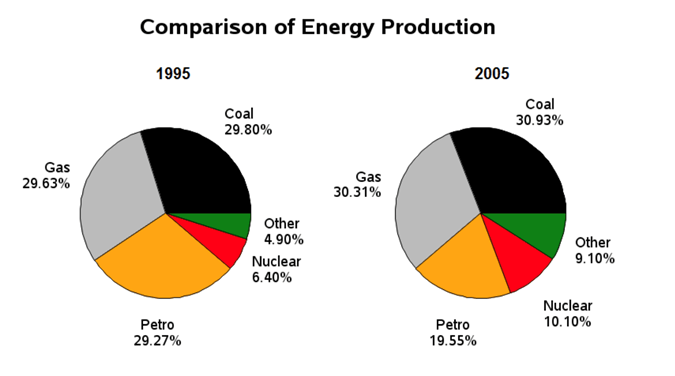
...................................................................................................................................................
...................................................................................................................................................
...................................................................................................................................................
Part 3. Essay writing (30 pts)
The inequality between rich and poor nations is now wider than it has ever been before. What do you think are the main causes of this difference and what do you think can be done to reduce the gap? Give reasons for your answer and include any relevant examples from your own experience or knowledge. Write at least 350 words.
...................................................................................................................................................
...................................................................................................................................................
...................................................................................................................................................
THE END
................................
................................
................................
Xem thêm đề thi học sinh giỏi Tiếng Anh lớp 11 hay khác:
Đề thi học sinh giỏi Tiếng Anh 11 trường THPT Chuyên Bảo Lộc (Lâm Đồng) năm 2024
Đề thi học sinh giỏi Tiếng Anh 11 trường THPT Chuyên Lê Hồng Phong (Nam Định) năm 2024
Đề thi học sinh giỏi Tiếng Anh 11 trường THPT Chuyên Lam Sơn (Thanh Hóa) năm 2024
Đề thi học sinh giỏi Tiếng Anh 11 trường THPT Chuyên Lê Khiết (Quảng Ngãi) năm 2024
Đề thi học sinh giỏi Tiếng Anh 11 trường THPT Chuyên Hùng Vương (Bình Dương) năm 2023-2024
Đề thi học sinh giỏi Tiếng Anh 11 trường THPT Chuyên Thái Nguyên (Thái Nguyên) năm 2024
TÀI LIỆU CLC DÀNH CHO GIÁO VIÊN VÀ PHỤ HUYNH LỚP 9
Bộ giáo án, bài giảng powerpoint, đề thi file word có đáp án 2026 tại https://tailieugiaovien.com.vn/
Hỗ trợ zalo: VietJack Official
Tổng đài hỗ trợ đăng ký: 084 283 45 85
 Đề thi vào 10 các sở Hà Nội, Tp. Hồ Chí Minh...
41 tài liệu
Đề thi vào 10 các sở Hà Nội, Tp. Hồ Chí Minh...
41 tài liệu
 Giáo án Word 9
95 tài liệu
Giáo án Word 9
95 tài liệu
 Đề thi giữa kì, cuối kì 9
254 tài liệu
Đề thi giữa kì, cuối kì 9
254 tài liệu
 Chuyên đề dạy thêm Toán, Lí, Hóa... 9
71 tài liệu
Chuyên đề dạy thêm Toán, Lí, Hóa... 9
71 tài liệu
 Đề thi HSG 9
8 tài liệu
Đề thi HSG 9
8 tài liệu
 Bài giảng Powerpoint 9
42 tài liệu
Bài giảng Powerpoint 9
42 tài liệu
Công cụ giáo viên (2048.VN)
Tạo- trộn đề thi miễn phí từ file PDF, Word, Giao bài nhanh chóng, Hoàn toàn Free
Bộ đề thi các lớp các môn học được Giáo viên nhiều năm kinh nghiệm tổng hợp và biên soạn theo Thông tư mới nhất của Bộ Giáo dục và Đào tạo, được chọn lọc từ đề thi của các trường trên cả nước.
- Đề thi lớp 1 (các môn học)
- Đề thi lớp 2 (các môn học)
- Đề thi lớp 3 (các môn học)
- Đề thi lớp 4 (các môn học)
- Đề thi lớp 5 (các môn học)
- Đề thi lớp 6 (các môn học)
- Đề thi lớp 7 (các môn học)
- Đề thi lớp 8 (các môn học)
- Đề thi lớp 9 (các môn học)
- Đề thi lớp 10 (các môn học)
- Đề thi lớp 11 (các môn học)
- Đề thi lớp 12 (các môn học)
- Giáo án lớp 1 (các môn học)
- Giáo án lớp 2 (các môn học)
- Giáo án lớp 3 (các môn học)
- Giáo án lớp 4 (các môn học)
- Giáo án lớp 5 (các môn học)
- Giáo án lớp 6 (các môn học)
- Giáo án lớp 7 (các môn học)
- Giáo án lớp 8 (các môn học)
- Giáo án lớp 9 (các môn học)
- Giáo án lớp 10 (các môn học)
- Giáo án lớp 11 (các môn học)
- Giáo án lớp 12 (các môn học)